Palmiers with Caramelised Sugar
Crisp, shattering puff pastry hearts, lacquered in cardamom demerara
Contents
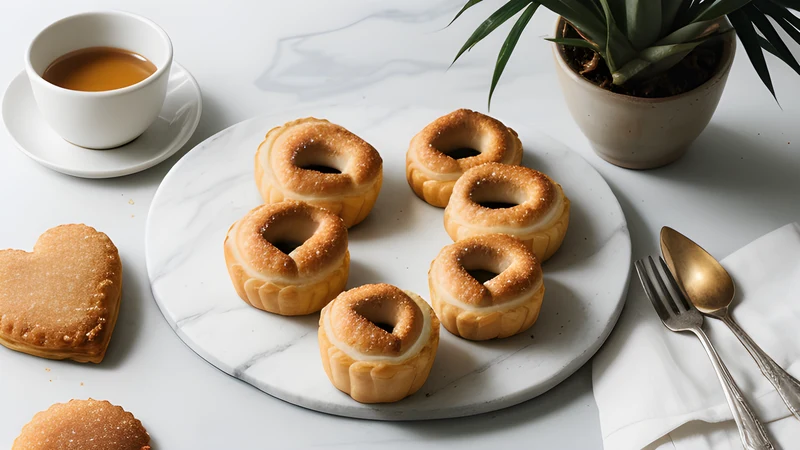
↓ Jump to recipePalmiers are the most flattering biscuit you can make from a shop-bought sheet of pastry. Three ingredients, no special equipment, and yet they come out of the oven looking like something from a Parisian window: glossy, caramel-lacquered hearts that shatter into hundreds of buttery flakes. The classic is puff pastry and sugar and nothing else, and it is very good. My version grinds cardamom into the sugar, which turns the caramel from straightforwardly sweet into something floral and faintly resinous, the kind of flavour people chase around their mouths trying to place. It costs you two minutes with a pestle and transforms the whole biscuit.
Palmiers with Caramelised Sugar
Ingredients
- 320g all-butter puff pastry (one ready-rolled sheet, or a block rolled to 3mm)
- 120g demerara sugar
- 60g caster sugar
- seeds from 8 green cardamom pods, finely ground
- 1/4 tsp fine sea salt
Method
- Grind the cardamom seeds to a powder, then mix with the demerara sugar, caster sugar and salt.
- Scatter a third of the sugar mix over the work surface and lay the pastry on top, then scatter another third over the pastry and press it in with the rolling pin.
- Fold the two long edges of the pastry in to meet at the centre, sprinkle with more sugar, then fold each side in again to meet in the middle.
- Fold one half over the other like closing a book, so you have six layers. Press gently and chill the log for 30 minutes until firm.
- Preheat the oven to 200C fan and line two trays with parchment.
- Slice the chilled log into 1cm pieces with a sharp knife and lay them cut-side down, well spaced, pressing the reserved sugar onto the exposed cut faces.
- Bake for 10 minutes until the undersides are caramelising, then flip each palmier with a palette knife.
- Bake for a further 6 to 8 minutes until both sides are deep amber and glassy. Watch closely as the sugar burns quickly.
- Cool on the tray for a few minutes to set hard, then lift onto a rack.
A biscuit of many names
The palmier is French, born in the pâtisserie boom of the early twentieth century, and its name means palm tree, after the way the rolled shape splays open like fronds. The French also call them palmiers, coeurs de France (hearts of France) or cochons, meaning little pigs, depending on the region and how fancy the shop is feeling. They belong to a broad family of sugared-pastry offcuts that thrifty bakers invented to use up the trimmings from making vol-au-vents and mille-feuille, which is why so many countries have their own version. In Spain and Latin America they are palmeras; across the Jewish diaspora and in much of the English-speaking world they turn up as elephant ears; in parts of Germany they are Schweineohren, pig’s ears. The shape is universal because it falls naturally out of the technique: roll the two edges of a sugared sheet in to meet, fold once more, slice, and each piece opens in the oven into a symmetrical heart.
What makes a palmier a palmier rather than a plain pastry twist is the sugar, and specifically what the sugar does in a hot oven. The sheet is coated generously before it is folded, so every one of the many layers carries a seam of sugar. In the heat, that sugar melts, runs to the tray, and caramelises against the metal into a hard, amber, glassy shell. The pastry above it puffs and flakes as normal. You end up with a biscuit that is crisp-shattering flake on the inside and brittle toffee on the outside, which is a genuinely thrilling combination of textures for something so simple.
The twist: cardamom in the sugar
Green cardamom is one of the great partners for caramel, and palmiers are the ideal place to prove it. The trick is to grind your own from whole pods rather than reaching for the pre-ground jar, because cardamom’s volatile oils fade within weeks of grinding and the powder in most cupboards tastes of little more than dust. Split eight pods, tip out the sticky black seeds, and grind them fine; the smell alone tells you why this is worth doing. Stir that fresh powder through a mix of demerara and caster sugar and you have a spice sugar that perfumes the whole biscuit as it bakes.
I use two sugars for a reason. Demerara is a coarse, partly refined sugar with large golden crystals and a faint molasses note, and those big crystals give the finished palmier its craggy, crunchy, glinting surface. On its own, though, demerara can be reluctant to melt evenly, leaving gritty pockets. A third of finer caster sugar melts readily and flows into the gaps, so the caramel sets into a proper continuous sheet with the demerara crystals suspended in it. The pinch of salt does what salt always does to caramel, which is make it taste of more than sugar. If cardamom is not your thing, a teaspoon of ground cinnamon or the finely grated zest of an orange works beautifully in exactly the same way.
Rolling and folding
Use all-butter puff pastry if you possibly can, because the whole pleasure of a palmier is butter and flake, and the cheaper vegetable-fat versions bake up waxy and dull. A ready-rolled sheet is genuinely fine here and saves a great deal of faff; if you are rolling a block, take it to about three millimetres, no thicker, or the layers will not crisp through.
The method is a sugar sandwich. Scatter sugar on the surface, lay the pastry on it, scatter more on top, and press it in with the rolling pin so the crystals bed into the dough rather than falling off later. Then fold the two long edges in to meet at the centre line, sugar again, and fold each side in once more so they meet in the middle a second time. Finally close the whole thing like a book, one half over the other, which gives you a tidy log of six stacked layers. Every fold traps another layer of sugar, and every layer of sugar becomes a seam of caramel. Chill the log until firm before slicing, because warm, soft pastry drags and squashes under the knife and you lose the clean spiral.
Baking: the flip is everything
Slice the chilled log into centimetre-thick pieces and lay them flat on lined trays with plenty of room, because they double in width as they open. Press any spare sugar onto the cut faces now, since those are the surfaces that will caramelise most dramatically. Space matters more than usual, so use two trays rather than crowding one.
The single technique that separates a good palmier from a burnt or pallid one is the flip. Bake them for the first ten minutes until the undersides are visibly caramelising and turning amber, then take the tray out and turn every biscuit over with a palette knife. This does two things: it caramelises the second side against the hot tray so both faces are glossy and even, and it stops the down-facing sugar from tipping over from amber into black. Sugar goes from perfect to burnt in under a minute at this temperature, so stay by the oven for the final stretch and pull them the moment both sides are a deep, even amber. They will feel soft coming out and set rock-hard as they cool, so leave them on the tray for a few minutes before you move them.
What can go wrong
Palmiers that stay pale and soft rather than crisp usually had too little sugar or too cool an oven; the sugar needs both quantity and real heat to caramelise properly, so be generous with the coating and do not open the door for the first eight minutes. Palmiers that spread into flat, greasy blobs went into the oven too warm, so the butter melted and leaked before the layers could set. Chilling the sliced biscuits for ten minutes before baking, as well as the log beforehand, fixes this on a hot day. And the ever-present risk is burning: the sugar caramelises fast and unevenly if your oven has hot spots, so rotate the trays when you flip and trust your eyes over the timer.
Storage and variations
Kept in an airtight tin, palmiers stay crisp for three or four days, though they are at their glorious best within hours of baking while the caramel is at its most brittle. If they soften, five minutes in a low oven crisps them straight back up. The unbaked log is a brilliant thing to keep in the freezer: wrap it tightly and it holds for two months, so you can slice off as many as you want and bake them from frozen with a couple of extra minutes, which makes them the fastest impressive thing you can offer an unexpected guest.
For savoury palmiers, skip the sugar entirely and roll the pastry with pesto, grated parmesan and a little black pepper for an aperitif with drinks. And for more of this all-butter, shatteringly crisp pastry pleasure, my sausage rolls with a flaky puff and fennel work the same pastry savoury, while my stroopwafels with caramel syrup chase the same caramel-and-crunch idea in a very different Dutch direction.
Related Content