Okonomiyaki with Charred Cabbage and Bonito Butter
Osaka's cabbage pancake, charred hard and finished in nutty bonito butter
Contents
↓ Jump to recipeOkonomiyaki is the pancake that argues cabbage should be the main event, not the garnish, and this version pushes that argument further by charring half the cabbage hard before it ever meets the batter. Charred first, the cabbage brings a smoky, faintly bitter backbone that a purely raw-folded version never gets, and a brown-butter bonito glaze brushed on at the end adds a nutty, umami-thick finish that plain sauce and mayo alone cannot. It is still unmistakably okonomiyaki: eggy, savoury, a little sweet, threaded with crisp pork belly. It just tastes like it spent longer over the flame.
Okonomiyaki with Charred Cabbage and Bonito Butter
Ingredients
- 200g plain flour
- 1 tsp baking powder
- 240ml dashi, chilled (or cold water with 0.5 tsp dashi powder)
- 2 large eggs
- 400g hispi or white cabbage, half finely shredded, half cut into thick 2cm ribbons
- 4 spring onions, finely sliced, plus extra to serve
- 50g tenkasu (tempura scraps), optional
- 8-10 thin strips streaky pork belly (about 150g)
- 40g unsalted butter
- 2 tbsp neutral oil, for the pan
- 15g katsuobushi (bonito flakes), divided
- 4 tbsp okonomiyaki sauce
- 3 tbsp Japanese mayonnaise
- 1 tsp aonori (dried green seaweed flakes)
- 2 tbsp beni shoga (pickled red ginger), to serve
Method
- Whisk the flour, baking powder, chilled dashi and eggs to a smooth, thick batter. Cover and rest in the fridge for 15 minutes.
- Heat a dry frying pan or wok over high heat with no oil. Add the cabbage ribbons and char, turning occasionally, for 4 to 5 minutes until blackened in patches and wilted. Tip onto a plate and cool slightly.
- Melt the butter in a small pan over medium heat. Swirl until it foams, turns golden-brown and smells nutty, about 3 minutes, then take off the heat immediately and stir in a small handful of the bonito flakes. Set aside.
- Fold the charred cabbage, remaining raw shredded cabbage, spring onion and tenkasu (if using) through the rested batter.
- Heat the neutral oil in a heavy 24cm non-stick pan or griddle over medium heat. Pour in the batter and shape into a round about 1.5cm thick. Lay the pork belly strips over the top.
- Cook undisturbed for 6 to 7 minutes until the base is deep golden and the edges look dry, then flip carefully with two spatulas, pork side down.
- Cook for a further 6 to 7 minutes, pressing gently once with a spatula halfway through, then flip once more, pork side up, and cook for 2 minutes to firm the crust.
- Slide onto a plate. Brush the bonito butter generously over the top while it is still hot.
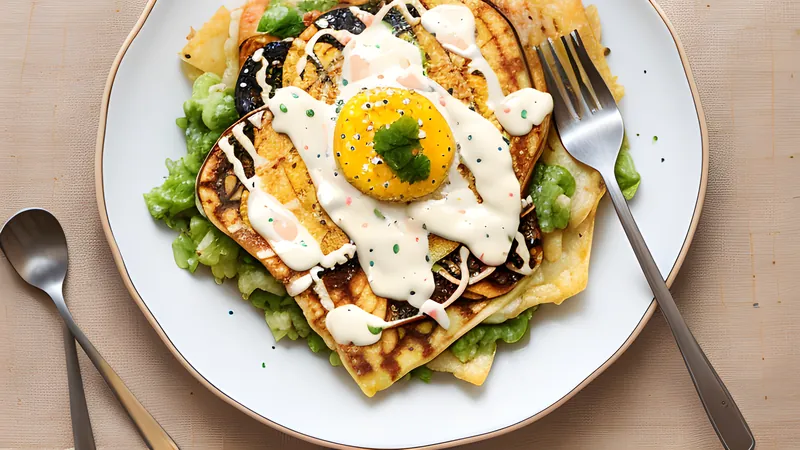
- Drizzle with the okonomiyaki sauce and mayonnaise in close parallel lines, then scatter with aonori, the remaining bonito flakes and the beni shoga. Serve immediately, cut into wedges.
Osaka’s “as you like it”
Okonomiyaki takes its name from okonomi, meaning “what you like” or “as you please”, and yaki, meaning grilled or cooked. The dish in something like its current form emerged in Osaka in the years after the Second World War, when flour was more available than rice and cooks stretched a thin batter with whatever vegetables were on hand, cabbage chief among them because it was cheap, kept well, and bulked out a meal when meat was scarce. Street stalls and small family-run shops around the Dotonbori and Shinsekai districts built reputations on their own batter ratios and sauce blends, and the dish never fully left the street-food register even as it moved indoors: many Osaka okonomiyaki restaurants still cook it on a built-in teppan at the table, so the customer finishes and flips their own.
Osaka-style okonomiyaki, which this recipe follows, mixes the shredded cabbage directly into the batter before cooking, so the whole disc rises and sets as one thick, custardy round studded with cabbage and whatever protein you choose. This is the version most people picture. Hiroshima-style is a different animal entirely: the batter is poured thin like a crepe, and the cabbage, noodles, bean sprouts and egg are layered on top rather than mixed in, building a tall stack that is assembled in stages on the griddle rather than folded together beforehand. The two are cooked by entirely different logic, and a Hiroshima local will tell you, not unkindly, that they are not really the same dish. This recipe is Osaka’s, mixed-batter style, because that is the version that takes best to a home stove and a single frying pan.
A third relative worth knowing, if only to place this recipe correctly, is monjayaki, Tokyo’s soupier cousin, particularly associated with the Tsukishima district, where the batter is deliberately thinned to a wet, almost pourable consistency and cooked in a shallow ring straight on the griddle, eaten in small scrapes with a tiny spatula rather than cut into wedges. It shares okonomiyaki’s cabbage-and-batter logic but almost none of its texture. Closer to home, modanyaki is an Osaka variation that layers cooked yakisoba noodles between the batter and the toppings, giving a heartier, carb-doubled version popular as a late-night meal after drinking; to try it, cook a portion of yakisoba noodles separately, spread them over the pan before pouring the batter on top, and add two or three minutes to the first side’s cooking time so the noodles heat through properly.
Why char the cabbage at all
Standard okonomiyaki batter is built almost entirely from raw shredded cabbage, which releases water as it cooks and can leave the finished pancake a little wet in the centre if you are not careful with heat and timing. Charring half the cabbage first solves two problems at once. First, dry, high heat drives off a good portion of the water before the cabbage ever reaches the batter, so the finished pancake sets firmer and holds its shape when cut. Second, and more importantly for flavour, that same high dry heat triggers the Maillard reaction on the cut edges of the cabbage: the natural sugars and amino acids at the surface brown and turn savoury rather than simply steaming and softening. The result is cabbage that tastes roasted and faintly sweet rather than just wilted, and that flavour carries through the whole pancake once it is folded through the batter. Keeping the other half of the cabbage raw and finely shredded means you still get the characteristic light, slightly crunchy interior texture okonomiyaki is known for; an all-charred pancake would be too smoky and too dense.
Brown butter works the same chemistry in a different register. Butter is mostly water, milk solids and fat; cooked gently past the foaming stage, the milk solids toast and turn a deep amber, giving off a smell close to hazelnuts and caramel. Stir bonito flakes into that hot butter the instant it comes off the heat and the flakes’ smoky, oceanic flavour infuses straight into the fat rather than sitting as dry flakes on top, the way they usually do as a garnish. Brushed over the finished pancake, that bonito butter melts slightly into the crust and adds a savoury depth that plain okonomiyaki sauce, for all its tang, cannot supply on its own. This is not a substitute for the sauce and mayo — it is a third layer, working underneath them.
The method, in practice
Rest the batter in the fridge, not on the counter. A cold, thick batter holds the cabbage in suspension rather than letting it sink, and it sets faster on contact with a hot pan, which matters for getting a clean flip. Char the cabbage in a completely dry pan or wok — any oil at this stage steams the cabbage instead of charring it, and you want direct contact with a very hot surface to get blackened patches rather than an evenly browned, damp result.
The flip is the part people worry about most and the part that rewards patience most. Do not attempt it until the underside is properly set — you should be able to see dry, slightly crisped edges and feel almost no give when you nudge the centre with a spatula. Judging readiness is as much about smell and sound as sight: a properly set base gives off a faint toasted, nutty aroma, and tapping the pan’s edge with a spatula produces a slightly hollow note rather than the wet slap of a batter that is still loose underneath. Use two spatulas, one to support and one to flip, or invert onto a plate and slide it back into the pan pork-side down if that feels safer. A second flip near the end, pork-side up again, firms the crust on both faces and makes sure the pork belly gets properly crisp rather than just cooked through.
Tips, substitutions and storage
No dashi powder to hand: a light vegetable or chicken stock works, though you lose some of the oceanic depth dashi brings — compensate with a slightly heavier hand on the bonito butter. Tenkasu is optional but worth sourcing (it is shelf-stable and sold in most East Asian grocers) as it adds small pockets of crisp texture through the batter; failing that, a few tablespoons of crushed prawn crackers do a passable job. Vegetarians can skip the pork belly and bonito flakes, use a vegetable dashi or plain water, and add a handful of grated yam (nagaimo) to the batter for the traditional light, slightly bouncy texture the pork would otherwise help create.
Okonomiyaki sauce itself is worth buying rather than improvising if you can find a bottle — Otafuku is the brand most Japanese grocers stock, a thick, slightly sweet blend of fruit and vegetable purée closer to a milder, fruitier Worcestershire sauce than to ketchup. In a pinch, a mix of 2 tablespoons Worcestershire sauce, 1 tablespoon ketchup and a teaspoon of honey approximates it reasonably well. Katsuobushi and Japanese mayonnaise (Kewpie, sold in its distinctive squeezable bottle with a red cap) are both shelf-stable and worth keeping in stock generally, since they turn up across Japanese cooking well beyond this one dish.
Okonomiyaki is best eaten the moment it comes off the pan, while the crust is still crisp, but leftover batter (unmixed with cabbage) keeps in the fridge for up to two days. Cooked pancakes reheat reasonably well in a dry frying pan over medium heat for 3 to 4 minutes a side, though the crust will never be quite as sharp as fresh. Do not microwave — it turns the whole thing rubbery.
Variations
Seafood okonomiyaki swaps the pork belly for a handful of peeled raw prawns and squid rings pressed into the top before the first flip; cook exactly as above. A cheese okonomiyaki, popular with Osaka teenagers, scatters a handful of shredded mozzarella over the pancake in the last two minutes of cooking on the second side, tented loosely with a lid to melt it. For a leaner version, replace the pork belly with thin-sliced bacon and reduce the oil in the pan by half, since bacon renders plenty of its own fat.
If this is your first time at the griddle, it sits well alongside other Japanese pantry staples — the same bonito-and-dashi backbone runs through chicken karaage, double-fried, ginger-soy, and the crisp-crust logic here is close cousin to the panko crust on a katsu sando. Once you have the flip down, okonomiyaki becomes one of those dishes you can make from whatever is wilting in the vegetable drawer, cabbage and an egg being the only non-negotiables.
Related Content