Nuoc Cham: The Dipping Sauce for Everything
The one ratio that runs the whole Vietnamese table
Contents
↓ Jump to recipeEvery cuisine has a sauce that does more work than its short ingredient list suggests, and in Vietnamese cooking that sauce is nuoc cham. It is not a garnish. It is the thing that turns a plate of grilled pork and rice noodles into bun cha, the thing you dunk a spring roll into, the thing that gets thinned and poured over broken rice, and the thing that, mixed slightly differently, becomes the sauce inside a banh mi’s quick pickle. Once you understand the ratio underneath it — sour, salty, sweet and hot, balanced against each other rather than against a fixed recipe — you can make it by taste, adjust it to whatever it’s sitting next to, and never need a written recipe again. This version keeps the classic four-way balance and treats the exact proportions as a starting point to taste toward, not a formula to follow blindly.
Nuoc Cham: The Dipping Sauce for Everything
Ingredients
- 3 tbsp fish sauce
- 3 tbsp fresh lime juice (about 2 limes)
- 3 tbsp caster sugar
- 3 tbsp warm water
- 2 garlic cloves, finely minced or grated
- 1–2 fresh red chillies (bird's eye or similar), finely sliced
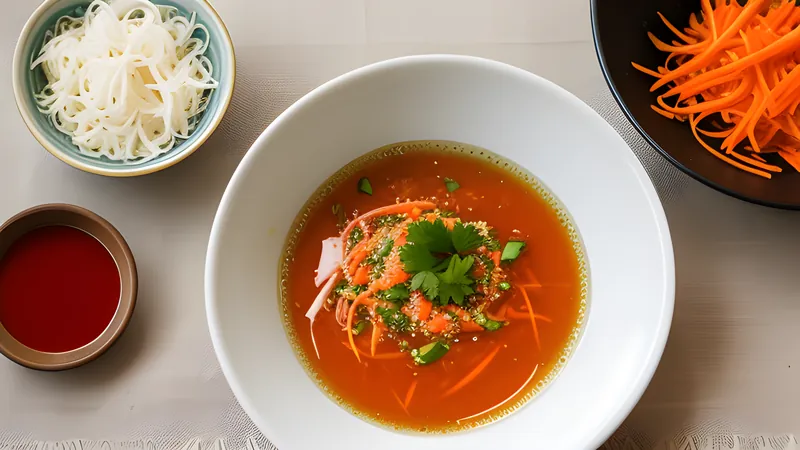
- 1 tbsp shredded carrot (optional, for a version to serve with spring rolls)
Method
- Dissolve the sugar in the warm water in a bowl or jar, stirring until no grains remain.
- Add the fish sauce and lime juice and stir to combine.
- Taste with a spoon against the back of your hand: it should hit salty, sour and sweet almost simultaneously, with no single note dominating.
- Adjust in small increments — more lime for sourness, more sugar for sweetness, more fish sauce for salt and depth — tasting after each addition.
- Stir in the minced garlic and sliced chilli last, so they float rather than sink.
- Add the shredded carrot if using, and let the sauce sit for 10 minutes before serving so the garlic and chilli mellow slightly and the flavours marry.
The sauce that holds Vietnamese food together
Nuoc cham (also written nước chấm, meaning simply “dipping sauce” or “sauce for dipping”) is arguably the most important preparation in Vietnamese home cooking, more central than any single dish. Vietnamese cuisine as a whole is built on balance — the constant negotiation between chua (sour), mặn (salty), ngọt (sweet), cay (spicy) and sometimes đắng (bitter) — and nuoc cham is where that balance is made explicit, sitting in a small bowl at the centre of the table so everyone can dip, spoon or pour according to their own taste.
Its backbone is nuoc mam, fermented fish sauce, which has been part of Vietnamese cooking for over two thousand years, with roots that trace back to a wider Southeast Asian and southern Chinese tradition of fermenting fish with salt to preserve it through wet seasons. Phu Quoc island, off Vietnam’s southern coast, has been a major fish sauce production centre for centuries, and its sauce — made from anchovies fermented in wooden barrels for up to a year — carries a protected designation of origin much like Parmesan or Champagne. Good fish sauce should smell sharp and briny when raw but taste rounded and almost meaty once diluted and balanced against sugar, lime and chilli; the sauces at the cheap end of the market taste one-dimensionally fishy because they’re often diluted with less fermentation time and more added salt or MSG.
Nuoc cham’s exact form shifts by region and by dish. In the north, around Hanoi, it tends to be served slightly warmed and more heavily flavoured with garlic and vinegar for bun cha, the grilled pork and noodle dish where the sauce is served as a warm bath you actually dunk your noodles and herbs into rather than a thin dipping sauce on the side. Further south, it tends to be sweeter, sometimes cut with coconut water, and served cooler as a straightforward dip for spring rolls and grilled meats. What travels across every regional version is the same underlying grammar: fish sauce for salt and umami depth, citrus for sourness (lime in the south, sometimes vinegar in the north), sugar to round the sharp edges, garlic and chilli for aromatic heat, and water to dilute it all down to a sippable strength.
The sauce also quietly appears inside dishes that don’t look like dipping-sauce dishes at all. The quick pickled carrot and daikon inside a banh mi uses the same sweet-sour vinegar logic in miniature; a splash of nuoc cham stirred into the mayonnaise or dressing of a Vietnamese salad performs the same balancing job. Once you’ve made it a few times you start recognising its DNA all over Vietnamese cooking, even where it isn’t served as a discrete sauce.
Getting the balance right
The reason nuoc cham resists a fixed recipe is that fish sauces vary enormously in saltiness and depth between brands, limes vary in acidity depending on ripeness and season, and everyone’s tolerance for chilli heat and sweetness is different. What doesn’t vary is the method for finding balance: build the sauce in stages, tasting after each addition, rather than dumping every ingredient in at once and hoping.
Start by dissolving sugar into warm water — this matters more than it sounds like it should, because sugar added straight to a cold, acidic liquid dissolves slowly and unevenly, leaving pockets of syrupy sweetness at the bottom of the jar. Warm water (not hot — hot water can start to cook the raw garlic flavour you’ll add later and dull the lime’s brightness if added too soon) dissolves sugar quickly and evenly, giving you a clean base to build on.
Add the fish sauce and lime juice to that sugar syrup and taste before you touch the garlic or chilli. This is the moment to find your salt-sour-sweet triangle: if it tastes flat, it usually needs more lime, not more fish sauce, since sourness is what makes a dipping sauce feel lively rather than heavy. If it tastes thin or one-note, a little more fish sauce deepens it without necessarily making it saltier, because good fish sauce carries umami compounds — glutamates from the fermentation — that read as savoury depth more than pure salt.
Garlic and chilli go in last and are added raw and finely cut so they stay suspended near the surface rather than sinking to the bottom of the jar — a nuoc cham where all the good bits have settled at the bottom is a nuoc cham that gets stirred constantly or, worse, poured out unevenly so the first person gets all the fire and the last gets none. Letting the finished sauce rest for ten minutes softens the garlic’s rawest edge slightly, the same mellowing effect you get from resting the onion in vinegar for a chimichurri, without losing its punch.
The recipe
Makes about 250ml, enough to serve four to six as a table dip or dressing.
In a small bowl or jar, dissolve 3 tablespoons of caster sugar into 3 tablespoons of warm water, stirring until no grains remain. Add 3 tablespoons of fish sauce and 3 tablespoons of fresh lime juice (roughly the juice of two limes) and stir well. Taste — literally dip a clean spoon and taste it against the back of your hand, where you can register salt, sour and sweet clearly. It should hit all three notes almost at once, with none shouting over the others. If it’s flat, add lime in half-teaspoon increments; if it’s harsh, add a little more sugar or water; if it feels watery and thin, a touch more fish sauce.
Once balanced, stir in 2 finely minced or grated garlic cloves and 1 to 2 finely sliced fresh red chillies — bird’s eye chillies for real heat, a milder red finger chilli if you want colour and gentler warmth. If you’re serving it alongside fresh spring rolls, stir through a tablespoon of very finely shredded carrot for a little sweetness and crunch. Let it sit for 10 minutes before serving.
Tips, substitutions, storage
Buy a decent fish sauce — Red Boat, Three Crabs or Squid brand are all widely available and considerably better than the cheapest bottle on the shelf; you use it in small amounts so the price difference per serving is negligible. If you don’t eat fish, a good vegan fish sauce (usually made from fermented mushrooms and seaweed) gets close, though the depth is slightly different — you may want to add a small pinch of MSG or a splash of soy to round it out.
Nuoc cham keeps in the fridge for up to a week in a sealed jar, though the garlic’s flavour intensifies and can turn slightly harsh after a couple of days, so if you’re making it ahead, consider adding the raw garlic fresh each time you serve rather than storing it mixed in. It does not need to come to room temperature before serving — it’s often served cool or even lightly chilled.
For the warm, dunk-your-noodles version served with bun cha, warm the finished sauce gently (do not boil) and add thin slices of pickled carrot and daikon or green papaya.
Variations
For a coconut nuoc cham, popular in southern Vietnam, replace half the water with coconut water for a rounder, slightly floral sweetness — lovely with grilled prawns. A tamarind nuoc cham swaps some of the lime for a spoon of tamarind pulp dissolved in the warm water, giving a deeper, more complex sourness that works well with richer, fattier meats. If you want a version built specifically for chicken pho style dishes rather than dipping, thin the base recipe further with an extra tablespoon or two of water so it pours rather than clings, and skip the garlic and chilli in favour of a squeeze of extra lime at the table.
Make a jar of this and you’ll find yourself reaching for it well outside Vietnamese cooking — over a fried egg, through a slaw, splashed onto grilled fish. It is, without exaggeration, the hardest-working sauce in the fridge.
Related Content