Nam Tok Beef Lettuce Cups with Toasted Rice
Isaan's charred, sour, herb-heavy beef salad, spooned into cold lettuce leaves instead of served over rice
Contents
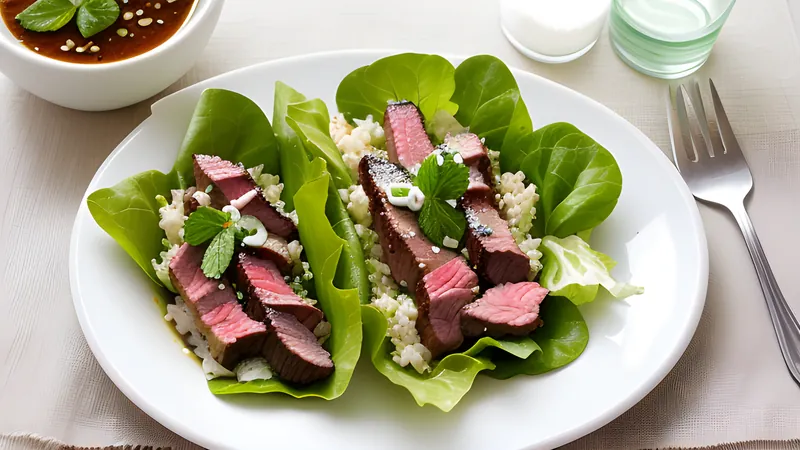
↓ Jump to recipeNam tok means “waterfall” in Thai, and the name comes from the sound and sight of fat and juice hissing off grilling beef, dripping onto hot coals like a small, violent waterfall. It’s a dish built on contrast: char against sour, fresh herbs against a nutty crunch of ground toasted rice, all of it eaten cold or barely warm. Spooned into cold lettuce leaves rather than piled over rice, it becomes the kind of snack you eat standing up, one cup after another, before you’ve noticed you’ve had five.
Nam Tok Beef Lettuce Cups with Toasted Rice
Ingredients
- 3 tbsp uncooked jasmine rice
- 600g flank steak or sirloin, about 3cm thick
- 1 tbsp vegetable oil
- 1/2 tsp salt
- 4 tbsp fresh lime juice
- 3 tbsp fish sauce
- 1 tbsp palm sugar (or light brown sugar), dissolved in the lime juice
- 1-3 tsp Thai chilli flakes (phrik pon), to taste
- 3 shallots, very thinly sliced
- 3 spring onions, sliced into 2cm lengths
- 1/2 cup mint leaves, roughly torn
- 1/2 cup coriander leaves, roughly chopped
- 2 baby gem or 1 iceberg lettuce, leaves separated into cups
- Extra lime wedges, to serve
Method
- Toast the raw rice in a dry frying pan over medium heat, shaking often, for 5-7 minutes until deep golden brown and fragrant, almost the colour of strong tea. Tip out immediately to stop it colouring further.
- Once cool, grind the toasted rice in a mortar and pestle or spice grinder to a coarse, sandy texture, not a fine powder. Set aside.
- Pat the steak dry and season with the salt. Heat the oil in a heavy pan or griddle over high heat until it's just starting to smoke.
- Sear the steak for 2-3 minutes per side for medium-rare, developing a real crust, then rest it on a board for 10 minutes before slicing.
- While the meat rests, whisk together the lime juice, fish sauce, dissolved palm sugar and chilli flakes in a large bowl to make the dressing.
- Slice the rested steak thinly against the grain, adding any resting juices from the board straight into the dressing bowl.
- Toss the sliced beef through the dressing while still warm, along with the shallots and spring onions, so the meat drinks in the sour-salty liquid.
- Just before serving, fold through the mint, coriander and two-thirds of the toasted rice powder, keeping the herbs from wilting.
- Spoon into lettuce cups, scatter the remaining toasted rice powder over the top, and serve immediately with extra lime wedges.
The story: Isaan’s answer to a hot climate
Nam tok belongs to the cooking of Isaan, Thailand’s northeastern region bordering Laos, where the food leans sourer, spicier and more herb-forward than the coconut-rich curries most people associate with Thai cooking further south and in Bangkok. Isaan cuisine shares deep roots with Lao food — the same reliance on sticky rice, the same love of toasted rice powder (khao khua) as both a thickener and a textural finish, the same instinct to dress grilled meat with a blast of lime and fish sauce rather than a sweet glaze. Nam tok sits in the same family as larb, Isaan’s better-known minced-meat salad, but where larb is built on finely chopped or minced meat, nam tok is built on a whole grilled or seared steak, sliced afterwards — a distinction Isaan cooks are fairly precise about, even though outside Thailand the two dishes often get blurred into one.
The dish likely developed as a way to use grilled meat efficiently in communities where beef and other proteins were relatively precious and the point was to stretch a modest amount of meat across a shared table, sliced thin and tossed through a punchy dressing bulked out with herbs, shallots and rice powder. It’s street food and home food both — you’ll find it on plastic tables outside markets in Khon Kaen and Udon Thani as often as you’ll find it made at home, always eaten with a mountain of raw vegetables and sticky rice on the side, and always meant to be eaten with the fingers as much as a spoon.
Toasted rice powder is the dish’s real signature, and it does something no other ingredient quite replicates: a coarse, nutty crunch alongside a faint smokiness from the toasting, plus enough starch to help the dressing cling to the meat rather than pool at the bottom of the bowl. It’s the same principle at work in a proper pad krapow, where technique — a hot pan, correctly timed — does more for the dish than any single ingredient.
Why lettuce cups instead of a plate of rice
Traditionally nam tok is served on a plate alongside sticky rice and a stack of raw vegetables — cabbage wedges, long beans, cucumber — for scooping. Serving it in cold lettuce cups instead turns the same salad into a snack that works standing up at a party, glass in one hand, rather than a seated meal that needs cutlery and a side of rice. The cold, crisp lettuce leaf also does something the sticky rice doesn’t: it cools the palate between mouthfuls of a dressing that’s deliberately sharp with lime and chilli, and it adds its own clean crunch alongside the toasted rice powder rather than competing with it. Baby gem holds its shape and cups the filling neatly; iceberg is a fair substitute if that’s what’s in the fridge, though its leaves are flatter and need a slightly firmer hand when filling.
Getting the beef and the rice right
The steak wants real heat and a short cook. A pan or griddle that isn’t properly hot before the meat goes in will steam the steak rather than sear it, and a nam tok without a genuine seared crust loses a lot of what makes the dish interesting — the contrast between the caramelised surface and the sour dressing is half the point. Two to three minutes a side in a screaming-hot pan, for a 3cm-thick piece of flank or sirloin, gets you a genuine crust with a medium-rare centre; go by touch or a thermometer (around 52-54°C for medium-rare) rather than a fixed clock, since pan heat and steak thickness vary.
Resting the meat for a full 10 minutes before slicing matters more here than in most steak dishes, because those resting juices go straight into the dressing rather than being wiped off a board and discarded. Slice against the grain — across the direction the muscle fibres run, not along it — since flank steak in particular has long, visible fibres, and slicing with the grain leaves you with chewy, stringy pieces no amount of dressing can fix.
Toasting the rice is a small step that rewards patience. Raw jasmine rice in a dry pan over medium heat needs regular shaking and around 5-7 minutes to go from white to a deep golden-brown, close to the colour of strong tea — stop too early and it tastes starchy and raw; push it too far and it turns bitter. Grinding it coarse rather than fine is deliberate too: a mortar and pestle gives an uneven, gritty texture that adds bite, while a fully powdered rice loses the crunch and just thickens the dressing like a stray spoonful of flour.
The recipe
Serves 4 as a snack, about 16 lettuce cups. Prep 20 minutes, cook 10 minutes.
For the rice powder: 3 tbsp uncooked jasmine rice.
For the beef: 600g flank steak or sirloin, 1 tbsp vegetable oil, 1/2 tsp salt.
For the dressing: 4 tbsp lime juice, 3 tbsp fish sauce, 1 tbsp palm sugar, 1-3 tsp Thai chilli flakes.
To finish: 3 shallots, 3 spring onions, 1/2 cup mint, 1/2 cup coriander, 2 baby gem lettuces, lime wedges.
- Toast the rice in a dry pan for 5-7 minutes until deep golden. Cool, then grind coarsely.
- Season the steak with salt and sear in hot oil, 2-3 minutes a side for medium-rare.
- Rest the steak 10 minutes, then slice thinly against the grain.
- Whisk the lime juice, fish sauce, palm sugar and chilli flakes together in a large bowl.
- Toss the sliced beef and its resting juices through the dressing with the shallots and spring onions.
- Fold through the herbs and two-thirds of the rice powder.
- Spoon into lettuce cups, top with the remaining rice powder, and serve at once with lime wedges.
Tips, substitutions and storage
Flank and sirloin both work well because they take a hard sear without overcooking through, but hanger steak or bavette are worth seeking out too, since they carry even more of the beefy, slightly mineral flavour this dish is built to showcase. Avoid very lean cuts like fillet, which sear well but don’t bring enough flavour to stand up to a dressing this assertive.
Fish sauce brands vary enormously in saltiness, so treat the 3 tbsp as a starting point and taste before committing — the same goes for palm sugar, which ranges from mild to quite intensely caramel-like depending on the source. Light brown sugar is a fair substitute if palm sugar isn’t available, though it lacks the faint smokiness of the real thing.
The dressed beef doesn’t keep well once assembled, since the lime juice continues to “cook” and toughen the meat’s surface the way it does in a ceviche, and the herbs wilt within an hour or two. If you need to prepare ahead, toast the rice and make the dressing up to 2 days in advance, sear the steak up to a few hours ahead and keep it whole and covered in the fridge, then slice and toss everything together just before serving.
Toasted rice powder itself keeps for weeks in an airtight jar and is worth making in a larger batch — it’s the same finishing touch used across Isaan and Lao cooking, and it’s just as good scattered over grilled chicken or a bowl of khao soi for extra texture. A batch made from a full cup of raw rice, toasted and ground the same way, stores for a month or more and saves the whole step next time the craving hits.
Variations
Swap the beef for grilled pork shoulder or chicken thigh, sliced the same way, for a version closer to the pork and chicken nam tok found on the same market stalls. Ground meat, browned in a hot pan and drained of excess fat before dressing, gives you something closer to larb if flank steak isn’t to hand. And for a version with real backbone alongside the sour dressing, a side of sticky rice or a bowl of thai green curry rounds the meal out for anyone who wants more than a handful of lettuce cups to call dinner. A scattering of crushed roasted peanuts over the top, while not traditional to every household version, adds a further layer of crunch that plenty of Isaan cooks are happy to include alongside the rice powder rather than instead of it.
Keep the sear hard, the slicing against the grain, and the herbs added last, and the waterfall does the rest of the work.
Related Content