Porcini Mushroom Risotto with White Truffle Oil
Earthy, creamy and indulgent
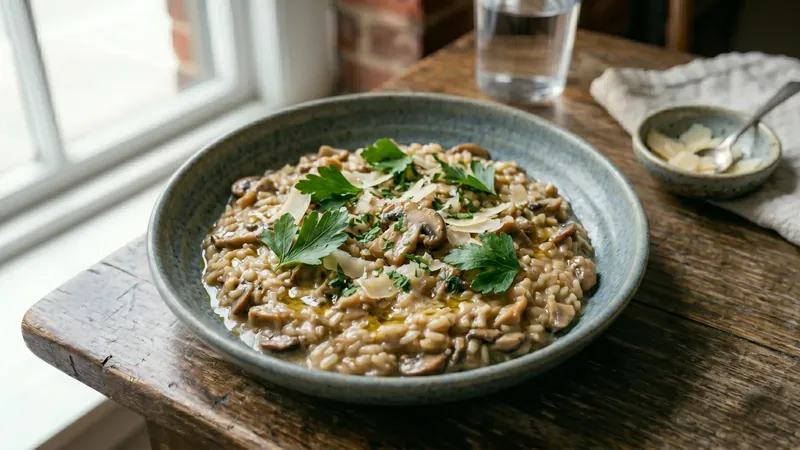
This risotto wrings every bit of flavour from the humble mushroom. Dried porcini are soaked and their fragrant liquor folded straight into the stock, so earthiness runs through every grain of rice, while a few drops of white truffle oil added at the end lift it into something genuinely indulgent. The result is creamy, deeply savoury and luxurious, yet built almost entirely from store-cupboard staples.
Porcini Mushroom Risotto with White Truffle Oil
Ingredients
- 30g dried porcini mushrooms
- 1.2 litres hot vegetable stock
- 50g butter
- 1 tbsp olive oil
- 1 onion, finely chopped
- 250g chestnut mushrooms, sliced
- 2 garlic cloves, crushed
- 300g arborio or carnaroli risotto rice
- 150ml dry white wine
- 60g Parmesan, finely grated, plus extra to serve
- 1 tsp white truffle oil, plus a few drops to finish
- Small handful of parsley, chopped
- Salt and black pepper, to taste
Method
- Soak the dried porcini in 300ml of the hot stock for 15 minutes. Lift out, chop, and reserve. Strain the soaking liquid and stir it back into the rest of the stock. Keep the stock warm over a low heat.
- Heat half the butter and the oil in a wide pan and cook the onion gently for 6-7 minutes until soft.
- Add the chestnut mushrooms and chopped porcini, and fry for 5 minutes until golden. Stir in the garlic for 1 minute.
- Add the rice and stir for 1-2 minutes until the grains look glossy and translucent at the edges.
- Pour in the white wine and stir until it has almost fully absorbed.
- Add the warm stock a ladleful at a time, stirring often and letting each addition be absorbed before adding the next, for about 18-20 minutes until the rice is creamy but still has a little bite.
- Remove from the heat and beat in the remaining butter, the Parmesan and 1 tsp truffle oil. Season to taste.
- Cover and rest for 2 minutes to let it relax and turn loose and creamy.
- Serve in warm bowls with extra Parmesan, a scattering of parsley and a few final drops of truffle oil.
3 The Story
Risotto is northern Italy’s great rice dish, a speciality of the Po Valley and the regions around Milan, Piedmont and the Veneto, where the wet, flat plains are well suited to growing rice. Unlike most of Italy, where pasta reigns, here rice is the carbohydrate of choice, and the technique of slowly coaxing it into a creamy whole is a point of regional pride. The dish is thought to have taken its familiar form by the nineteenth century, though rice cultivation in the area is older still.
The magic of risotto lies in the rice. Short, starchy varieties such as arborio and carnaroli are essential, because their high starch content is what makes the dish creamy as it is gradually released by stirring and the steady addition of warm stock. Carnaroli is often prized for holding its shape while still turning velvety, but arborio is more widely available and works beautifully. Long-grain rice simply will not produce the same effect.
The hero ingredient here is the porcini. Known in Italian as funghi porcini, “little pigs”, and in France as cep, these prized wild mushrooms have an intense, savoury, almost meaty depth. Fresh ones are seasonal and costly, but dried porcini are a brilliant store-cupboard shortcut, and their real value lies as much in the soaking water as in the mushroom itself. That fragrant, dark liquor is pure mushroom essence, and folding it into the stock, once strained of any grit, infuses the entire dish.
Truffle is the natural luxury to pair with all this earthiness. True truffles are wildly expensive, but a good white truffle oil offers an accessible hint of that heady, aromatic perfume. It should be treated with restraint, added off the heat at the very end, since its aroma is volatile and fades with cooking, and a few drops are plenty.
Two final habits make or break a risotto. The stock must be kept hot, so each ladleful keeps the rice cooking steadily rather than shocking it cold, and the rice should be stirred attentively to work out its starch. Finish off the heat by beating in cold butter and Parmesan, a step Italians call the mantecatura, which gives the dish its glossy, loose, creamy texture. Aim for a risotto that spreads gently when spooned onto the plate, all’onda, “on the wave”, rather than standing stiff.
Related Content