Millefeuille with Vanilla Crème Pâtissière
Caramelised puff pastry, a real vanilla custard, three crisp layers
Contents
↓ Jump to recipeThe millefeuille is French pastry showing off. Its name means “a thousand leaves”, a nod to the impossibly many layers of butter and dough in puff pastry, and a good one is an engineering feat: three sheets of shatteringly crisp caramelised pastry holding two thick bands of vanilla custard, somehow cut into a neat slice without the whole thing exploding. It is also, secretly, one of the most achievable grand desserts, because a sheet of bought all-butter puff does the hardest part for you.
My twist is to caramelise the pastry properly, the way a Parisian pâtissier does. Dusted with icing sugar and given a final blast of heat, the surface melts and sets into a thin, glassy caramel that is both a flavour and a waterproofer, keeping the layers crisp against the cream for longer. It is the step most home versions skip, and it is the difference between good and genuinely special.
Millefeuille with Vanilla Crème Pâtissière
Ingredients
- 1 x 320g sheet all-butter puff pastry
- 2 tbsp icing sugar, for caramelising, plus extra to finish
- 500ml whole milk
- 1 vanilla pod, split, or 2 tsp vanilla bean paste
- 6 large egg yolks
- 100g caster sugar
- 40g cornflour
- 30g unsalted butter
- 150ml double cream
Method
- For the custard, warm the milk with the split vanilla pod and its seeds until steaming, then leave to infuse for 15 minutes and remove the pod.
- Whisk the egg yolks, caster sugar and cornflour to a pale paste. Pour over the hot milk, whisking, then return to the pan.
- Cook over medium heat, whisking constantly, until thick and boiling; let it boil for 1 to 2 minutes. Beat in the butter, press cling film on the surface and chill.
- Roll the puff pastry a little thinner on its paper and prick all over with a fork. Chill for 15 minutes.
- Bake at 200C fan between two lined trays (one weighting the pastry) for 15 minutes until pale gold and flat.
- Remove the top tray, dust the pastry with 2 tbsp icing sugar, and bake for a further 6 to 8 minutes until the sugar melts to a glossy caramel. Cool completely.
- Whip the double cream to soft peaks and fold into the smooth, cold custard to make a lightened crème pâtissière.
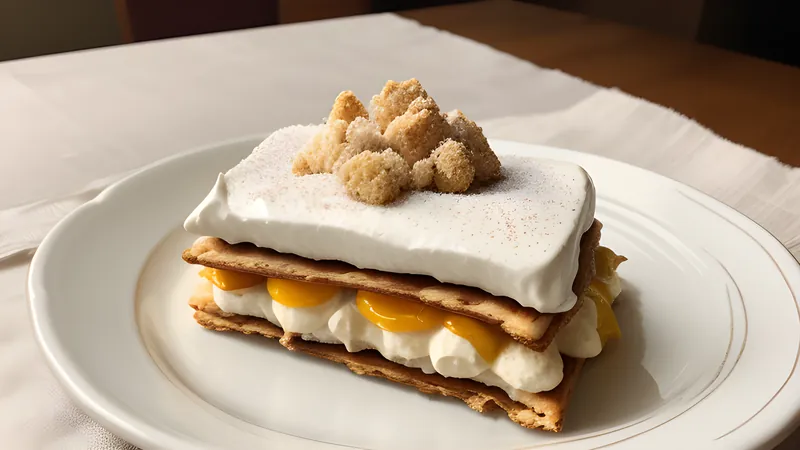
- Trim the pastry and cut into three equal rectangles. Pipe the cream onto two layers, stack, top with the third caramelised sheet and dust with icing sugar.
- Chill for 30 minutes, then cut into slices with a sharp serrated knife using a gentle sawing motion.
A thousand leaves, and a napoleon
Puff pastry, pâte feuilletée, is built by folding a slab of butter into dough and rolling it out again and again, so that hundreds of wafer-thin layers of fat and flour stack up. In the oven the water in the butter turns to steam and forces the layers apart while the fat crisps them, and the whole thing rises into a flaky, brittle sheet. The technique was refined in seventeenth-century France, and the millefeuille built from it appears in cookbooks by the early nineteenth century.
Confusingly, in Britain and America the same dessert is often called a vanilla slice or a napoleon. The napoleon name has nothing to do with the emperor; it is thought to be a corruption of napolitain, meaning something in the style of Naples, which had its own tradition of layered pastries. Whatever you call it, the grammar is fixed: crisp layers, soft custard, and a top that is either dusted with icing sugar, glazed with fondant, or, as in the classic feathered version, marbled with chocolate.
Custard first, and made stiff
Make the crème pâtissière well ahead, because it needs to be cold and firm. Warm the milk with the split vanilla pod and its scraped seeds until it steams, then leave it to infuse for a quarter of an hour so the vanilla perfumes it thoroughly. Whisk the yolks, sugar and cornflour into a pale, thick paste, pour the hot milk over while whisking, and return everything to the pan.
Cook over a medium heat, whisking without pause, until it thickens and comes to a boil, then keep it boiling for a full minute or two. As with any cornflour-set custard, that boil is what deactivates the starch-thinning enzyme in the yolks; skip it and the custard slackens as it stands. Beat in the butter for shine, press cling film onto the surface, and chill until cold and set. This custard needs to be on the firm side, because it is the mortar holding your pastry together, and a runny filling will slide the layers apart the moment you cut.
Baking the pastry flat and glassy
The one thing puff pastry wants to do is puff, and for a millefeuille you want it to do almost the opposite: rise a little, then stay flat and even so the layers are thin and crisp. The trick is to bake it weighted. Unroll the pastry onto its paper, roll it a touch thinner, and prick it all over with a fork to stop wild bubbling. Chill it for fifteen minutes so the butter is firm.
Bake it between two lined baking trays, the upper one pressing gently down, at 200C fan for about fifteen minutes, until it is pale gold and set flat. Now remove the top tray, dust the pastry evenly with the icing sugar, and return it to the oven for another six to eight minutes. Watch it: the sugar will melt, bubble and set into a shining caramel lacquer. Pull it the moment it is a deep, even gold, because from there it burns quickly and turns bitter. Let it cool completely and harden before you touch it.
Assembly, and the honest truth about cutting
Fold the whipped double cream through the cold, smooth custard. This lightens the crème pâtissière into a mousse-like cream that pipes cleanly and eats less heavily, while still being firm enough to hold. Spoon it into a piping bag with a plain nozzle.
Trim the cooled pastry to neat edges with a serrated knife and cut it into three equal rectangles. Pipe fat, even beads of cream over two of them, right to the edges, and stack them. Top with the third sheet, caramel side up, and dust with icing sugar. Then chill the assembled millefeuille for half an hour to let the cream firm.
Now the honest part: a millefeuille is difficult to cut cleanly, and anyone who tells you otherwise has not made one. The secret is a very sharp serrated knife and patience, sawing gently rather than pressing down, which would crush the layers and squeeze the cream out of the sides. Wipe the blade between slices. Even so, a little shattering is part of its character, and it will taste no less wonderful for a few stray flakes on the board.
Getting ahead, and where to go next
The custard can be made a day ahead, and the pastry baked several hours ahead and kept somewhere dry and uncovered so it stays crisp. Assemble no more than two or three hours before serving, because however well you caramelise the pastry, the moisture of the cream will eventually soften it. A millefeuille is at its glorious best within an hour or two of building, when the contrast between crisp and creamy is at its sharpest.
For variations, feather the top with white and dark fondant for the classic look, fold a little coffee or praline paste into the cream, or slip a layer of thinly sliced strawberries between the pastry and custard in summer. The vanilla crème pâtissière at the heart of this is the same custard that fills a batch of éclairs with coffee crème pâtissière, and if you have caught the pastry bug, the choux technique behind profiteroles with warm chocolate sauce is the obvious next thing to learn. Master the caramelised sheet and the firm custard, and you will make a dessert people photograph before they eat it.
What can go wrong
Most millefeuille disappointments trace back to one of three things. If the pastry rose into an uneven, puffy mess, the weighting tray was too light or the pastry was not pricked enough, so press more firmly and dock it well all over. If the caramel top burned, the oven was too hot or you looked away at the wrong moment, because the sugar goes from amber to bitter in under a minute, so stay at the door. And if the finished slices collapsed and slid apart, the culprit is almost always the custard: it was either undercooked and too loose, or the pudding was cut before it had chilled and firmed. A firm custard and a cold, rested assembly are what hold the architecture together.
One more small tip that pays off: bake a fourth strip of pastry if your sheet allows, crush it, and press the crumbs into the exposed cream along the long sides of each slice. It hides any untidy edges, adds another hit of crisp caramelised pastry, and makes a home millefeuille look as though it came from a very good patisserie window. It is the finishing touch that turns a slightly messy first attempt into something you are proud to carry to the table.
Related Content