Louisiana Chicken and Andouille Gumbo
A dark, patient roux built by hand, loaded with chicken, andouille and the holy trinity
Contents
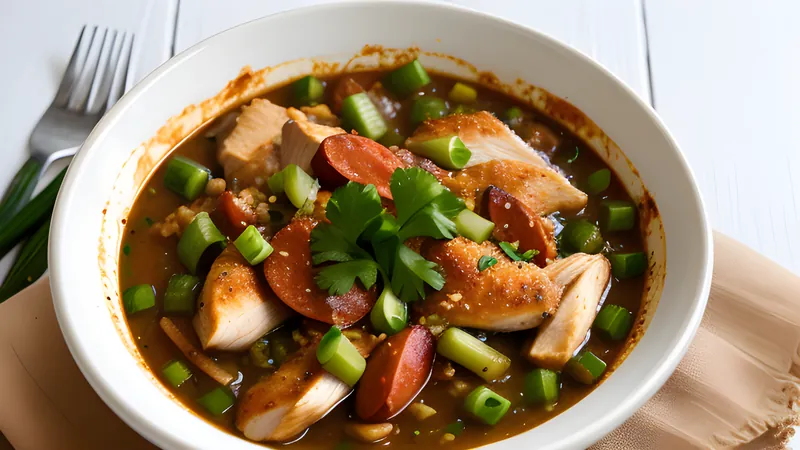
↓ Jump to recipeGumbo is built backwards from every other stew you have made: the first hour belongs entirely to the roux, standing at the stove whisking flour and oil until it turns the colour of a well-worn penny, long before the meat, stock or vegetables ever reach the pot. Get that roux right and the rest of the pot more or less takes care of itself. Rush it, or walk away from it, and you either end up with a thin, pale soup that tastes of nothing in particular or a bitter, scorched mess you have to bin and start again. This version keeps the roux at the centre where it belongs, loads the pot with chicken thighs and smoky andouille, and leaves the choice of okra or filé powder to whoever is eating it — which, as you will see, is a genuinely contentious question in Louisiana.
Louisiana Chicken and Andouille Gumbo
Ingredients
- 200g plain flour
- 200ml neutral oil (vegetable or groundnut)
- 1 large onion, finely diced (about 250g)
- 2 green bell peppers, finely diced (about 300g)
- 3 celery stalks, finely diced (about 200g)
- 6 garlic cloves, minced
- 450g andouille sausage, sliced into 1cm rounds
- 900g boneless, skinless chicken thighs, cut into 3cm chunks
- 2 tsp fine salt, plus more to taste
- 1 tsp cayenne pepper
- 1 tsp smoked paprika
- 1 tsp dried thyme
- 2 bay leaves
- 1.5 litres chicken stock, hot
- 400g okra, trimmed and sliced into 1cm rounds (optional but traditional)
- 4 spring onions, sliced, to finish
- 2 tbsp flat-leaf parsley, chopped
- 1-2 tsp filé powder, for the table (optional)
- Cooked long-grain white rice, to serve
- Hot sauce, to serve
Method
- Combine the flour and oil in a heavy-based pot or Dutch oven over medium heat and whisk to a smooth paste. This is the roux.
- Cook the roux, whisking or stirring constantly and never leaving the pot, for 45 to 60 minutes, lowering the heat if it darkens too fast or starts to smell scorched. You are done when it is the colour of dark chocolate or a well-worn copper penny, deep brick-red-brown, and smells toasted and nutty rather than burnt.
- The instant the roux hits colour, tip in the onion, green pepper and celery and stir hard and fast; the vegetables' moisture stops the cooking. Cook, stirring often, for 5 to 6 minutes until softened.
- Add the garlic and cook for 1 minute until fragrant.
- Stir in the cayenne, smoked paprika, thyme and andouille, and cook for 5 minutes, letting the sausage render a little of its fat into the roux.
- Gradually whisk in the hot stock, a ladleful at a time at first, until fully smooth, then bring to a simmer.
- Add the chicken and bay leaves. Simmer uncovered, stirring occasionally and skimming any fat that rises, for 45 minutes.
- Season with the salt and taste; adjust with more salt or cayenne. If using okra, stir it in now and simmer for a further 15 minutes.
- Take off the heat and rest for 10 minutes. Discard the bay leaves and stir through half the spring onion and the parsley.
- Serve ladled over rice, with filé powder, the remaining spring onion and hot sauce at the table.
Cajun, Creole, and the argument over the pot
Gumbo’s ancestry runs through three very different kitchens at once: West African okra stews (the word “gumbo” itself likely descends from a Bantu word for okra, ki ngombo), French roux technique brought by colonial and Acadian settlers, and the filé powder — ground dried sassafras leaves — that Choctaw and other Indigenous communities in the Mississippi Delta used as both a thickener and a seasoning long before Europeans arrived. By the eighteenth century in and around New Orleans, those three threads had knotted into something recognisably its own, and they never fully separated again; a good gumbo still carries all three influences in a single bowl.
What did split, over the following century, was gumbo along regional and cultural lines. Creole gumbo, the New Orleans city style associated historically with the city’s free people of colour and European-descended households, tends to include tomatoes, often uses seafood alongside or instead of meat, and leans on both a roux and okra for body. Cajun gumbo, from the rural Acadiana parishes settled by French-Canadian exiles, generally skips the tomatoes entirely, relies more heavily on a very dark roux for both colour and thickening, and is more likely to be built on chicken and sausage or on game. Neither is more authentic than the other — they reflect different larders and different histories — but the tomato question in particular is one Louisiana cooks will happily argue about for the length of a meal. This recipe sits closer to the Cajun side of that line: no tomatoes, a dark roux doing most of the thickening work, chicken and andouille as the backbone, with okra offered as an option rather than a requirement, because plenty of excellent gumbos leave it out and finish with filé powder stirred in at the table instead.
The roux is the whole point
A roux is nothing more than fat and flour cooked together, but what happens over that hour of cooking is where gumbo gets its character, and it is worth understanding why the colour matters so much. A pale, blond roux, the kind used to thicken a béchamel, has barely been cooked at all — the starch is still doing its full thickening job, but almost none of the flour’s raw taste has cooked away and no deep flavour has developed. Push the same roux further, past golden, past peanut-butter brown, towards the near-black brick-red this recipe asks for, and two things happen simultaneously. The starch granules break down under sustained heat, which means the roux loses most of its thickening power — a dark roux thickens a pot far less than a pale one, gram for gram, which is exactly why properly made gumbo is loose enough to eat with a spoon rather than a fork — a looser gravy is what a dark roux is meant to produce. At the same time, the proteins and sugars in the flour undergo a slow version of the Maillard reaction, the same browning chemistry that gives seared meat and toasted bread their savoury depth, and that reaction is what turns a roux from “flour and oil” into something that tastes distinctly nutty, faintly bitter in a good way, almost like coffee or dark chocolate.
The danger is that the line between “perfectly dark” and “irreversibly burnt” is narrow and gets narrower the longer you cook, because a dark roux holds an enormous amount of heat and can go from beautifully brick-red to acrid in the time it takes to answer the phone. Whisk or stir constantly — a flat wooden spoon or a flat whisk that can reach the corners of the pot works best — and keep the heat at a true medium rather than being tempted to rush it on high, which almost guarantees scorching. If you ever see black flecks appear or catch a sharp, burnt smell rather than a toasted one, there is no saving it; tip it out, wash the pot, and start again with a slightly lower heat. It is a genuinely meditative forty-five minutes once you accept you cannot leave the stove, and the colour you land on — anywhere from milk chocolate to the darkest brick-red — is a matter of taste; darker means more smoke and bitterness, lighter means more thickening power and a milder base.
Building the pot
Once the roux is at colour, everything moves quickly, because the roux keeps cooking from residual heat even once you start adding vegetables. The “holy trinity” — onion, green pepper and celery, the Louisiana answer to French mirepoix — goes in first and stops the roux dead in its tracks; the moisture the vegetables release drops the pot’s temperature almost instantly, which is why you want them diced and ready before the roux is even close to done. Andouille goes in before the liquid so its fat renders into the roux and seasons the whole pot from the inside, rather than just floating as chunks of sausage in a separately-flavoured broth. The stock should go in hot and gradually, whisked in a ladleful at a time to start, so the roux disperses evenly rather than seizing into lumps that never fully smooth out.
Chicken thighs, not breast, are non-negotiable here: thigh meat has enough fat and connective tissue to survive forty-five minutes of simmering and stay tender, where breast meat turns dry and stringy well before the gumbo itself is ready. Let the pot simmer gently rather than boil hard — a hard boil breaks the roux’s emulsion and can leave an oily sheen on the surface rather than the glossy, cohesive gravy you are after. If you do see fat pooling, skim it off with a spoon; a little is fine and adds richness, a lot means the pot was too hot at some point.
The okra and filé question
Okra and filé powder both thicken gumbo, and Louisiana cooks generally use one or the other rather than both, because filé stirred into a pot that already contains a lot of okra can turn stringy and gluey. Fresh or frozen okra, sliced and simmered into the pot for the final fifteen minutes, breaks down slightly and adds a distinctive, faintly grassy thickening along with genuine vegetable flavour; some cooks char or sauté it separately first to cut down on the sliminess it is famous (or infamous) for, though a properly dark roux already carries plenty of the pot’s body so the okra does not need to work overtime. Filé powder, by contrast, should never be cooked — it is stirred into an individual bowl at the table, or into the whole pot only after it is off the heat entirely, because sustained heat turns it stringy and bitter. Offering both options at the table, as this recipe does, lets everyone finish their own bowl the way they prefer, which is very much in keeping with how gumbo is actually eaten in most Louisiana kitchens: as a base that gets adjusted, bowl by bowl, to taste.
Tips, substitutions and storage
No andouille to hand: a good smoked kielbasa or another firm, well-smoked pork sausage is the closest substitute; avoid anything wet-cured or overly sweet, since andouille’s appeal here is smoke and coarse texture, not sweetness. Shellfish lovers can stir in 400g of peeled raw prawns for the final 5 minutes of cooking for a chicken-sausage-and-shrimp gumbo, a very traditional combination. Gumbo genuinely improves overnight in the fridge as the flavours settle and marry, and it freezes well for up to three months — freeze it without rice, since rice turns mushy on reheating; add freshly cooked rice to each bowl instead. Reheat gently on the stove rather than in the microwave, as high, uneven heat can split the roux.
Variations and what to serve alongside
A seafood-forward Creole version swaps the chicken for firm white fish and prawns added in the last ten minutes, and welcomes a tin of chopped tomatoes stirred in with the stock — heresy to a Cajun cook, entirely correct to a New Orleans one. For a leaner pot, use skinless chicken thighs and halve the andouille, leaning more on smoked paprika for that missing smokiness. However you build it, gumbo wants a starchy, unfussy neighbour on the table: a wedge of warm, not-too-sweet cornbread with brown butter and honey does exactly that job, soaking up the gravy at the edge of the bowl. It shares a stovetop patience with other long-simmered pots worth knowing, too — the slow, spiced build of a jollof rice with a smoky party bottom rewards the same kind of attention, just with a different pot and a different fire underneath it.
Related Content