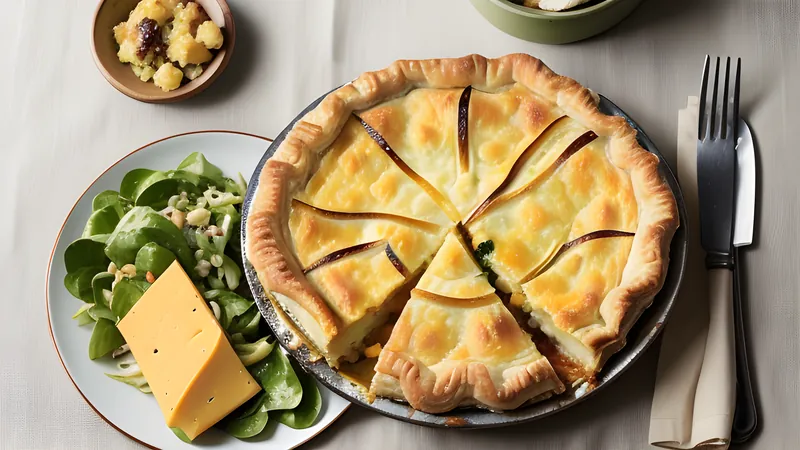
Leek and Cheese Pie with Rough Puff
A soft, sweet tangle of leeks under shatteringly crisp pastry
Contents
↓ Jump to recipeEvery leek and cheese pie lives or dies on one decision: whether you take the time to properly soften the leeks before they go anywhere near pastry. Skip it, and you seal raw slices into a case where they weep and steam and turn the base to grey sludge. Give them twenty patient minutes in a pan first, and they collapse into something sweet, silky and almost jammy, ready to be held together by cheese and lifted by mustard.
I make this on cold Sundays when I want the house to smell of baking and I have a spare afternoon to potter. The pastry is a quick rough puff you can manage entirely by hand, and the filling asks for nothing you can’t buy at a corner shop. My one small trick is to brown the butter the leeks cook in, which threads a nutty, toasted note through the whole pie and makes people think you did something far cleverer than you did.
Leek and Cheese Pie with Rough Puff
Ingredients
- 250g plain flour, plus extra for dusting
- 200g cold unsalted butter, 175g for the pastry and 25g for the leeks
- 1/2 tsp fine sea salt
- 120ml ice-cold water, plus a squeeze of lemon juice
- 800g leeks (about 5 medium), trimmed and sliced 1cm thick
- 2 fat garlic cloves, finely chopped
- 1 tbsp fresh thyme leaves
- 150g mature Cheddar, coarsely grated
- 50g Gruyère or Comté, coarsely grated
- 2 tbsp crème fraîche
- 2 tsp English mustard
- 2 large eggs, 1 beaten into the filling and 1 for glazing
- Fine sea salt and black pepper
Method
- Make the rough puff: cube 175g cold butter, toss in the flour and salt, press each cube into a flake, cut in the lemony ice-cold water until it clumps, fold in three three times, then chill for at least 30 minutes.
- Brown 25g butter in a wide pan until nut-brown, add the sliced, washed leeks with a pinch of salt and soften over a low heat for 18-20 minutes, adding the garlic and thyme for the final 2 minutes. Cool to lukewarm.
- Fold the cooled leeks with the Cheddar, Gruyere, crème fraîche, mustard and 1 beaten egg; season well with black pepper.
- Heat the oven to 200C fan with a baking sheet inside. Line a greased 23cm dish with the larger piece of pastry, add the filling, top with the lid, crimp the edges, cut a steam hole and glaze all over with beaten egg.
- Bake on the hot sheet for 40-45 minutes until deep golden and puffed, then rest for 10 minutes before slicing.
Why leeks and cheese belong together
The pairing is old, and it is British to the bone. Leeks have grown in these islands since before the Romans, thriving through the hungry gap of late winter when little else stood in the garden. They became the vegetable of the poor smallholder precisely because they were hardy and cheap, and the leek’s place as the national emblem of Wales — pinned to lapels every St David’s Day — tells you how deep the affection runs.
Cheese was the natural partner because it too was a farmhouse staple, a way of banking summer milk against lean months. A pie was how a careful cook stretched both into a meal that filled labouring stomachs. You can trace a straight line from the medieval “coffin” pastries, whose thick crusts were really just edible cooking vessels, to the Cornish and Welsh baking traditions that gave us leek pasties and the glorious cheese-and-onion pie of the Valleys. Mine sits in that lineage, borrowing the crisp, buttery crust that later French technique lent to British kitchens.
If you like a savoury pastry supper, this shares a kitchen with my fish pie with a Cheddar mash crust and the more theatrical mushroom Wellington with chestnut and spinach. All three prove the same point: a soft, well-seasoned filling wants a crisp lid to play against.
The rough puff, demystified
Proper puff pastry is a day’s work of folding and chilling. Rough puff gives you eighty per cent of the drama for a fraction of the effort, and it is the pastry I reach for whenever I want flaky height without the ceremony.
The principle is simple. You keep flakes of cold butter visible in the dough rather than rubbing them fully in. When those flakes hit the oven, the water in them flashes to steam and pushes the layers apart, giving you that shattering, leafy rise.
Cut 175g of cold butter into rough 1cm cubes. Tip the flour and salt into a big bowl, add the butter, and toss so every cube is coated. Now press each cube flat between finger and thumb into a rough flake. You want an untidy mixture of floury flakes and pea-sized lumps, with plenty of butter still clearly there. Add a squeeze of lemon to the ice water — the acid relaxes the gluten and keeps the pastry tender — then trickle it in, cutting it through with a butter knife until the dough just clumps. Bring it together with your hands for the fewest seconds possible.
Turn it out and shape it into a rough rectangle. Roll it away from you into a long strip, then fold it in three like a letter. Give it a quarter turn and repeat twice more. By the third fold the dough will look smooth and marbled with butter streaks. Wrap it and chill for at least thirty minutes; warm butter is the enemy of layers, and a rested dough rolls without fighting back.
Softening the leeks
Leeks hide grit deep between their layers, and nothing ruins a pie faster than a mouthful of soil. Slice them first, then tip the rings into a bowl of cold water and swish hard with your hands; the sand sinks and the leeks float. Lift them out into a colander rather than draining, so you don’t pour the grit back over them, and shake them fairly dry. Use the pale and light-green parts for this pie and save the tough dark tops for stock. A word on quantity: leeks lose more than half their bulk once softened, so the 800g here is not a misprint. It looks like a mountain in the pan and cooks down to a modest, glossy heap.
While the pastry chills, brown the butter. Put 25g in a wide pan over a medium heat and let it foam, then keep going until the milk solids at the bottom turn the colour of a hazelnut and the smell shifts from creamy to toasted. This takes three or four minutes and happens fast at the end, so watch it.
Add the leeks with a good pinch of salt, stir to coat them in the brown butter, then turn the heat low and let them soften for eighteen to twenty minutes. Stir now and then. They should melt down to a fraction of their volume, sweet and completely tender, with no squeak of rawness left. Add the garlic and thyme for the final two minutes so the garlic perfumes the pan without scorching. Tip everything into a bowl and let it cool to lukewarm.
Cold filling matters. Stir grated cheese into hot leeks and it splits into a greasy puddle; let the leeks cool first and the cheese binds instead. Once the mixture is barely warm, fold in both cheeses, the crème fraîche, the mustard and one beaten egg. Season well with black pepper and check the salt, remembering the Cheddar brings plenty of its own.
Building and baking the pie
Heat the oven to 200°C fan and slide a baking sheet onto the middle shelf to preheat; a hot base is what crisps the underside of the pastry and stops the dreaded soggy bottom. Grease a 23cm pie dish or tin.
Cut the pastry into two pieces, one slightly larger. Roll the larger piece to line the dish, leaving an overhang. Spoon in the leek filling and spread it level. Roll the second piece for the lid. Brush the rim with beaten egg, lay the lid over, press the edges together and crimp them firmly with a fork or your fingers. Trim the excess, then cut a small steam hole in the centre — trapped steam will bloat the lid and unstick your layers.
Glaze the top all over with beaten egg for a deep, glossy finish, and if you like, mark the surface with the back of a knife in a lattice. Set the pie on the hot baking sheet and bake for forty to forty-five minutes, until the pastry is a rich, even brown and you can see it has puffed at the edges. If the top colours before the base has had its time, drop the oven by 10°C for the last ten minutes.
Let the pie stand for ten minutes before cutting. This is the hardest instruction to obey and the most important; the filling needs those minutes to settle so your slice holds its shape instead of sliding out in a molten avalanche.
Getting it right, and changing it up
The commonest failure is a wet pie, and it almost always comes from underdone leeks or a filling packed in hot. Cook the leeks fully and cool the mixture, and you sidestep both. If your pastry slumps rather than rises, the butter got warm; chill the assembled pie for fifteen minutes before it goes in and the layers will hold.
For make-ahead, you can build the whole pie and refrigerate it unbaked for a day, or freeze it. Bake from chilled as written; from frozen, add fifteen minutes and cover loosely with foil if it darkens too soon. Leftovers reheat beautifully at 180°C for fifteen minutes, which re-crisps the pastry in a way a microwave never will.
To ring the changes, a handful of cooked, squeezed spinach folded through the leeks adds colour and iron. Blue cheese in place of the Gruyère turns it sharper and more grown-up. A few spoons of soft, buttery leeks left over from a batch of buttered leeks with thyme and breadcrumbs can be stirred straight in, which is exactly the kind of thrifty, one-thing-becomes-another cooking this pie was born from. Serve it with a sharp green salad and a spoonful of chutney, and a cold March afternoon suddenly has a point to it.
Related Content