Larb with Toasted Rice Powder and Lime
Isan's answer to a salad — minced meat sharpened with lime, chilli and rice toasted dark enough to smell like popcorn
Contents
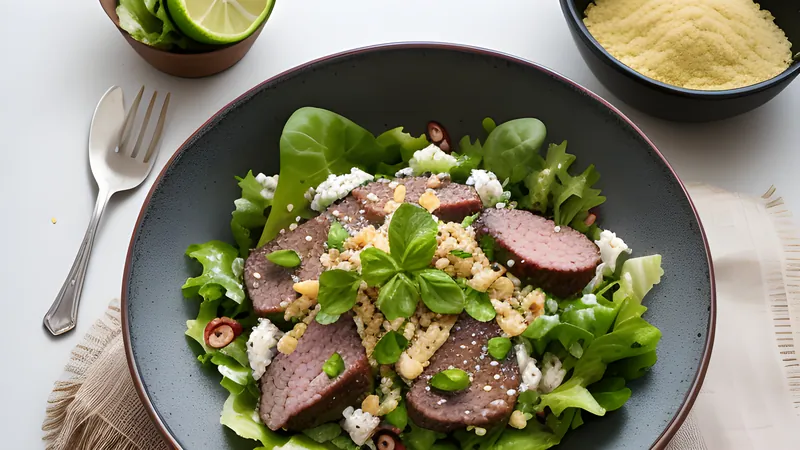
↓ Jump to recipeLarb is Isan’s salad in the loosest sense of the word: hot minced meat, dressed hard with lime and fish sauce, showered with herbs, and finished with a spoonful of rice toasted so dark it smells like popcorn. The twist that makes this version worth the extra ten minutes is toasting the rice yourself, from raw grains in a dry pan, rather than reaching for a jar of the ready-made stuff — home-toasted khao khua has a depth and nuttiness that pre-ground versions lose within weeks of grinding, and it’s the ingredient that turns a good larb into an unmistakable one.
Larb with Toasted Rice Powder and Lime
Ingredients
- 3 tbsp uncooked jasmine rice, for the rice powder
- 2 tbsp vegetable oil
- 500g minced pork (or chicken, or beef)
- 60ml chicken stock or water
- 3 tbsp fresh lime juice
- 3 tbsp fish sauce
- 1 tbsp toasted rice powder (see method)
- 1-2 tsp dried chilli flakes (phrik pon), or to taste
- 2 tbsp finely sliced shallots
- 3 spring onions, finely sliced
- 3 tbsp roughly chopped coriander leaves
- 3 tbsp roughly chopped mint leaves
- 1 tsp caster sugar (optional, to taste)
- Lettuce leaves, cucumber slices and extra herbs, to serve
- Steamed sticky rice, to serve
Method
- Toast the raw rice in a dry frying pan over medium heat, shaking or stirring often, for 8-10 minutes until deep golden-brown all over and smelling of popcorn and toasted nuts. Take it further than you think; pale rice powder gives no flavour.
- Tip the toasted rice into a mortar and pound (or blitz in a spice grinder) to a coarse, sandy powder with some texture rather than a fine flour. Set aside; this makes more than one batch needs, and keeps well.
- Heat the oil in a wide pan or wok over medium-high heat. Add the minced pork and the stock or water, breaking the meat up as it cooks, for 4-5 minutes until just cooked through. The added liquid keeps the meat tender rather than dry and crumbly.
- Remove the pan from the heat and let the meat cool for 2-3 minutes; if dressed while too hot, the herbs wilt and the lime juice loses its edge.
- Stir in the lime juice, fish sauce, 1 tablespoon of the toasted rice powder and the chilli flakes. Taste: it should hit sour, salty and spicy all at once, with sweetness only as a light background note.
- Add the sugar only if the balance needs rounding out, then fold through the shallots, spring onions, coriander and mint just before serving so they stay bright and don't wilt.
- Taste again and adjust with more lime for sourness, fish sauce for salt, or chilli flakes for heat.
- Pile onto a plate lined with lettuce leaves and cucumber slices, and serve immediately with sticky rice, extra rice powder and extra lime wedges on the side.
The story: Isan and Laos, and a dish that belongs to both
Larb (also spelled laab or lahb) comes from Isan, the northeastern plateau of Thailand that borders Laos along the Mekong, and it is every bit as much a Lao national dish as a Thai one — in fact many food historians and plenty of Lao cooks would say larb originated on the Lao side of the river first, travelling into Isan through the shared Lao-Isan population and cultural ties that predate the modern border. The two countries argue, good-naturedly, over whose version is more authentic, in roughly the same spirit as the sinigang debates that run through Filipino households; the honest answer is that larb belongs to a shared Lao-Isan food culture rather than to one country’s cuisine alone.
Isan food generally sits apart from the coconut-rich, sweeter cooking of central and southern Thailand, leaning instead on sourness, funk and fire, and larb is the clearest single expression of that palate. It’s typically eaten with sticky rice rather than jasmine, torn off in small balls with the fingers and used to scoop up the meat, and it’s almost always part of a spread rather than a solo dish — served alongside grilled meats, a papaya salad like som tam, and more sticky rice than seems reasonable. Meat can be pork, chicken, beef, duck or fish, and in some traditional Isan and Lao versions it’s served raw (larb dip) rather than cooked, though the cooked version travels far better and is what most people outside the region actually eat.
Provinces within Isan have their own inflections worth knowing. Ubon Ratchathani and Sisaket, near the Cambodian border, tend towards larger portions of fresh herbs and a heavier hand with mint, while larb around Khon Kaen and Udon Thani, closer to the Lao border proper, often carries more chilli heat and a stronger showing of toasted rice powder. A related but genuinely distinct dish, larb kua, comes from northern Thailand around Chiang Mai rather than Isan, and swaps the sour, herb-heavy Isan style for a drier, deeply spiced version cooked with a specific larb spice mix (prik larb) containing dried chillies, cinnamon, star anise and other warming spices — closer to a northern curry paste than to anything sour. Confusing the two is a common mistake outside Thailand, but they share only a name and a base of minced meat; the flavour profiles point in almost opposite directions.
Offal versions are common and worth trying if you come across them: larb tap (liver), larb huajai (heart) and larb moo krob (crispy pork skin folded through) all use the same dressing and rice powder but bring a mineral depth or crunch that the plain minced version doesn’t have, and they’re a good way to understand how flexible the format really is once you’ve made the base version a few times.
The toasted rice powder, khao khua, is what anchors the whole dish and separates larb from a simple lime-and-fish-sauce dressed meat. It adds a nutty, slightly bitter crunch and — just as importantly — a thickening, almost sandy texture that clings to the meat and carries the dressing rather than letting it pool at the bottom of the bowl.
The method, explained
Toasting rice for khao khua is simple in principle and easy to underdo in practice. Raw jasmine rice grains, toasted dry in a pan with no oil, need to go past pale gold and into a genuinely deep brown — closer to the colour of strong coffee than of digestive biscuits — before they’re pounded. Underdone rice powder tastes of not very much beyond a faint cereal note; taken properly dark, the sugars in the rice caramelise deeply enough to smell like popcorn and taste faintly bitter and smoky, which is exactly the note that plays off the sourness of the lime. It’s worth toasting a larger batch than one recipe needs, since it keeps in an airtight jar for a couple of weeks and having it ready shaves ten minutes off the next larb.
The other technique worth understanding is why the meat is cooked with a splash of liquid rather than dry-fried. Minced meat cooked bone-dry in a hot pan seizes and turns crumbly, shedding its own moisture fast; a few tablespoons of stock or water added at the start lets the meat poach gently as it cooks through, staying tender and slightly loose rather than compacting into hard little pellets. And the dressing goes on only once the meat has cooled for a couple of minutes off the heat — lime juice loses its sharp, bright acidity fast when it hits something still steaming hot, and the fresh herbs wilt within seconds against real heat, turning limp and losing the volume that’s meant to make up half the dish’s texture.
Supermarket mince, coarsely ground, gives a fine result, but if you want the texture served in an Isan restaurant, ask a butcher for a piece of pork shoulder and chop it by hand with a heavy knife until it’s a rough, uneven mince (larb sap, “hand-chopped larb”) rather than a uniform paste — the slightly ragged texture holds the dressing differently and gives a better bite than machine-ground meat, which can compact into an almost pâté-like mass once cooked. Fish sauce quality matters more in a dish this sparse than in almost anything else in Thai cooking, since there’s nowhere for a thin, salty-only fish sauce to hide; a well-aged Thai or Vietnamese brand, sold in glass rather than plastic where possible, brings a rounder savouriness that a bargain bottle simply doesn’t have. Limes should be properly ripe and give slightly under a thumb’s pressure — under-ripe limes are more bitter than sour and throw the whole balance off no matter how much juice you add.
The recipe
Serves 2 as a main, 4 as a starter. Prep 15 minutes, cook 15 minutes.
For the rice powder: 3 tbsp uncooked jasmine rice (makes extra).
For the larb: 2 tbsp oil, 500g minced pork, 60ml stock or water, 3 tbsp lime juice, 3 tbsp fish sauce, 1 tbsp toasted rice powder, 1-2 tsp dried chilli flakes, 2 tbsp sliced shallots, 3 spring onions, 3 tbsp coriander, 3 tbsp mint, 1 tsp sugar (optional). Lettuce, cucumber and sticky rice to serve.
- Toast the raw rice in a dry pan for 8-10 minutes until deep brown and fragrant.
- Pound to a coarse powder. Set aside.
- Cook the pork with the stock in oil for 4-5 minutes until just done.
- Cool the meat for 2-3 minutes off the heat.
- Stir in the lime juice, fish sauce, 1 tbsp rice powder and chilli flakes.
- Taste and adjust with sugar if needed, then fold in the shallots, spring onions and herbs.
- Taste again, adjust lime, fish sauce or chilli, and serve at once with lettuce, cucumber and sticky rice.
Tips, substitutions and storage
Ground beef or minced chicken thigh both work in place of pork; duck is the traditional upgrade for a special occasion, and mushrooms pulsed to a rough mince plus a splash of soy sauce make a solid vegetarian version, though the texture won’t be identical. Toasted rice powder keeps for 2-3 weeks in an airtight jar at room temperature, and it’s worth having a jar on hand for pad krapow with a crispy fried egg nights too — a small pinch scattered over that dish, though not traditional, adds a pleasant crunch.
The dressed larb itself is best eaten fresh, within the hour, since the herbs and lime juice both fade fast; it doesn’t reheat well because the second application of heat turns the fresh herbs grey. If you must make ahead, cook and cool the meat, then dress it just before serving.
Variations
For larb dip, the traditional raw version eaten in parts of Isan and Laos, use very fresh, good-quality beef or venison, finely minced, dressed the same way without cooking — this is a dish for a trusted butcher and confident cooks, not a casual weeknight swap. A vegetable-forward version using finely chopped mushrooms and toasted rice powder makes a genuinely good starter for anyone avoiding meat. And larb made with grilled, then chopped, chicken thigh instead of raw mince (larb gai yang, in effect) brings a smokier char that plays beautifully against the same lime-and-rice-powder dressing.
However you dress it, taste before the herbs go in and taste again after — larb should hit sour and salty hard enough that the sticky rice on the side feels necessary, not optional.
Related Content