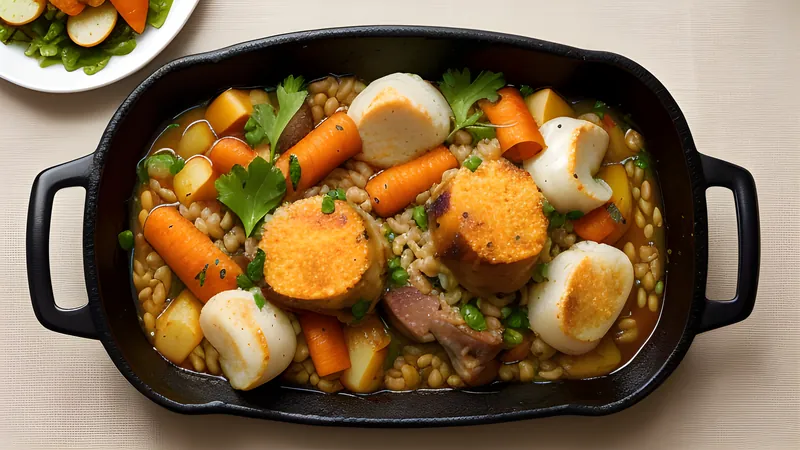
Lancashire Hotpot with Barley and Lamb
The classic layered lamb bake, with pearl barley thickening the gravy from within
Contents
↓ Jump to recipeLancashire hotpot is one of those dishes that carries a whole region’s social history in it. It’s a mill-town dish from the cotton belt of northern England, designed to be assembled in the morning, left in the low residual heat of a bread oven or the range all day, and eaten when the workers came home. The construction is the genius of it: chunks of cheap lamb and onions at the bottom, a lid of sliced potatoes on top, and long, slow, unattended cooking that turns tough meat tender and crisps the potatoes into a golden crust. It needed almost no watching, which is exactly what a household of mill workers could offer it.
The version here keeps the layered structure sacred but adds one thing to the base: a handful of pearl barley. As it cooks, the barley swells and releases starch, thickening the gravy from the inside and adding a nubbly, satisfying chew that makes the dish more of a complete meal. It’s a small addition with roots in the same thrifty northern cooking that gave us the hotpot in the first place, and it turns a good bowl into a properly hearty one.
Lancashire Hotpot with Barley and Lamb
Ingredients
- 800 g lamb neck fillet or shoulder, in 4 cm chunks
- 2 tbsp plain flour, seasoned with salt and pepper
- 3 tbsp butter, plus 25 g melted for the top
- 1 tbsp vegetable oil
- 2 onions, sliced
- 3 carrots, in thick coins
- 2 tsp Worcestershire sauce
- 4 anchovy fillets, finely chopped (optional)
- 100 g pearl barley, rinsed
- 600 ml lamb or chicken stock
- 2 bay leaves
- 3 sprigs thyme
- Sea salt and black pepper
- 800 g waxy potatoes (Maris Piper or Desirée), peeled
Method
- Heat the oven to 160C fan. Toss the lamb in the seasoned flour. Heat 1 tbsp butter and the oil in a casserole over a medium-high heat and brown the lamb in batches until well coloured, about 6 minutes per batch. Set aside.
- Add another 1 tbsp butter to the pot. Cook the onions and carrots over a medium heat for 8 minutes until softening. Stir in the Worcestershire sauce and chopped anchovies, if using, and cook for 1 minute.
- Return the lamb to the pot. Scatter over the rinsed pearl barley, then pour in the stock and tuck in the bay leaves and thyme. Season lightly, bearing in mind the anchovies add salt. Bring to a simmer.
- Slice the potatoes into 3 mm rounds, ideally on a mandoline. Arrange them in overlapping layers over the top of the stew, covering it completely. Season the potatoes and brush the surface with the melted butter.
- Cover the casserole and bake for 1 hour 30 minutes, until the lamb and barley are tender when tested.
- Uncover, raise the heat to 190C fan, and bake for a further 30 minutes, until the potatoes are golden and crisp at the edges.
- Rest for 10 minutes before serving, spooning through the potato lid to bring up the lamb and barley beneath.
A dish born in the cotton towns
The hotpot belongs to Lancashire’s industrial nineteenth century, when the county’s cotton mills drew huge numbers of workers into towns like Bolton, Oldham and Burnley. Households had little time to cook and little money to spend, so a dish that used cheap cuts of lamb or mutton, cooked itself over a long day with no attention, and fed a family from one pot was exactly what the moment called for. The tall, straight-sided brown earthenware pot it was traditionally cooked in gave the dish its name, and older recipes often included oysters, which were cheap and plentiful before overfishing made them a luxury.
The classic cut is mutton or lamb from the neck and shoulder, the tougher, cheaper, more flavourful end of the animal. These cuts are full of connective tissue that needs long, gentle cooking to break down, which suits the hotpot’s all-day method perfectly. Middle-neck chops on the bone were traditional and add wonderful flavour; boneless neck fillet is easier to eat and what this recipe uses, though shoulder works just as well. Whatever you use, avoid lean, quick-cooking cuts like leg steaks, which turn dry and tight over this length of time.
Brown the lamb, then respect the layers
As with any braise, browning the lamb first builds the savoury foundation. Toss it in seasoned flour, colour it hard in batches without crowding the pan, and don’t rush it; the dark crust that forms is where a lot of the flavour lives, and the flour helps thicken the gravy later. Once that’s done, the assembly follows a strict order that matters. Meat, onions, carrots and barley go at the bottom, sitting in the stock where they braise in moist heat. The potatoes go on top, above the liquid line, where they steam and then roast rather than boil.
That separation is the whole trick of the hotpot. If the potatoes were submerged they’d turn to mush; sitting proud on top, they cook in two stages. Under the lid for the first ninety minutes they soften in the rising steam, then with the lid off and the heat up for the final half hour they dry out and crisp into a golden, buttery crust. Slice them thin and even, ideally on a mandoline, and overlap them like roof tiles so they cover the surface completely and hold together as a lid. Brushing them with melted butter is what gets that deep golden colour and crisp edge.
The umami twist: a few anchovies
Here is the small clever addition. Four anchovy fillets, chopped so finely they dissolve, stirred into the onions before the stock goes in. They melt away entirely during cooking and leave behind no fishiness at all, only a deep, savoury, meaty background that makes the lamb taste more of itself. Anchovies and lamb are an old, quiet partnership in British and French cooking, and this is one of the easiest places to see why. If you’re cooking for anyone who won’t touch anchovy, leave them out and add an extra teaspoon of Worcestershire sauce, which does a similar if lighter job.
Season with a careful hand if you use the anchovies, because they bring salt of their own. Taste the base before the potatoes go on, and remember that the barley soaks up seasoning as it cooks, so a base that tastes correct at the start may taste flat at the end. It’s easier to add a little salt at the table than to fix an over-salted pot.
Getting the barley right
Pearl barley has had its tough outer husk polished off, which is why it cooks in the same window as the lamb, roughly ninety minutes, softening to a tender, slightly chewy grain. Rinse it before it goes in to wash off surface starch and keep the gravy from turning gluey. As it cooks it absorbs a fair amount of liquid and releases starch, which is what gives this hotpot its thicker, more stew-like gravy compared with the classic. Because of that thirst, the recipe uses a generous 600 ml of stock; if you skip the barley, drop the stock to 450 ml or the base will be too loose.
Don’t substitute pot barley (the unpolished wholegrain) without adjusting the timing, as it takes considerably longer to soften and would still be firm when the lamb is done. If pearl barley is all you can find and you want a different grain, spelt or farro behave similarly, though each has its own texture. For another barley-thickened lamb dish in a brothier register, Scotch Broth with Barley and Lamb shows how the same grain works in a soup.
Serving and what goes with it
A hotpot is close to a complete meal in one dish, with meat, vegetables, grain and potatoes all present, so it needs little alongside. The traditional Lancashire accompaniment is pickled red cabbage, whose sharp, sweet-sour crunch cuts brilliantly through the rich, buttery lamb; a spoonful on the side of each plate is the classic finish. Beyond that, some buttered greens or a simple green salad are all it wants. Serve it straight from the pot at the table, breaking through the golden potato lid to bring up the tender lamb and barley underneath.
Rest it for a good ten minutes off the heat before serving. This lets the gravy settle and thicken and makes it easier to portion without everything sliding apart. Spoon down through all the layers so each plate gets crisp potato, soft lamb and some of that thickened, savoury gravy.
Make-ahead and storage
The hotpot base reheats well, and like most lamb stews it tastes deeper the next day. If you’re making it ahead, you have two options. Cook the whole thing, cool it, and reheat portions in a low oven until piping hot, accepting that the potato lid will soften rather than stay crisp. Or, better, cook the lamb-and-barley base fully in advance, refrigerate it for up to three days, then assemble the fresh potato lid on top and do the full bake just before serving, which gives you a crisp top from a made-ahead base.
It freezes well without the potato topping, which turns watery on thawing. Freeze the base for up to three months, defrost overnight in the fridge, then reheat, top with fresh sliced potato and bake as normal. For a beefy cousin built on the same slow-braise logic, complete with suet dumplings, see Beef Shin and Ale Stew with Herb Dumplings.
Related Content