Moroccan Lamb Tagine with Apricots and Preserved Lemon
Slow-cooked, sweet and savoury
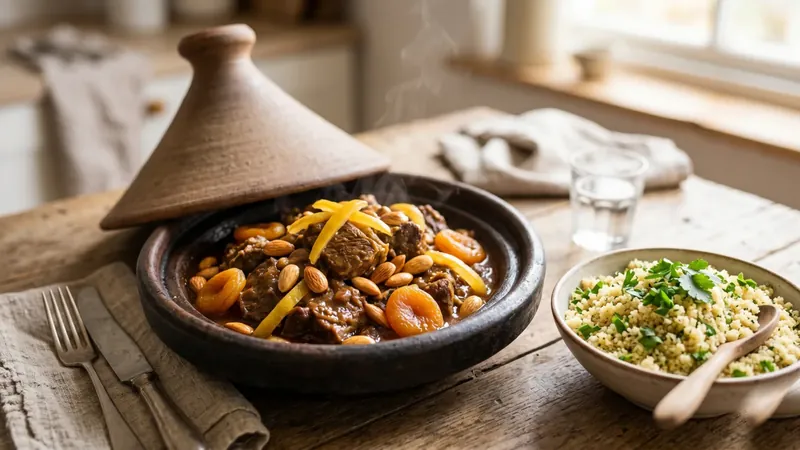
A good tagine balances sweet against savoury, and this one leans into both ends. Dried apricots, plumped in the sauce and lifted with honey, give a gentle, jammy sweetness, while the salty, citrus tang of preserved lemon cuts straight through the richness of slow-cooked lamb. Warmly spiced and meltingly tender, it is the kind of dish that fills the kitchen with the scent of cinnamon and saffron long before it reaches the table.
Moroccan Lamb Tagine with Apricots and Preserved Lemon
Ingredients
- 1.2kg lamb shoulder, cut into large chunks
- 3 tbsp olive oil
- 2 onions, finely sliced
- 4 garlic cloves, crushed
- 1 thumb of fresh ginger, grated
- 2 tsp ground cumin
- 2 tsp ground coriander
- 1 tsp ground cinnamon
- 1 tsp ground turmeric
- Pinch of saffron threads
- 2 tbsp tomato purée
- 700ml lamb or chicken stock
- 150g dried apricots
- 2 tbsp clear honey
- 1 preserved lemon, flesh discarded, rind finely chopped
- Salt and black pepper, to taste
- Toasted flaked almonds and coriander, to serve
Method
- Season the lamb. Heat 2 tbsp oil in a large casserole and brown the lamb in batches until well coloured, then set aside.
- Add the remaining oil and cook the onions over a low heat for 10 minutes until soft and golden.
- Stir in the garlic and ginger for 1 minute, then add the cumin, coriander, cinnamon, turmeric and saffron and cook for 1 minute until fragrant.
- Stir in the tomato purée, then return the lamb to the pot with the stock. Bring to a gentle simmer.
- Cover and cook over a very low heat, or in a 160C (140C fan) oven, for 1 hour and 30 minutes.
- Stir in the dried apricots and honey, then cook uncovered for a further 30 minutes until the lamb is meltingly tender and the sauce has thickened.
- Stir through the chopped preserved lemon rind and season to taste.
- Rest for 10 minutes, then scatter with toasted almonds and coriander. Serve with couscous or flatbread.
3 The Story
A tagine is two things at once: the conical earthenware pot, and the slow-cooked stew prepared inside it. The pot, with its distinctive pointed lid, is the traditional cooking vessel of Morocco and the wider Maghreb. The shape is cleverly designed for cooking over low heat or coals, the tall lid trapping rising steam so it condenses and trickles back down, keeping the contents moist and gently braising the meat with very little liquid. A heavy casserole with a tight lid does the same job perfectly well at home.
What defines the food is the layering of warm spices with a savoury and often sweet character. Cumin, coriander, cinnamon, ginger, turmeric and saffron form the backbone, sometimes blended into the famous spice mix ras el hanout, whose name loosely translates as “top of the shop”, a blend of the merchant’s finest spices. The combination of meat with dried fruit is a hallmark of this cooking, an inheritance from the wider Arab and Persian culinary world where sweet and savoury have long shared a plate.
The two ingredients highlighted here are pillars of the Moroccan kitchen rather than novelties. Apricots, prunes and dates all appear in classic tagines, where their concentrated sweetness softens into the sauce and balances the spice. Preserved lemons are perhaps the most characteristic Moroccan ingredient of all: whole lemons packed in salt and their own juice and left to mature for weeks, mellowing into something intensely fragrant and savoury. Only the rind is used, the soft flesh usually discarded, and it brings a salty, almost floral citrus note that no fresh lemon can replicate.
Patience is the real secret. Lamb shoulder is a tough, well-marbled cut that needs long, slow cooking to break down its connective tissue and turn meltingly tender, so resist the urge to rush it over high heat. Browning the meat first builds a savoury depth, and cooking the onions gently until soft and sweet gives the sauce its body. Add the apricots towards the end so they plump without dissolving, and stir the preserved lemon in last so its bright, salty edge stays clear. Serve with fluffy couscous or warm flatbread to soak up every drop.
Related Content