Lake Mead, sinking water level
crimes uncovered
Contents
<p>On 1 May 2022, two sisters paddleboarding near the Hemenway Harbour marina on Lake Mead came across a rusted metal barrel poking out of the newly exposed lakebed. Inside was a human skeleton, and among the remains were clothing and shoes that pointed to the 1970s or early 1980s, along with a gunshot wound that Las Vegas police quickly classified as a homicide. The water that had hidden the body for four decades was simply no longer there. By July 2022, Lake Mead, the largest reservoir in the United States, had dropped to about 1,041 feet above sea level, its lowest since the lake was first being filled in 1937, and the shrinking shoreline was returning secrets that its builders never imagined it would keep.</p>
<h2 id="what-lake-mead-actually-is">What Lake Mead actually is</h2><div class="ad-unit ad-in-article" aria-label="Advertisement">
<span class="ad-label">Advertisement</span>
<ins class="adsbygoogle" style="display:block;text-align:center"
data-ad-client="ca-pub-3726833845844946"
data-ad-slot="3291553914"
data-ad-format="auto"
data-full-width-responsive="true"></ins>
<script>(adsbygoogle = window.adsbygoogle || []).push({});</script>
</div>
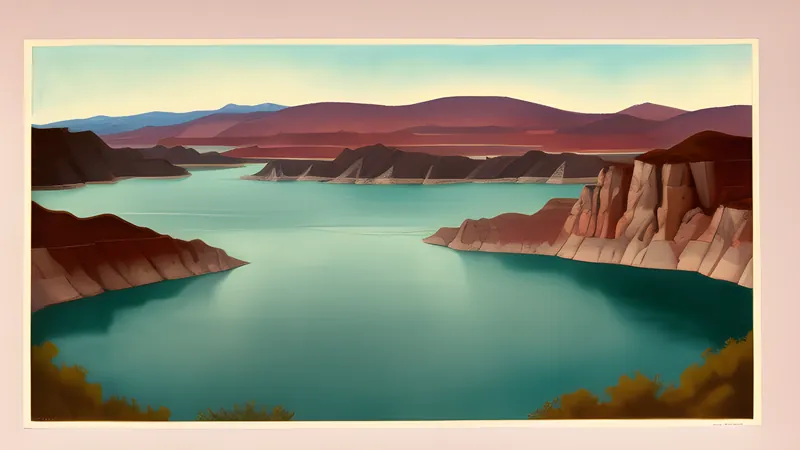
<p>Lake Mead is a man-made reservoir on the Colorado River, straddling the border between Nevada and Arizona about 30 miles south-east of Las Vegas. It was created by the construction of the Hoover Dam, originally called Boulder Dam, which was completed in 1935 and began impounding the river behind a wall of concrete more than 200 metres high. As the water backed up through Black Canyon, it flooded the valley to form what was, at full capacity, the largest reservoir in the country by volume, capable of holding enough water to submerge a state the size of Connecticut under roughly a foot of water. It stretches for well over a hundred miles when full, with a shoreline that winds for hundreds of miles around a maze of desert coves and canyons, and it took years to fill even after the dam was finished.</p>
<p>The lake was named not for an explorer but for Elwood Mead, who served as commissioner of the US Bureau of Reclamation from 1924 to 1936 and oversaw the planning of the Boulder Canyon Project that produced the dam. Mead died in January 1936, only months after the dam that would define his legacy was finished. The reservoir supplies water and hydroelectric power to tens of millions of people across the American South-west, including Las Vegas, Phoenix and parts of Southern California, and irrigates vast tracts of desert farmland. It is one of the load-bearing pieces of infrastructure that made the modern South-west possible.</p>
<h2 id="a-history-of-always-taking-more-than-the-river-gives">A history of always taking more than the river gives</h2>
<p>The Colorado River was over-promised from the very beginning, and that original miscalculation is at the root of everything happening to Lake Mead today. In 1922, seven states signed the Colorado River Compact, dividing the river’s flow between an upper basin and a lower basin. The problem was that the negotiators based their allocations on streamflow measurements taken during an unusually wet stretch of the early twentieth century, and they assumed the river carried substantially more water on average than it actually does. They divided up a river that, in most years, was smaller than the one they thought they were dividing.</p>
<p>For decades this went unnoticed because the reservoirs, Lake Mead and later Lake Powell upstream, held enough of a buffer to paper over the shortfall. But the buffer was always finite. The lake reached its highest recorded level of about 1,225 feet in the summer of 1983, during an exceptionally wet year, and that high-water mark is now a distant memory bleached onto the canyon walls. From roughly the year 2000 onward, the South-west entered a prolonged drought that many scientists describe as a megadrought, the driest multi-decade stretch the region has seen in over a thousand years of tree-ring records, and the structural over-allocation stopped being an accounting curiosity and became a crisis.</p>
<h2 id="why-the-level-is-falling">Why the level is falling</h2><div class="ad-unit ad-in-article" aria-label="Advertisement">
<span class="ad-label">Advertisement</span>
<ins class="adsbygoogle" style="display:block;text-align:center"
data-ad-client="ca-pub-3726833845844946"
data-ad-slot="3291553914"
data-ad-format="auto"
data-full-width-responsive="true"></ins>
<script>(adsbygoogle = window.adsbygoogle || []).push({});</script>
</div>
<p>The decline is not caused by any single villain but by several forces pulling in the same direction. The dominant driver is the long-term drying of the Colorado River basin, itself worsened by a warming climate that both reduces the mountain snowpack feeding the river and increases the rate at which existing water evaporates from the reservoir’s vast surface in the desert heat. Warmer air is thirstier air, and Lake Mead loses an enormous volume every year simply to evaporation off its exposed face.</p>
<p>At the same time, demand has never eased. The population of the South-west has grown relentlessly, agriculture in the lower basin continues to draw its full allocated share, and the compact of 1922 still governs how much each state may take, even as the river delivers less than the treaty assumes exists. The result is a reservoir being emptied faster than it can refill, a slow arithmetic of subtraction that no single wet winter can reverse. This is the same climatic pressure documented in <a href="/story/the-climate-change-chronicles-a-whirlwind-tour-through-earths-wacky-weather-history/">the long story of Earth’s shifting weather</a>, playing out at the scale of a single reservoir that millions of people depend on.</p>
<h2 id="what-the-falling-water-reveals">What the falling water reveals</h2>
<p>The most visible sign of the decline is the bathtub ring, a pale band of mineral deposits staining the rock around the entire shoreline, marking where the water used to reach. By 2022 that ring stood well over 150 vertical feet above the lake surface, a stark measurement of how much had been lost, visible from space in satellite imagery that shows the reservoir shrinking year by year.</p>
<p>The retreat has also uncovered a landscape that had been drowned for the better part of a century. Boats that sank decades ago have re-emerged upright on the dry lakebed. The remains of the town of St Thomas, a Mormon settlement flooded when the reservoir first filled in the 1930s, periodically reappear as the water withdraws, its foundations and chimneys standing in the mud like a ghost town returned. And, most sensationally, the human remains. Beyond the body in the barrel found in May 2022, at least three more sets of human remains surfaced along the shoreline that same year as the water kept dropping, some the apparent victims of drowning accidents, at least one the object of an open homicide investigation. A reservoir, it turns out, is also an archive, and drought is the thing that opens it.</p>
<h2 id="why-it-matters-beyond-nevada">Why it matters beyond Nevada</h2>
<p>It would be a mistake to read Lake Mead as a regional curiosity. The reservoir sits at the centre of a water system that sustains roughly 40 million people and a substantial share of America’s winter vegetable production. When the level approaches critical thresholds, it triggers formal shortage declarations under the rules governing the Colorado River, forcing mandatory cutbacks in the water delivered to Arizona and Nevada first, with California’s larger, senior allocation cut later if the decline continues.</p>
<p>There is also the question of power. Hoover Dam generates hydroelectricity for the surrounding states, and that generation depends on there being enough water pressure behind the dam to spin the turbines. As the lake drops toward what engineers call dead pool, the level below which water can no longer pass through the dam at all, the reservoir’s ability to produce power falls with it. The falling water is not merely a scenic tragedy; it is a threat to the electricity and drinking supply of a large slice of the country, and a live test of whether a region built on the assumption of abundant water can adapt to scarcity. The parallel is hard to avoid with <a href="/story/smoke-on-the-water-the-deep-purple-saga-rocks-resilient-titans/">other resources whose apparent permanence proved illusory once conditions turned</a> — what looks fixed and reliable is often only holding until the underlying conditions shift.</p>
<h2 id="fun-facts">Fun facts</h2>
<ul>
<li>Lake Mead’s high-water mark of about 1,225 feet was set in July 1983; by 2022 the surface had fallen more than 180 feet below that peak, a decline you can read directly off the pale bathtub ring on the canyon walls.</li>
<li>The reservoir was named after Elwood Mead, a bureaucrat who died months after the dam was completed, not after any explorer of the region as is often assumed.</li>
<li>When Lake Mead first filled in the 1930s, it drowned the town of St Thomas, whose ruins now reappear whenever the water drops far enough, effectively un-flooding a town nearly a century after it went under.</li>
<li>The 1922 compact that governs the river was based on flow measurements taken during an unusually wet period, meaning the entire legal framework divides up more water than the Colorado actually carries in a typical year.</li>
<li>The body found sealed in a barrel in May 2022 had been submerged so long that police dated the death to the late 1970s or early 1980s using the style of the victim’s clothing and shoes.</li>
</ul>
<h2 id="a-closing-reflection">A closing reflection</h2>
<p>Lake Mead is often described as a warning, but it is really something more uncomfortable than that: it is a bill coming due. The over-allocation of the Colorado was not a mistake that anyone made recently; it was baked into a treaty signed in 1922 by people who genuinely believed the river was bigger than it was. The reservoir simply hid the consequences for three generations. What the falling water exposes is not only sunken boats and old crimes but the gap between the world the South-west was promised and the one it actually has, and the drained shoreline is where those two finally meet.</p>
Advertisement
Related Content


Advertisement
