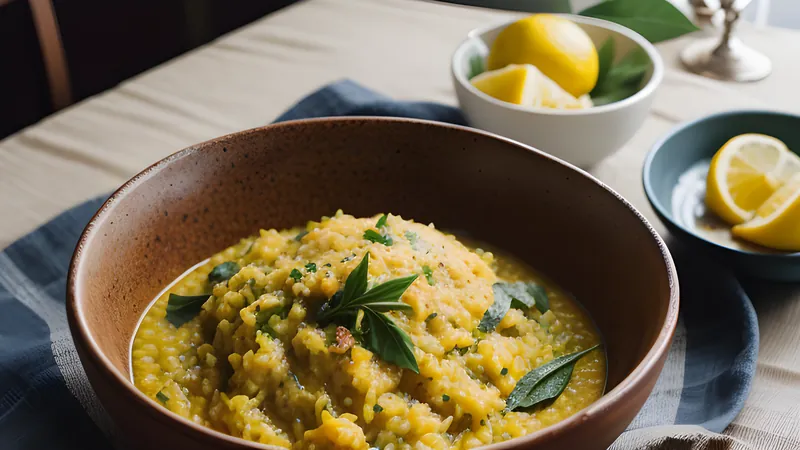
Khichdi with Ghee and Crispy Onion
The one-pot rice and dal that India reaches for when nothing else will do
Contents
↓ Jump to recipeThere is a particular kind of tiredness that khichdi was invented for. Not physical exhaustion so much as the flat, wrung-out feeling at the end of a long day when you want to be fed rather than to eat, when a plate should ask nothing of you. Every household in the subcontinent has a version, and almost every one of them treats it as the food you make when you are unwell, or broke, or simply cannot face the stove for more than twenty minutes of real attention.
That reputation does the dish a disservice. Khichdi is one of the oldest cooked meals in continuous human use — travellers to the Mughal court wrote it down in the fourteenth and fifteenth centuries, and the word itself gave English its “kedgeree” once the Raj got hold of it and bolted on smoked fish and boiled eggs. What survives everywhere is the core idea: rice and a split pulse cooked together until they collapse into each other, seasoned with fat and warm spice. It is nursery food and festival food at the same time, which is a rare thing.
My twist is small and it is the whole point of this recipe. Most khichdi gets a tarka of ghee heated only until the cumin sizzles. I take the ghee a shade further, to the nutty, toasted-hazelnut stage that the French call noisette, before the aromatics go in. That browning gives the finished dish a depth that plain ghee never reaches, and it costs you nothing but thirty seconds of nerve. Crisp fried shallots on top do the rest.
Khichdi with Ghee and Crispy Onion
Ingredients
- 150g basmati rice
- 150g yellow moong dal (split, skinless)
- 4 tbsp ghee, plus extra to finish
- 1 tsp cumin seeds
- 2 cloves garlic, finely sliced
- 2cm piece ginger, julienned
- 1 green chilli, split lengthways
- 10 fresh curry leaves
- 1/2 tsp ground turmeric
- 1.2 litres hot water, plus more as needed
- 1.25 tsp fine salt, or to taste
- 2 banana shallots, very thinly sliced
- 4 tbsp neutral oil, for frying the onion
- juice of 1/2 lemon, to serve
Method
- Rinse the rice and moong dal together under cold water through three or four changes until the water runs nearly clear, then drain.
- Heat 2 tbsp ghee in a heavy pan over medium heat until the milk solids turn nutty brown (noisette), then add the cumin seeds, garlic, ginger, split green chilli and curry leaves and fry for 1 minute.
- Stir in the turmeric for 10 seconds, then add the drained rice and dal and toast, stirring, for 1 minute.
- Pour in 1.2 litres hot water, add the salt, bring to a brisk simmer, then cover and cook on low for 20-25 minutes, stirring occasionally and adding more hot water if it tightens, until soft and creamy.
- Stir in the remaining 2 tbsp ghee off the heat and check the seasoning.
- Meanwhile, fry the sliced shallots in 4 tbsp oil over medium heat for 8-12 minutes until deep amber, then drain on kitchen paper to crisp.
- Serve the khichdi in warm bowls topped with the crisp shallots, an extra knob of ghee and a squeeze of lemon.
What khichdi actually is, and why the ratio matters
Strip away the regional arguments and khichdi is a study in one variable: how much water, and therefore how soft. A drier, fluffier version with grains still distinct is what you want alongside a wet curry. A looser, almost porridge-like bowl — sometimes eaten with a spoon straight from the pan — is the convalescent’s version, and the one I default to. The recipe below lands in the middle, soft and spoonable with the grains just holding their shape.
The pulse is the other decision. Yellow moong dal — split, skinless mung beans — is the classic for a reason. It cooks in roughly the same time as rice, it needs no soaking, and it breaks down into a silky background that carries the ghee. Split pigeon peas (toor dal) make a heartier, earthier khichdi but want a longer cook and ideally an overnight soak. Stick with moong the first time.
I use equal weights of rice and dal here, which gives a properly savoury, dal-forward bowl. If you grew up with a rice-heavier version, shift the ratio to 200g rice and 100g dal and add a touch more water. There is no wrong answer, only your grandmother’s answer.
Method
Rinse the rice and the moong dal together in a sieve under cold running water, swirling with your fingers, until the water runs from cloudy to nearly clear — three or four changes. This washes off loose surface starch and stops the khichdi turning gluey. Leave to drain.
Put a heavy pan or a small casserole over medium heat and add 2 tablespoons of the ghee. Once it has melted, keep it moving and watch it closely: it will foam, the foam will subside, and the solids at the bottom will turn from pale gold to a proper toasted brown, throwing off a smell like warm biscuits. That is noisette. The moment you smell it, add the cumin seeds — they will crackle within seconds — followed by the garlic, ginger, split green chilli and curry leaves. Stand back, because the curry leaves spit. Fry for about a minute until the garlic is pale gold and everything is fragrant.
Stir in the turmeric, let it bloom for ten seconds in the hot fat, then tip in the drained rice and dal. Stir for a minute so every grain is coated and lightly toasted — this is where the finished khichdi gains its backbone of flavour. Pour in the hot water, add the salt, and bring to a brisk simmer.
Turn the heat to low, cover, and cook for 20 to 25 minutes, stirring two or three times to stop it catching, until the dal has broken down and the rice is soft. It should look loose and creamy; if it tightens up before the grains are tender, splash in more hot water, a little at a time. Khichdi thickens dramatically as it sits, so err on the wet side. Stir in the remaining 2 tablespoons of ghee off the heat and taste for salt.
While the khichdi cooks, fry the onions. Warm the neutral oil in a small frying pan over medium heat and add the thinly sliced shallots with a pinch of salt. Fry, stirring often, for 8 to 12 minutes as they go from limp to gold to deep amber. Pull them out just before they look done — they carry on darkening off the heat, and burnt onion is bitter. Drain on kitchen paper, where they crisp as they cool.
Spoon the khichdi into warm bowls, pile the crisp shallots on top, add a final knob of ghee if you are feeling generous, and finish with a squeeze of lemon to lift the whole thing. Eat it hot.
Getting the texture right
The two failures are gluey and dry, and both are avoidable. Gluey khichdi comes from under-rinsed rice or from stirring too hard once it is cooked, which smashes the grains and releases starch; rinse properly and stir with a gentle folding motion. Dry, claggy khichdi comes from too little water or from letting it sit uncovered — always keep a kettle of hot water to hand and loosen it right before serving. The consistency you are after is that of a loose risotto that just holds a soft mound on the spoon.
If you have a pressure cooker or an electric multicooker, khichdi is one of its best uses: do the tarka on the sauté setting, add rice, dal, water and salt, and cook under pressure for about 6 minutes with a natural release. The texture comes out beautifully uniform.
Make it your own
Once the base is second nature, khichdi becomes a canvas. Vegetable khichdi takes to diced carrot, peas, potato and cauliflower, added with the water so they cook through — this is the version most Gujarati households eat on a weeknight. A spoonful of frozen peas stirred in at the end adds colour and a sweet pop. For a richer, spicier bowl, bloom a quarter-teaspoon of asafoetida and a pinch of chilli powder in the tarka alongside the cumin.
The traditional partners are worth knowing. Khichdi with a dollop of thick yoghurt, a spoon of mango pickle and a pile of papad is a complete, deeply satisfying meal — the sharp, salty, crunchy accompaniments exist precisely to play against the soft blandness of the base. A cooling raita works the same way. If you want to lean into the comforting side of things, a scoop of my dal makhani with butter and cream alongside turns a humble bowl into something closer to a feast, and a plate of jeera aloo cumin-fried potatoes gives you the crisp textural contrast the soft khichdi quietly craves.
Storage and reheating
Khichdi keeps in the fridge for three days but sets to a solid block as the starch retrogrades. Reheat it in a pan with a generous splash of water or milk, breaking it up and stirring until it loosens back to a spoonable cream; a fresh knob of ghee revives the aroma. It does not freeze well — the texture turns grainy — so make what you will eat within a few days. Fry the shallots fresh each time if you can, since their whole appeal is the crunch, and store any extras in an airtight jar where they will stay crisp for a couple of days.
A pinch of caution: taste for salt again after reheating, because a spell in the fridge dulls the seasoning noticeably and a cold khichdi always reads blander than a hot one.
This is the meal I make when the fridge is nearly empty and I cannot be bothered, and it is also the meal I make for someone who is under the weather, and somehow it is exactly right in both cases. If you want the celebratory cousin of this dish once you have the technique down, my chicken dum biryani, layered and sealed is where the same rice, treated with far more ceremony, ends up.
Related Content