Khao Soi with Crackling Egg Noodles
Northern Thailand's curried noodle soup, crowned with a fistful of fried egg noodles that stay crisp to the last spoonful
Contents
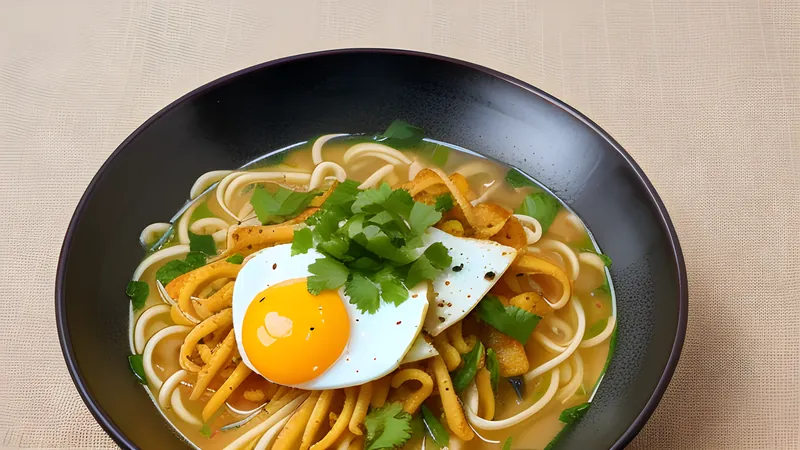
↓ Jump to recipeKhao soi is the dish that separates the food of northern Thailand from the coconut-curry cooking most people associate with the country: a rich, turmeric-gold, curried coconut broth ladled over soft egg noodles, chicken falling off the bone, and — the part that makes it unmistakable — a fistful of the same noodles, deep-fried until they crackle. The twist here is making sure that crown of fried noodles stays properly crisp against the hot broth right up until the last spoonful, by frying them separately, drying them properly first, and adding them at the table rather than the stove.
Khao Soi with Crackling Egg Noodles
Ingredients
- 500g fresh egg noodles, divided
- Vegetable oil, for deep-frying
- 3 tbsp vegetable oil, for the curry
- 4 tbsp khao soi curry paste (shop-bought, or see method for home paste)
- 2 x 400ml tins full-fat coconut milk
- 500ml chicken stock
- 800g bone-in chicken thighs, skin removed
- 2 tbsp fish sauce
- 1 tbsp palm sugar
- 1 tsp ground turmeric
- For the curry paste (if making your own): 6 dried long red chillies, soaked; 2 shallots; 6 garlic cloves; 3cm fresh ginger; 3cm fresh turmeric (or 1 tsp ground); 1 tbsp coriander seeds, toasted; 1 tsp cumin seeds, toasted; 1 tsp shrimp paste
- 4 spring onions, sliced, to serve
- 2 shallots, thinly sliced, to serve
- 2 limes, cut into wedges, to serve
- Pickled mustard greens (Chinese gai choy), chopped, to serve
- Chilli oil, to serve
Method
- If making the curry paste from scratch, drain the soaked chillies and pound or blend them with the shallots, garlic, ginger, turmeric, toasted coriander and cumin seeds and shrimp paste into a smooth, deep orange paste.
- Cook 350g of the fresh egg noodles in boiling water for 1-2 minutes until just tender, then drain, toss with a little oil to stop them sticking, and set aside for serving.
- Take the remaining 150g of raw noodles, loosen the strands apart, and pat them completely dry on a tea towel.
- Heat 4-5cm of oil in a wok or deep pan to 180C. Fry the reserved raw noodles in two batches, using tongs to keep them loosely separated, for 1-2 minutes until golden and crisp. Drain on kitchen paper and set aside; they crisp further as they cool.
- In a large pot, heat the 3 tbsp curry oil over medium heat and fry the curry paste for 3-4 minutes, stirring constantly, until it darkens slightly and smells deeply toasted rather than raw.
- Add a third of one tin of coconut milk and stir until it splits and the oil separates out at the edges, about 2-3 minutes; this step, known as 'breaking' the coconut cream, deepens the flavour.
- Add the remaining coconut milk, the chicken stock, turmeric and chicken thighs. Bring to a bare simmer and cook, uncovered, for 30 minutes until the chicken is tender and the broth has thickened slightly.
- Lift the chicken out, shred the meat off the bone, and return the shredded meat to the pot. Stir in the fish sauce and palm sugar, and taste, adjusting salt and sweetness.
- Divide the boiled noodles between bowls. Ladle over the hot curry broth and chicken.
- Top each bowl with a generous fistful of the crispy fried noodles, sliced shallots, spring onions, chopped pickled mustard greens, a wedge of lime and a spoonful of chilli oil to taste.
The story: Chiang Mai’s borrowed, adapted classic
Khao soi belongs to Chiang Mai and the wider Lanna region of northern Thailand, but its roots run further afield. Food historians trace it to Yunnanese Muslim traders — the Chin Haw, or Hui Chinese — who moved cattle and goods along overland routes between southern China and northern Thailand, Laos and Myanmar, carrying with them a curried noodle dish descended from the same broad family as Burmese ohn no khao swè. Over generations it picked up Thai curry paste technique, Thai coconut milk and Thai chicken, while keeping the double-noodle idea — soft noodles submerged, crisp noodles on top — that marks it out from anything you’d find in Bangkok.
Walk through Chiang Mai’s old city today and khao soi stalls cluster near the moat, each with a pot of curry simmering since dawn and a wok of oil going for the noodle topping. It’s eaten with a specific ritual: squeeze lime over the top, stir in pickled mustard greens for a sour crunch, add raw shallot for sharpness, and a spoon of chilli oil (nam prik pao, or a simple chilli-fried-in-oil) stirred through to taste rather than mixed in wholesale. Every bowl ends up a little different because the diner finishes it, not the cook.
The curry paste is built differently from a green or red Thai curry paste too — it leans on dried chillies rather than fresh, and on warming spice: coriander seed, cumin, turmeric, sometimes a little cinnamon or star anise in family versions, closer in spirit to the spice trade that moved through Yunnan than to the lemongrass-and-galangal pastes of central and southern Thailand. That’s what gives khao soi its distinctive colour and its slightly drier, spicier warmth against the sweetness of coconut milk, setting it apart from a massaman curry, which shares some of the same warming spices but stays a stew rather than a soup.
Well-known Chiang Mai khao soi shops — Khao Soi Mae Sai and Khao Soi Islam among the names most often cited by visiting food writers — tend to specialise in little else, running the same pot of broth for decades and building a following on consistency rather than variety, in the way a good ramen-ya in Japan often does. Islam-run stalls in particular reflect the dish’s Yunnanese Muslim lineage directly: no pork appears anywhere in the dish or the kitchen, chicken and beef are the standard proteins, and the shrimp paste sometimes found in commercial curry pastes is left out of those kitchens’ versions entirely. That detail is worth knowing if you’re sourcing paste rather than making your own and want a more traditional result — a beef- or halal-friendly paste will generally list no shrimp paste on the label, where a general-purpose Thai curry paste almost always will.
The method, explained
Two techniques do the real work here, and neither is difficult once you understand why they matter.
The first is “breaking” the coconut cream — frying the curry paste in oil until it’s toasted and fragrant, then adding just a small amount of coconut milk and letting it bubble until the fat visibly separates back out at the edges of the pan. This looks like the curry has gone wrong, but it’s the opposite: the paste’s oil-soluble aromatics (the chilli, the toasted spice, the shrimp paste’s funk) bind properly into the coconut fat at this stage, in a way they never fully do if you just dump all the coconut milk in at once and simmer. Skipping this step is the single most common reason a home-cooked coconut curry tastes flat and thin compared with a good restaurant version.
The second is the crispy noodle topping, and it lives or dies on moisture. Fresh egg noodles come damp from the packet; frying them wet means the oil spits violently and the noodles steam rather than crisp, going leathery instead of shattering. Pat them properly dry — a tea towel, a few minutes, no shortcuts — and fry in small batches so the oil temperature doesn’t crash, and you get noodles that genuinely crackle, holding their crunch against hot broth for a good five or six minutes, which is roughly how long it takes to eat a bowl at a sensible pace. Frying them well ahead and storing them airtight for the day is fine; frying them the moment the broth’s poured is a mistake, since they need those few minutes to drain and firm up before they go anywhere near liquid.
The recipe
Serves 4. Prep 25 minutes, cook 40 minutes.
For the curry: 3 tbsp oil, 4 tbsp khao soi curry paste, 2 x 400ml tins coconut milk, 500ml chicken stock, 800g bone-in, skinless chicken thighs, 2 tbsp fish sauce, 1 tbsp palm sugar, 1 tsp ground turmeric.
For the noodles: 500g fresh egg noodles, oil for deep-frying.
To serve: sliced spring onions and shallots, lime wedges, chopped pickled mustard greens, chilli oil.
- Boil 350g of the noodles for 1-2 minutes, drain, toss with a little oil, set aside.
- Pat the remaining 150g of raw noodles dry, then deep-fry at 180C in batches for 1-2 minutes until golden and crisp. Drain and set aside.
- Fry the curry paste in the 3 tbsp oil for 3-4 minutes until darkened and fragrant.
- Stir in a third of one tin of coconut milk and cook until the oil splits out, 2-3 minutes.
- Add the rest of the coconut milk, stock, turmeric and chicken. Simmer uncovered 30 minutes.
- Shred the chicken off the bone, return it to the pot, and stir in the fish sauce and palm sugar. Taste and adjust.
- Divide the boiled noodles and broth between bowls, top generously with the crispy noodles and all the garnishes, and serve at once.
Tips, substitutions and storage
Shop-bought khao soi paste (look for it in Asian supermarkets, sometimes labelled just “curry paste for khao soi”) is genuinely good and saves real time; Mae Ploy and Maesri both make reliable versions. If you can’t find fresh egg noodles, dried egg noodles work for both the soft and crispy elements — just boil according to the packet for the soft portion, and dry thoroughly before frying the rest.
Coconut milk quality matters more here than in most curries, because it’s doing double duty as both liquid and the main source of richness rather than being cut heavily with stock. Buy full-fat tins with a high coconut extract percentage if the label states it (look for tins listing 60% or higher coconut extract), and avoid “light” coconut milk entirely — the broth needs the fat content both to carry the curry paste’s aromatics and to give the finished soup its characteristic silky body, and a light version will taste thin and separate rather than glossy no matter how long you simmer it. Bone-in chicken thighs are worth the slightly fussier shredding step over boneless: the bone gives the simmering broth more body over the 30 minutes it spends in the pot, the same reason a good stock always starts with bones rather than trimmed meat alone.
Scaling up for a crowd works well, since the broth only improves with a longer simmer, but fry the crispy noodles in smaller batches regardless of how many people you’re feeding — overcrowding the oil is the one step that doesn’t scale, as it drops the oil temperature and leaves you with soggy rather than crackling noodles.
The curry broth (without noodles) keeps beautifully — refrigerate up to 4 days or freeze up to 3 months, and it often tastes better the next day once the spices have had time to settle. Fried noodles keep crisp in an airtight container at room temperature for a day; do not refrigerate them, since the fridge’s moisture turns them soft. Assemble bowls fresh each time rather than storing the dish complete.
Variations
Beef shin, braised low and slow until it falls apart, is the traditional swap for chicken in many Chiang Mai stalls and suits the curry’s warming spice well — just extend the simmer to around 90 minutes. For a vegetarian version, use a good vegetable stock, swap the fish sauce for soy sauce and a squeeze of extra lime, and simmer firm tofu and sliced shiitake in place of the chicken. And if you’re cooking for a crowd that also loves a bowl of noodles with a fried egg on top, this pairs well on a menu alongside pad krapow with a crispy fried egg — both built on the same idea that something crisp and something soft belong in the same bowl.
Either way, don’t skip the lime and the pickled greens at the table. The curry is rich enough that it needs that last acid stirred in by hand, bowl by bowl.
Related Content