Katsudon: Pork Cutlet and Egg over Rice
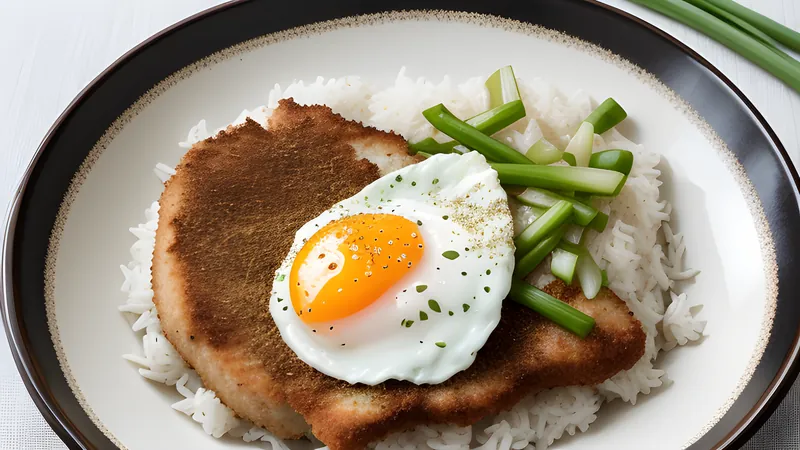
A crisp tonkatsu simmered soft in sweet dashi and bound with barely-set egg
Contents
↓ Jump to recipeThere is a superstition attached to katsudon that I love: Japanese students eat it before an exam because katsu sounds like the verb “to win”. A bowl of fried pork and egg over rice becomes a small edible charm against failure. It is a good story, and it also happens to describe exactly the kind of food this is. Katsudon is a restorative, generous, unfussy bowl, the sort of thing you make when you need cheering up or feeding fast, and it turns a single pork cutlet into a full meal.
The clever part of katsudon is structural. It takes a tonkatsu, a thing prized for being crisp, and deliberately softens one side of it in sweet dashi while keeping the other crunchy. My one twist is to fry the cutlet in a knob of browned butter along with the oil, so the panko toasts a shade deeper and nuttier before it ever meets the broth.
Katsudon: Pork Cutlet and Egg over Rice
Ingredients
- 2 pork loin steaks, about 150g each
- Salt and white pepper
- 3 tbsp plain flour
- 1 egg, beaten, for coating
- 80g panko breadcrumbs
- 20g unsalted butter
- Neutral oil, for frying
- 1 large onion, thinly sliced
- 200ml dashi
- 3 tbsp soy sauce
- 2 tbsp mirin
- 1 tbsp sake
- 1 tbsp caster sugar
- 4 eggs, for the topping
- 2 spring onions, sliced
- 400g cooked short-grain rice, hot
- Shichimi togarashi, to serve
Method
- Season the pork and bash lightly to an even thickness. Coat in flour, then beaten egg, then panko, pressing firmly.
- Toast the panko-coated cutlets first: melt the butter in the frying oil so the crumb browns nutty. Fry at 175C for 3 to 4 minutes per side until deep gold and 63C inside.
- Rest the katsu on a rack, then slice each cutlet across into 2cm strips, keeping the shape.
- In a small, wide pan, simmer the sliced onion in the dashi, soy, mirin, sake and sugar for 5 minutes until soft and sweet.
- Lay one sliced cutlet over the onions in the simmering broth. Beat 2 eggs loosely, leaving streaks of white, and pour two-thirds over the pork and onion.
- Cover and cook for 60 to 90 seconds until the egg is just set but still glossy and soft. Pour over the remaining beaten egg and cover for 20 seconds more.
- Slide the whole thing, egg and pork together, onto a bowl of hot rice. Repeat for the second serving.
- Scatter with spring onion and shichimi and serve at once.
From cutlet culture to comfort bowl
Katsudon belongs to a whole family of Japanese dishes called donburi, meaning “bowl”, where a savoury topping is served over rice. Its parent is tonkatsu, the breaded deep-fried pork cutlet that arrived as part of yoshoku, the wave of Western-influenced cooking that swept Japan after the country reopened to the world in the late nineteenth century. Cutlets, croquettes and curry all entered the Japanese kitchen in that period and were quickly, thoroughly made Japanese.
The egg-bound version is usually credited to Tokyo in the early twentieth century, an inspired bit of thrift that let a restaurant stretch a cutlet and use up the trimmings by simmering everything in a sweet broth and binding it with egg. It spread fast because it solved a real problem: a cutlet on its own is a dry thing that needs a sauce, and the dashi-and-egg does the job while turning one piece of pork into a meal over rice. Regional variations abound, including a sauce-dunked version in Fukui and Komoro that skips the egg entirely, but the egg-bound Tokyo style is the one most people mean.
The cutlet, and the browned butter
Start as you would for any tonkatsu. Bash the pork to an even thickness so it cooks evenly, season it, and set up the standard three-stage coating of flour, beaten egg and panko. Panko is not negotiable here; its large, jagged flakes fry into a coating far crisper and lighter than fine breadcrumbs, and that crispness is what survives the simmering.
Frying the cutlet in oil with a knob of butter added is my small departure. Butter alone would burn at frying temperature, so the oil raises the smoke point and carries the heat, while the butter browns and lends the crumb a toasted, almost biscuity depth. Fry at around 175C for three to four minutes a side, until the crust is deep gold and the interior reaches 63C, then rest the cutlet on a rack so it stays crisp rather than steaming soft on a plate. Slice it across into fat strips before it goes into the broth, keeping the cutlet’s shape so it slides onto the rice in one neat piece.
The simmer and the egg
This is where nerve is required. Everything happens in a small, wide pan, ideally a dedicated oyakodon pan but any little frying pan will do. Simmer the sliced onion in a broth of dashi, soy, mirin, sake and a little sugar until the onion turns translucent and sweet, five minutes or so. The onion matters more than people expect; cooked properly it goes silky and gives the whole bowl its background sweetness.
Lay the sliced cutlet over the onions, then pour over loosely beaten egg. The trick, the entire trick, is to underbeat the egg so streaks of white and yolk remain distinct, and to undercook it so it sets into soft, glossy curds with a few just-liquid pockets. I add the egg in two stages: two-thirds first, cooked covered for a minute, then the last third poured over and given twenty seconds under the lid, so the finished topping ranges from set to barely-there in a single mouthful. Overcook it and you get a rubbery omelette; stop just short and you get silk.
Getting the details right
- Dashi shortcuts. Instant dashi granules dissolved in hot water are entirely respectable here and used in plenty of Japanese home kitchens. A kombu-and-bonito dashi is better if you have it.
- Rice. Short-grain Japanese rice, cooked slightly sticky, is right. Have it hot and ready before you start the egg, because the egg waits for no one.
- One bowl at a time. Cook each serving separately in the small pan. Trying to do two at once gives you unevenly set egg and a crowded pan.
- The sauce balance. The classic ratio is roughly equal soy and mirin with dashi to loosen; taste and add sugar if you like it sweeter, as many Tokyo shops do.
- Chicken version. Swap the pork cutlet for a breaded chicken thigh and you have chicken katsudon; use plain poached chicken and it becomes the closely related oyakodon, “parent and child”, chicken and egg together.
Why the crisp-then-soft contrast works
The genius of katsudon is that it refuses to pick a side in the eternal argument about whether fried food should stay crisp. It has it both ways. The underside of the sliced cutlet, sitting in the broth, drinks up the sweet dashi and turns tender and savoury, almost like a braise. The top edge, poking up through the egg, keeps enough of its panko crunch to give every mouthful texture. That gradient, from sodden-and-flavourful at the bottom to crisp at the top, is the whole reason to slice the cutlet before it goes in rather than serving it whole. Every strip carries the full range.
This is also why timing is so tight. Leave the cutlet in the simmering broth for more than a minute or two and the crisp edge surrenders entirely, and you have lost the contrast that makes the dish. The broth should be barely simmering, the cutlet should go in at the last possible moment, and the egg should follow immediately. From the cutlet hitting the pan to the bowl on the table is under three minutes.
A note on dashi and depth
Dashi is the savoury foundation of Japanese cooking, a quick stock of kombu seaweed and dried bonito flakes that delivers pure umami with almost no effort. It is what gives katsudon its rounded, moreish background, the quality that makes you keep eating past the point of being full. If you make it fresh, steep a strip of kombu in water heated to just below the boil, remove it, then add a handful of bonito flakes off the heat and strain after a couple of minutes. Do not boil the kombu, which turns the stock bitter and slippery. A good dashi is subtle and you will barely notice it as a distinct flavour; you will only notice its absence, in a bowl that tastes flat and one-dimensional however much soy you add.
If you want to master the crisp cutlet that starts all of this, make a proper tonkatsu with shredded cabbage and Bulldog sauce first and simply divert one cutlet into the bowl. And for another bowl built on the same sweet-savoury Japanese seasoning logic, a plate of yaki udon with pork and cabbage uses the very same soy, mirin and dashi backbone to different, brilliant ends. Fry crisp, simmer briefly, and pull the egg off the heat while it still wobbles: do those three things and you have a bowl that genuinely feels like winning.
Related Content