Jollof Rice with a Smoky Party Bottom
West African party-pot jollof, cooked on purpose until the base catches and turns smoky
Contents
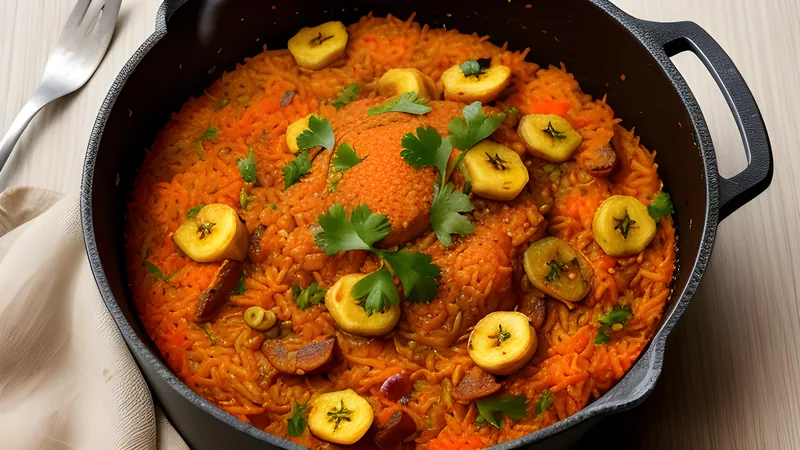
↓ Jump to recipeEvery good pot of jollof rice has a top layer and a bottom layer, and the bottom layer is the one people fight over. Down at the base of the pot, where the rice sits closest to the heat, a thin crust forms once the liquid has cooked away: darker, chewier, faintly smoky, somewhere between a Spanish socarrat and the crackling scrape you get from the bottom of a good Persian tahdig. Home cooks across West Africa call it the party bottom, or the bottom pot, and rather than treating it as an accident to avoid, this version chases it deliberately. The result is rice with two distinct textures in one dish: soft, glossy, tomato-red grains on top, and a caramelised, savoury crust underneath that turns a everyday side dish into something people ask for seconds of.
Jollof Rice with a Smoky Party Bottom
Ingredients
- 3 red bell peppers, roughly chopped
- 1 to 2 scotch bonnet chillies, stalks removed
- 2 onions: 1 roughly chopped, 1 finely chopped
- 1 x 400g tin plum tomatoes
- 3 tbsp tomato purée
- 120ml groundnut or vegetable oil
- 4 garlic cloves, crushed
- 1 thumb fresh ginger, grated
- 2 bay leaves
- 1 tbsp curry powder
- 2 tsp smoked paprika
- 1 tsp dried thyme
- 2 chicken or vegetable stock cubes, crumbled
- 500g long-grain rice, rinsed until the water runs clear
- 750ml hot chicken or vegetable stock
- Salt, to taste
- Fried plantain, to serve
Method
- Blitz the roughly chopped onion, red peppers, scotch bonnet and tinned tomatoes to a smooth purée in a blender.
- Heat the oil in a wide, heavy-based pot over a medium heat and fry the finely chopped onion for 5 minutes until soft.
- Stir in the tomato purée and fry for 3 to 4 minutes until it darkens and loses its raw, tinny smell.
- Pour in the blended pepper mix and simmer uncovered for 20 to 25 minutes, stirring occasionally, until reduced, darkened and the oil separates at the edges.
- Add the garlic, ginger, curry powder, smoked paprika, thyme, bay leaves and crumbled stock cubes, and cook for 5 minutes.
- Tip in the rinsed rice and stir until every grain is coated in the sauce.
- Pour in the hot stock so the liquid sits about 2cm above the rice, season with salt and bring to a boil.
- Cover tightly with foil and then the lid, reduce the heat to the lowest setting and cook undisturbed for 20 minutes.
- Uncover and check the rice: if it is tender but the pot still looks wet, re-cover and cook a further 3 to 4 minutes.
- Once the liquid has gone, raise the heat slightly for a final 3 to 4 minutes to deliberately catch the base, listening for a faint crackle rather than a harsh burning smell.
- Take off the heat, keep the lid on and rest for 10 minutes, then fluff the top layers with a fork, scraping up the smoky base for each serving.
Where jollof comes from, and why nobody agrees on it
Jollof rice traces back to the Wolof people of the Senegambia region, where a dish of rice cooked in a single spiced tomato and pepper sauce, known as thieboudienne in its fish-based form, has been made for centuries. From there the technique spread east along trade routes into what is now Ghana, Nigeria, Sierra Leone, Liberia, Togo, Cameroon and beyond, and every country built its own version around whatever rice, peppers and aromatics were locally abundant. Nigerian jollof leans on long-grain parboiled rice and a heavy tomato base; Ghanaian jollof traditionally favours a fragrant basmati and a slightly different balance of spice; Senegalese thieboudienne keeps closer to its fish-stew roots. All of them are, at heart, the same idea: rice cooked directly in a rich pepper sauce so the starch absorbs the flavour rather than sitting alongside it.
This shared ancestry is exactly what fuels the so-called Jollof Wars, the long-running, mostly good-natured rivalry between Nigeria and Ghana over whose version is better, which flares up reliably at weddings, on social media and occasionally in the pages of the British press when a Nigerian and Ghanaian restaurant happen to sit on the same high street. Chefs have cooked it out on television, diplomats have joked about it at state dinners, and neither side has ever conceded an inch. This recipe does not attempt to settle it. It borrows the Nigerian preference for parboiled long-grain rice and a bold tomato-pepper base, because that is the version most forgiving of a British kitchen and the one that takes best to the deliberately scorched bottom this recipe is built around, but the technique of building a thick pepper sauce first and cooking the rice inside it, rather than boiling it separately, is common ground across the whole region and the real point of the dish.
Why the pepper base matters more than anything else
The single biggest determinant of how good your jollof will taste is not the rice, the stock or even the spice mix. It is how thoroughly you cook the pepper-tomato base, sometimes called the stew or the sauce, before the rice ever goes in. Blitzed raw peppers and tomatoes taste sharp, watery and faintly bitter, and if you rush this stage that raw edge carries straight through into the finished dish. Frying the tomato purée until it visibly darkens drives off its tinned, metallic notes and starts the Maillard reaction that builds real savoury depth. Then simmering the full blended pepper mix, uncovered, for a full twenty minutes or more, reduces it until the water has cooked off, the colour has deepened from bright orange-red to a burnished brick, and the oil visibly separates and pools at the edges of the pot. That separation is the tell that the base is properly cooked: it means the tomatoes and peppers have given up their water and the flavour is now concentrated rather than diluted. Skip this stage, or hurry it because you are hungry, and no amount of seasoning afterwards will save the rice.
Chasing the party bottom on purpose
Once the rice has absorbed the sauce and steamed through, most recipes tell you to take the pot straight off the heat to avoid burning. This one asks you to do the opposite for the last few minutes. Once the visible liquid has disappeared and the rice on top looks dry and separate rather than wet, raise the heat under the pot slightly rather than lowering it. What happens at the base is the rice grains touching the hot metal lose their remaining moisture fast, their surface starches caramelise, and a thin, dark, chewy layer forms that tastes of toasted rice and concentrated tomato rather than plain starch. This is the same chemistry behind a good paella crust or the crisp base of Persian rice: contact heat plus low residual moisture equals a Maillard crust rather than plain steaming.
The line between smoky and simply burnt is narrow, so use your nose more than the clock. A properly caught base smells nutty and faintly toasted, like the crust on good flatbread; a burnt one smells acrid and bitter, and that bitterness will leach up into the whole pot if you leave it too long. Two or three minutes at slightly raised heat is usually enough once the moisture has gone, and a wide, heavy-based pot helps enormously here because it spreads the heat evenly and gives you a bigger, more even crust than a narrow, thin-walled saucepan, which tends to scorch unevenly in hot spots. If you smell any sharp, acrid note, pull the pot off the heat immediately rather than waiting to see if it improves; it will not.
The method in full
Start by blending the roughly chopped onion, red peppers, scotch bonnet and tinned tomatoes to a smooth purée; a jug blender gives a finer, more even sauce than a food processor. In your widest heavy-based pot, fry the finely chopped onion in the oil for five minutes until soft, then stir in the tomato purée and fry it on its own for three to four minutes until it darkens noticeably, which cooks out its raw edge before the wetter ingredients dilute it. Pour in the blended pepper mix and simmer it uncovered, stirring every few minutes, for twenty to twenty-five minutes, until it has reduced by roughly a third, deepened in colour and started to release oil at the edges of the pot. Stir in the garlic, ginger, curry powder, smoked paprika, thyme, bay leaves and crumbled stock cubes and cook for five minutes to let the spices bloom in the hot oil.
Add the rinsed rice, stirring until every grain is coated in the red sauce, then pour in the hot stock so the liquid sits roughly two centimetres above the rice. Season with salt, bring to a boil, then cover tightly, foil first and then the lid for the best seal, and turn the heat right down to the lowest setting your hob offers. Resist the urge to lift the lid for a full twenty minutes; every peek lets steam escape and the rice cooks unevenly as a result. After twenty minutes, check: if the rice is tender but there is still visible moisture, re-cover and give it a few more minutes. Once the pot looks dry on top, that is the signal to raise the heat slightly and chase the crust, two to four minutes, nose alert for that toasted rather than acrid smell. Take it off the heat, keep the lid on, and let it rest for a full ten minutes before you touch it; this settles the steam and firms up the crust so it lifts cleanly rather than crumbling.
Getting it right: rice, ratios and rescue moves
Parboiled long-grain rice is worth seeking out specifically, since its partially precooked starch holds its shape through the long simmer without turning to mush, unlike ordinary long-grain, which can. Rinse it under a cold tap, working the grains between your fingers, until the water runs close to clear; this washes off surface starch that would otherwise make the finished rice gluey rather than separate. If you only have basmati, it will still work and gives a lighter, more fragrant result closer to a Ghanaian-style pot, but watch the cooking time closely, since it cooks faster and scorches sooner.
If the rice is cooked through but you cannot get a crust to form because there is still liquid in the bottom of the pot, the fix is more time with the lid off at a gentle simmer to drive off the last of the moisture before you attempt the final scorch, rather than more heat straight away. Conversely, if you catch a bitter smell early, do not panic: take the pot straight off the heat, and once the rice has rested, gently lift out the top layers without disturbing the very base, leaving the over-caught bit behind rather than stirring its bitterness through the whole dish.
Pot shape genuinely changes the outcome here. A wide, shallow, heavy-based casserole gives you a broad, thin crust across most of the base, which is what most home cooks in Lagos or Accra are actually working with, since it means more people get a piece of it. A tall, narrow pot concentrates the same amount of rice into a deeper layer, which cooks more evenly through the middle but gives you a smaller crust relative to the volume of rice, so if you are choosing a pot specifically for this recipe, go wider rather than deeper. If your only pot is narrow, you can still get a good result, just expect the crust to be thicker in a smaller area rather than thin and widespread.
Scaling up and variations
This recipe scales easily for a genuine party crowd: doubling the rice and stock works cleanly as long as your pot is wide enough that the rice sits no more than about five centimetres deep, since a deeper layer struggles to cook through evenly before the base scorches. For very large batches, some cooks finish the rice in a low oven, around 160°C fan, for the last stretch instead of on the hob, which gives steadier, more even heat across a wide pot, though you lose some control over exactly when the crust catches and need to check it more often through the final ten minutes.
For a vegetarian party pot, swap the stock cubes for vegetable ones and the stock for vegetable stock, and stir through a tin of black-eyed peas or a couple of handfuls of sweetcorn once the rice is nearly done for extra substance. A smokier, more Ghanaian-leaning version swaps the curry powder for a touch more thyme and a pinch of grated nutmeg, and uses basmati in place of the parboiled long-grain, though watch it closely, since basmati cooks faster and can scorch before the flavours have had time to develop fully. Leftover jollof also makes exceptional fried rice the next morning: crumble cold rice into a hot, oiled pan with a beaten egg and any leftover vegetables, and fry hard until it starts to catch at the edges again, chasing that same crust a second time.
Serving, storage and what goes alongside
Jollof is properly a party dish, built to feed a crowd from one enormous pot, and it wants equally bold company: fried plantain is close to essential, its caramel sweetness a perfect foil for the rice’s heat, alongside grilled chicken or fish. If you want a peanut-forward main to sit beside it, my suya with a peanut-spice crust shares the same smoky, charred instincts and comes together on a griddle in well under half an hour, and a bowl of egusi soup with ground melon seed and greens makes a genuinely traditional pairing if you want to serve two West African dishes at the same table.
Leftovers keep for three days in the fridge in an airtight container and reheat well in a pan with a splash of water to loosen the grains, though the crust will soften on reheating no matter how carefully you do it, so eat that part fresh if you can. The dish also freezes for up to two months; thaw it fully before reheating for the best texture. However you serve it, cook it for someone you actually want to feed, because a pot this size deserves an audience.
Related Content