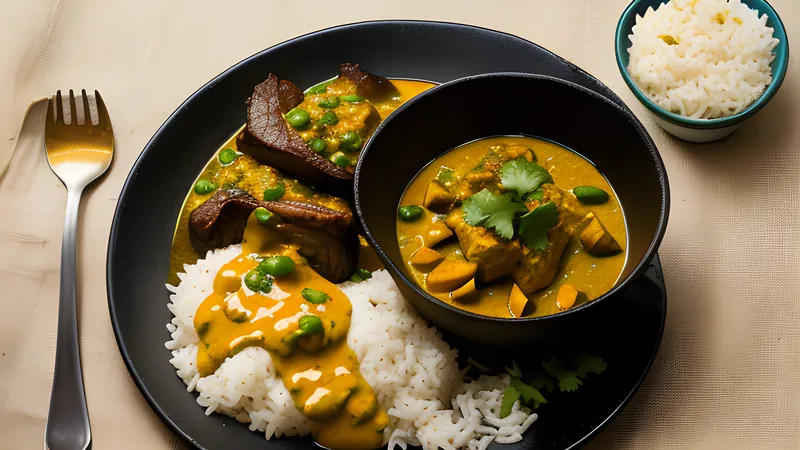
Jamaican Curry Goat with Toasted Curry Powder
Blooming the curry powder in oil before the braise, for a rounder, less raw heat
Contents
↓ Jump to recipeCurry goat lives or dies on one small, often-skipped step: toasting the curry powder in oil before it ever touches the meat or the pot liquid. Most recipes stir the powder straight into the marinade, where it stays raw and a little chalky no matter how long the braise runs. Blooming a portion of it separately in hot oil first, until it darkens and turns properly fragrant, gives the finished gravy a roundness and depth that a purely raw application never reaches — the difference between a curry that tastes assembled and one that tastes cooked.
Jamaican Curry Goat with Toasted Curry Powder
Ingredients
- 1.8kg bone-in goat meat (shoulder or leg), cut into 4cm chunks
- 5 tbsp Jamaican curry powder, divided
- 2 tsp ground allspice
- 1 scotch bonnet chilli, left whole and pierced once (or finely chopped for more heat)
- 6 spring onions, chopped
- 1 large onion, diced
- 6 garlic cloves, finely chopped
- 4cm ginger, finely grated
- 2 tbsp fresh thyme leaves
- 4 tbsp vegetable oil, divided
- 1 litre chicken or beef stock, plus more as needed
- 3 medium potatoes, peeled and cut into 4cm chunks
- 1 tsp fine salt, plus more to taste
- Freshly ground black pepper
- Cooked white rice or rice and peas, to serve
Method
- Pat the goat meat dry and toss it in a bowl with 3 tablespoons of the curry powder, the allspice, half the garlic, half the ginger, half the thyme and 1 teaspoon salt, working the spices into the meat with your hands. Cover and marinate in the fridge for at least 2 hours, ideally overnight.
- Heat 2 tablespoons of the oil in a large, dry, heavy-based pot or Dutch oven over medium heat. Add the remaining 2 tablespoons of curry powder and toast, stirring constantly, for 60-90 seconds until it darkens slightly and smells deeply toasted and nutty rather than dusty; watch it closely, as it can go from toasted to burnt in seconds.
- Remove the toasted curry powder from the pot and set aside; wipe the pot if needed.
- Heat the remaining 2 tablespoons of oil in the same pot over medium-high heat. Working in batches so the pot isn't crowded, brown the marinated goat pieces well on all sides, about 8-10 minutes per batch, then set aside.
- Reduce the heat to medium, add the diced onion to the pot and cook for 6-8 minutes until soft and golden, scraping up any browned bits from the base.
- Add the remaining garlic, ginger and thyme, along with the toasted curry powder, and stir for 1 minute until fragrant.
- Return the browned goat to the pot along with any resting juices, then add the stock and the whole scotch bonnet. Bring to a simmer, cover, and cook on low for 1.5-2 hours, stirring occasionally and adding more stock if it reduces too far, until the meat is fully tender and pulling easily from the bone.
- Add the potatoes and spring onions, and simmer uncovered for a further 25-30 minutes until the potatoes are tender and the sauce has thickened to a rich gravy.
- Remove the scotch bonnet before serving unless you want the option of a small taste of its heat; taste the sauce and adjust salt and black pepper.
- Serve hot over rice or rice and peas.
Where this comes from
Curry goat is central to Jamaican celebration food — weddings, christenings, big Sunday gatherings — and its ingredients trace two separate migrations that met on the island. Goat itself has long been raised across the Caribbean and West Africa and was already part of the diet of enslaved Africans and their descendants in Jamaica. Curry powder arrived later, brought by indentured labourers from India who came to Jamaica after the abolition of slavery in 1838, when plantation owners looked for a new source of cheap labour; between roughly 1845 and 1917, tens of thousands of Indian workers settled on the island, and Jamaican curry powder, a distinct blend heavier on turmeric and allspice than most Indian masalas, developed from that community’s cooking traditions blending with what was locally available.
The dish that resulted, goat slow-braised in that curry powder with scotch bonnet, thyme and allspice, is genuinely Jamaican rather than a copy of anything Indian — it’s built on local ingredients and a local spice logic, allspice in particular giving it a warmth that marks it out from a South Asian curry immediately. Goat is prized here for a reason beyond tradition: it’s a lean meat with plenty of connective tissue running through cuts like shoulder and leg, and that tissue, mostly collagen, breaks down slowly over a long, moist braise into gelatine, which is what gives a properly cooked curry goat its rich, almost sticky-textured gravy and its meat that pulls apart rather than needing to be cut.
Curry goat’s place at the centre of Jamaican celebration cooking is hard to overstate. It’s the dish most likely to appear at a wedding reception or a christening lunch, cooked in enormous batches over wood fire in huge outdoor pots for gatherings running to hundreds of guests, and it has its own competitive circuit: town fetes and church fundraisers judge curry goat cook-offs on precisely the balance this recipe chases — meat tender enough to fall off the bone, a curry that doesn’t taste raw or chalky, and a gravy thick enough to cling to rice without slumping into a thin soup. Outside Jamaica, curry goat is a fixture of Caribbean takeaways and roti shops across London, Toronto and New York, and it’s often listed on menus as “curry mutton” even when the meat is genuinely goat — an old, persistent naming overlap in Jamaican English that has never quite gone away and still causes the odd confused order.
Why the curry powder gets toasted twice
This recipe uses curry powder in two separate applications, and each one is doing different work. The first portion goes into the raw marinade with the meat, where it has hours, ideally overnight, to slowly penetrate the goat alongside the salt, garlic and ginger — this stage is about seasoning the meat itself, not about building the sauce’s flavour, and raw spice works fine here because it has time on its side.
The second portion is bloomed separately, in hot oil, before it meets anything else. Curry powder is a blend of ground, already-dried spices — turmeric, coriander, cumin, fenugreek and more — and like any ground spice mix, its flavour compounds are largely fat-soluble, meaning they dissolve and disperse far more fully into hot oil than they ever would sitting in a watery braise. Toasted dry (or in a small amount of oil) over direct heat for a minute or so, those compounds also undergo their own version of a Maillard-adjacent reaction, deepening and turning nuttier, richer and less sharply raw than the same powder used straight from the jar. Skip this step, as many home recipes do, and the final gravy tastes correctly spiced but somehow flat, missing the toasted backbone a good curry house sauce has. Watch this stage closely regardless of method: curry powder is mostly fine, dry ground spice, and it scorches within seconds of turning fragrant, tipping from toasted to bitter almost without warning.
Browning the goat itself, in batches so the pot never overcrowds and steams, adds a third layer of the same principle: real Maillard colour on the meat’s surface before it ever meets the braising liquid, building a foundation of roasted flavour that a long simmer alone can’t produce, no matter how many hours it runs.
Cooking the goat bone-in matters beyond tradition, too. Marrow and the connective tissue clinging to the bone contribute body and a subtle richness to the braising liquid that boneless meat alone can’t match, which is a large part of why a good curry goat gravy has a slight cling and depth that a curry made from, say, stewing steak never quite reaches. It’s worth asking a butcher for bone-in shoulder or leg specifically rather than accepting whatever’s pre-cut in the chiller, since supermarket goat, where it’s stocked at all, is sometimes sold boneless for convenience.
The recipe
Serves 6.
Ingredients
- 1.8kg bone-in goat meat, cut into 4cm chunks
- 5 tbsp Jamaican curry powder, divided
- 2 tsp ground allspice
- 1 scotch bonnet, whole and pierced
- 6 spring onions, chopped
- 1 large onion, diced
- 6 garlic cloves, chopped
- 4cm ginger, grated
- 2 tbsp fresh thyme leaves
- 4 tbsp vegetable oil, divided
- 1 litre stock
- 3 medium potatoes, chunked
- 1 tsp salt, plus more to taste
- Black pepper
Method
- Marinate the goat with 3 tbsp curry powder, allspice, half the garlic, ginger and thyme, and salt, for at least 2 hours or overnight.
- Toast the remaining 2 tbsp curry powder in 2 tbsp oil for 60-90 seconds until darkened and fragrant; set aside.
- Brown the goat in batches in the remaining oil.
- Soften the onion, then add the remaining garlic, ginger, thyme and the toasted curry powder; cook 1 minute.
- Return the goat, add the stock and scotch bonnet, cover, and simmer on low 1.5-2 hours until tender.
- Add the potatoes and spring onions, simmer uncovered 25-30 minutes.
- Remove the scotch bonnet, adjust seasoning, and serve over rice.
Tips, substitutions and storage
Goat can be hard to find outside Caribbean or halal butchers; lamb shoulder or mutton are the closest and most traditional substitutes, cooked exactly the same way, though goat’s leaner meat and firmer texture do give a slightly different result. A whole, unpierced scotch bonnet added and removed at the end gives real flavour with manageable heat; pierce it once for a touch more, or chop it in for genuine fire — taste as you go, since heat varies wildly between individual chillies. Not all curry powders behave the same way here either: Jamaican brands such as Betapac or Blue Mountain are formulated specifically with the allspice-forward, turmeric-heavy profile this dish expects, and they toast differently to a generic supermarket blend, which tends to be milder and more finely ground and can scorch faster given the same 60 to 90 seconds. If using a generic curry powder, watch the toasting step even more closely and consider boosting the ground allspice slightly to compensate for the flatter base flavour. Curry goat keeps beautifully: refrigerate up to four days, or freeze for three months, and like most long braises it’s genuinely better the day after, once the sauce has had time to settle into the meat.
This dish sits well alongside jerk chicken for a full Caribbean spread, and the same slow, spice-bloomed braising logic runs through doro wat, if you want to see the same principle — a spice paste bloomed in fat before the braise — applied on another continent entirely.
Variations
Some Jamaican households add a tin of butter beans in the final 15 minutes, which soak up the gravy and stretch the dish for a crowd. A drier, more concentrated version — cooked uncovered for longer at the end, until the gravy reduces to a thick coating rather than a pourable sauce — is common for serving over festival or hard dough bread rather than rice. Some households finish the pot with a splash of coconut milk in the last ten minutes for a rounder, slightly sweeter gravy; it’s uncommon in some kitchens, though widespread enough to count as a legitimate regional variation. Curry goat is also almost always served with rice and peas rather than plain rice for a proper Sunday table, the kidney beans and coconut-cooked rice adding their own savoury backbone underneath the curry. However the pot ends up, the toasted curry powder stage is worth protecting in any version: it’s a sixty-second step that changes the entire character of the finished gravy.
Related Content