Horchata with Toasted Cinnamon and Almond
Rice milk with a deep, smoky-sweet backbone from charred cinnamon bark
Contents
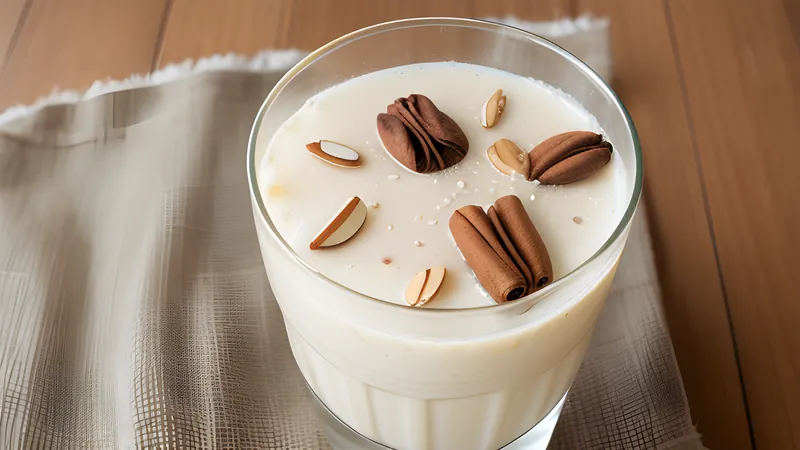
↓ Jump to recipeMost horchata I have been served in the last decade tastes of sugar first and rice a distant second, with the cinnamon reduced to a polite dusting on top. This version puts the cinnamon back at the centre of the drink, where it belongs, by toasting the bark hard enough to blister and char at the edges before it ever meets water. The almonds get the same treatment. The result is a horchata that tastes toasted and faintly smoky underneath the milky sweetness, closer to what you get from a good Mexican market stall than anything poured from a jug at a taqueria counter.
Horchata with Toasted Cinnamon and Almond
Ingredients
- 200g long-grain white rice
- 2 cinnamon sticks, ideally Mexican canela
- 60g whole blanched almonds
- 1 litre water, plus 750ml for the second blend
- 400ml whole milk (or oat milk for dairy-free)
- 100g caster sugar, or to taste
- 1 tsp vanilla extract
- Pinch of fine salt
- Ice, to serve
- Ground cinnamon, to serve (optional)
Method
- Toast the cinnamon sticks in a dry frying pan over medium heat for 2 to 3 minutes, turning often, until fragrant and the edges are lightly charred and blistered.
- Add the almonds to the same hot pan and toast for a further 2 minutes, shaking constantly, until golden and smelling nutty; tip both out onto a plate to cool slightly.
- Break the toasted cinnamon into a few pieces and blitz with the almonds and rice in a blender for 20 to 30 seconds to a coarse rubble.
- Tip into a large jug or bowl, pour over the 1 litre of water, stir once, cover and leave to steep at room temperature for at least 4 hours, or overnight in the fridge.
- Pour the whole soaked mixture, liquid and all, back into the blender with the extra 750ml water and blend on high for a full 2 minutes until milky and smooth.
- Strain through a fine-mesh sieve lined with muslin or a clean tea towel, or a nut-milk bag, squeezing hard to extract as much liquid as possible; discard the solids.
- Whisk the milk, sugar, vanilla and salt into the strained horchata until the sugar has fully dissolved.
- Chill for at least 1 hour, stir well (it separates on standing) and serve over ice, dusted with ground cinnamon if you like.
Rice milk with a long memory
Horchata’s name and its rice-and-water logic both trace back to a drink that has nothing to do with Mexico. The original, horchata de chufa, is made in Valencia from tiger nuts (small, earthy tubers, unrelated to true nuts despite the name), and it has been sold from stalls there since at least the Middle Ages, with some accounts pushing its roots back to the Moorish period in Spain. Spanish colonists carried the idea, if not the tiger nuts, across the Atlantic, and cooks in Mexico and Central America adapted it to what grew locally: rice, in most of Mexico; melon seeds in parts of Central America; even barley in some regional versions. Rice horchata as we know it today, sweet, milky, spiced with cinnamon, is largely a Mexican invention layered onto a much older Iberian template, and it has been sold from clay jars (ollas de barro) at markets and street corners for generations, the porous clay keeping the drink cool through evaporation the way it always has.
Every region has its own ratio and its own extras. Some cooks add a little rice flour for body, others blend in a few tablespoons of condensed milk instead of sugar and dairy, and Oaxacan versions sometimes fold in ground melon seed for a nuttier finish. What almost never changes is cinnamon, specifically canela, the softer, more fragrant Ceylon cinnamon that is the default in Mexican kitchens rather than the harder, more assertive cassia bark sold as “cinnamon” in most UK supermarkets. If you can find canela (look in Latin American grocers or the international aisle, sometimes labelled “true cinnamon” or “Ceylon cinnamon”), use it here; it toasts to a softer, more floral char and is easier to blitz in a blender because the bark is thin and papery rather than dense.
Rice is the Mexican default, but it’s worth knowing horchata is a category rather than a single fixed drink across Latin America. In El Salvador and parts of Guatemala, the classic version is horchata de morro, which skips rice entirely in favour of ground morro seeds (a small, hard seed from the jícaro gourd tree) toasted and blended with a spice mix that usually includes cinnamon and sometimes cacao, and it is sold everywhere pupusas are, from market stalls to petrol stations. The Dominican Republic and parts of the Caribbean lean toward a coconut-and-rice version closer in spirit to this recipe’s own coconut milk instinct. What unites all of them is the same basic logic: a starchy or oily base, ground fine, steeped and strained into a milky drink carried by warm spice.
Why toasting changes everything
Raw cinnamon bark and raw almonds both taste of very little beyond a faint sweetness and a vague nuttiness. Heat is what unlocks them. Dry-toasting the cinnamon in a hot pan drives off surface moisture and starts the Maillard reaction across the bark’s edges, the same browning reaction that turns bread crust from pale to deeply flavoured, and it also volatilises the essential oils bound up in the bark’s resin, specifically cinnamaldehyde, so they bloom into the air and onto the surface rather than staying locked inside. A few seconds too far and those oils scorch bitter, which is why the char here is deliberate but light: aim for blistered, dark edges while the bark itself stays well short of fully black and acrid. Two to three minutes over medium heat, turning it so it browns evenly, is the window.
The almonds do similar work but along a different path. Raw almonds carry a green, slightly grassy flavour that toasting converts into something warmer and more rounded, again through Maillard browning of the natural sugars and proteins at the nut’s surface. Toasted almonds also release more of their oil into the blend, which is exactly what gives this horchata its characteristic silky, slightly creamy mouthfeel even before the milk goes in. Toast them straight after the cinnamon, in the same hot pan, so you are not dirtying a second pan and so the almonds pick up a faint trace of the cinnamon oils left behind.
The long steep matters as much as the toasting. Four hours minimum, overnight for preference, gives the rice starch time to soften and the toasted flavours time to migrate fully into the water rather than sitting on the surface. Skip the steep and blend everything straight away, and you get a thinner, grittier horchata that tastes more of raw rice than of cinnamon.
If the finished horchata still tastes gritty or thin after straining, the fix is almost always more steeping time or a second pass through the sieve rather than a different ratio of rice to water — a domestic blender rarely pulverises soaked rice as finely as the stone mills used in Mexican markets, so a weaker blender leans harder on the steep to soften the starch and on a firm double-strain to catch what the blades left behind. Cloth strains cleaner than a metal sieve alone; if you only have a sieve, line it with a few layers of kitchen paper for the final pass.
The recipe, step by step
Toast two cinnamon sticks in a dry frying pan over medium heat, turning them every 20 seconds or so, until fragrant and lightly charred at the edges, about 2 to 3 minutes. Add 60g whole blanched almonds to the same pan and toast for a further 2 minutes, shaking constantly so they colour evenly rather than catching in one spot. Tip both out to cool for a minute, then break the cinnamon into two or three pieces and blitz it with the almonds and 200g long-grain rice in a blender for 20 to 30 seconds, until you have a coarse rubble rather than a fine powder.
Tip this into a large jug, pour over 1 litre of water, stir once, cover, and leave at room temperature for at least 4 hours, or in the fridge overnight. The water will turn cloudy and faintly beige as the rice starch and toasted oils release.
Blend the whole soaked mixture, water and all, with a further 750ml water for a full 2 minutes on high speed. You want the rice broken down as far as possible; a weak blender may need an extra minute. Strain through a fine sieve lined with muslin, a clean tea towel or a nut-milk bag, squeezing hard, because a surprising amount of the flavour is trapped in the solids and only comes out under real pressure. Discard the pulp (or save it; see below).
Whisk in 400ml whole milk, 100g caster sugar, a teaspoon of vanilla extract and a small pinch of salt, tasting as you go since sweetness preference varies a lot here. Chill for at least an hour before serving over ice, and give it a stir first: horchata separates on standing, the rice solids settling toward the bottom, and a quick shake or stir brings it back together.
Tips, substitutions and storage
Horchata keeps in the fridge for 3 to 4 days in a sealed jar or bottle, though it is at its best in the first 48 hours while the toasted aroma is still bright. It separates every time it sits, which is normal; shake before pouring rather than worrying about it.
For a dairy-free version, swap the whole milk for oat milk, which has enough body to stand in for dairy without tasting thin; almond milk is a slightly odd choice here since the drink already carries almond flavour from the toasted nuts, though it works fine if that is what you have. If you cannot find canela, cassia bark is a perfectly good substitute; it toasts a shade harder and more peppery, so pull it from the pan a little earlier.
Do not throw the strained pulp away without a thought. Blitzed again with a splash of milk and a spoon of sugar, it makes a rough rice pudding, or stir it into porridge the next morning; it still carries plenty of the toasted cinnamon flavour.
Plain long-grain white rice is the right choice here rather than basmati or jasmine, whose stronger scent competes with the toasted cinnamon rather than staying out of its way; short-grain rice works too and blends down slightly softer. For sweetener, piloncillo (unrefined Mexican cane sugar, sold in hard cones) dissolved into the warm strained liquid before it’s chilled gives a deeper, faintly molasses note that caster sugar can’t match, and it’s the version you’re more likely to find at a proper market stall. This recipe is naturally gluten-free as written, since rice and almonds carry no gluten, which is worth knowing if you’re serving a mixed crowd alongside the churros suggested below.
Variations
A shot of strong cold-brew coffee stirred into a glass of finished horchata, over ice, makes a “horchata latte” that tastes like a Mexican answer to a Vietnamese ca phe sua da, rice sweetness standing in for condensed milk. For a boozier version, a measure of dark rum or spiced rum stirred through a glass turns this into a proper dessert drink. And it is the natural partner to a plate of churros fresh from the fryer, the cold, cinnamon-toasted milk cutting straight through the hot sugar and oil.
However you serve it, the point of toasting the cinnamon and almonds this hard is that the drink stops being background sweetness and starts tasting like something was actually cooked to make it. That is the whole difference, and it takes about five minutes at the stove.
Related Content