Hong Shao Rou: Red-Braised Pork Belly
Glossy, caramel-dark pork, braised low and slow
Contents
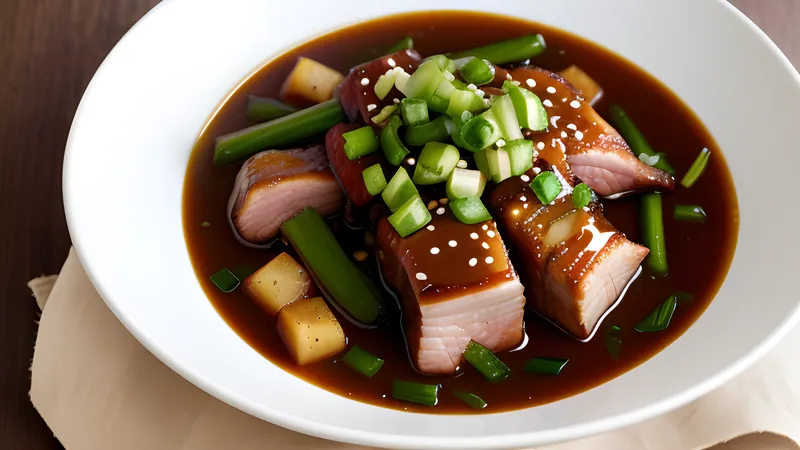
↓ Jump to recipeHong shao rou is deceptively simple on paper, pork belly, soy, sugar, a handful of aromatics, and yet it’s one of the dishes Chinese home cooks argue about most fiercely, because everyone has a strong opinion about the caramel. My version leans on a proper rock-sugar caramel cooked slowly to a deep amber before the pork ever touches the pot, rather than the shortcut of dumping in soy sauce and sugar together and hoping for the best. That caramel is the difference between a braise that’s merely brown and one that’s a genuine, glossy mahogany, with a faint bitter edge underneath the sweetness that makes the whole dish taste layered rather than one-note.
Hong Shao Rou: Red-Braised Pork Belly
Ingredients
- 1kg pork belly, skin on, cut into 3cm cubes
- 2 tbsp neutral oil
- 60g rock sugar (or caster sugar), roughly crushed
- 3 slices fresh ginger, plus 1 tbsp finely chopped
- 3 spring onions, cut into 5cm lengths, plus extra sliced to garnish
- 3 star anise
- 1 cinnamon stick
- 2 bay leaves
- 1 tsp Sichuan peppercorns
- 3 tbsp Shaoxing rice wine
- 2 tbsp light soy sauce
- 1 tbsp dark soy sauce
- 500ml hot water, plus more as needed
- 1 tsp salt, to taste
- Steamed rice and blanched greens, to serve
Method
- Bring a large pan of water to the boil, add the pork belly cubes and blanch for 3 minutes to remove scum, then drain and rinse under cold water; pat dry thoroughly.
- Heat the oil in a heavy-based pot or wok over medium-low heat, add the crushed rock sugar and cook, stirring constantly, for 4 to 6 minutes until it melts and turns a deep amber, almost like dark honey.
- Add the pork belly immediately and toss quickly to coat every piece in the caramel before it hardens, cooking for 2 to 3 minutes until the pork is glazed and lightly browned.
- Add the ginger slices, spring onion lengths, star anise, cinnamon, bay leaves and Sichuan peppercorns, stir for 1 minute until fragrant.
- Pour in the Shaoxing wine and let it bubble off for 30 seconds, then add the light and dark soy sauce and stir to coat.
- Pour in the hot water so the pork is just covered, bring to a simmer, then reduce the heat to low, cover, and braise gently for 60 to 75 minutes, checking occasionally and topping up with a little hot water if it reduces too fast.
- Uncover for the final 15 to 20 minutes and raise the heat slightly to reduce the sauce until it thickens and clings to the pork in a dark, glossy coat.
- Taste and add salt if needed, discard the whole spices and ginger slices if you like a cleaner presentation, then scatter with the chopped ginger and sliced spring onion.
- Rest for 5 minutes before serving over steamed rice with blanched greens.
The story
Hong shao rou, literally “red-braised meat,” is one of the oldest and most widespread techniques in Chinese home cooking, found in regional variations from Shanghai to Hunan to Sichuan, each with its own tweak to the aromatics and sweetness. Its most famous association is with Mao Zedong, who was said to favour a Hunanese version of the dish so strongly that it became something of a political food symbol decades later, served at official banquets and referenced in restaurants across China as “Chairman Mao’s braised pork.” Whatever the truth of that story, the technique long predates any single figure, rooted in the broader Chinese tradition of hong shao, red-braising, in which meat is browned, then slow-cooked in a soy-and-sugar liquid until the sauce reduces to a thick, dark glaze.
The “red” in the name doesn’t refer to chilli, there’s none in the classic version, but to the deep mahogany colour the sauce takes on from dark soy sauce and caramelised sugar working together over a long, gentle braise. Shanghainese versions tend sweeter, sometimes finished with a splash of black vinegar; Hunanese versions push more chilli and garlic; this recipe sits closer to the Jiangnan style, savoury-sweet with warm spice in the background rather than at the front.
The Mao association is worth a closer look, since it explains why the dish still carries political weight in China today. Mao was from Shaoshan, in Hunan, and the story goes that he ate hong shao rou regularly, believing (with no real medical basis) that fatty pork fed the brain and sharpened thinking during the long, gruelling years of the Communist revolution. After 1949, the dish became attached to his image deliberately, served at state functions and eventually written into restaurant menus across the country as a kind of edible nostalgia for revolutionary asceticism, however incongruous that pairing of luxury pork belly and peasant simplicity actually was. Hunanese chefs today will still argue that the “real” Mao’s braised pork uses dried chillies and no rock sugar caramel at all, relying purely on stir-fried sugar in oil, a distinction that matters enormously to people from Shaoshan and not at all to most of China, where hong shao rou is simply a beloved home-cooking staple served on ordinary weeknights as much as at any banquet.
Pork belly is non-negotiable here. The dish depends on the fat rendering slowly over the long braise until it turns silky and almost custard-soft, while the lean layers stay intact enough to hold their shape rather than falling apart. A leaner cut like shoulder will cook dry long before the connective tissue and fat in belly have had the time they need to break down properly. When buying, look for belly with roughly even bands of fat and lean stacked through it rather than one thick slab of fat sitting on top of a thin strip of meat; a butcher who sells whole bellies can usually cut you a piece from further up the rack, nearer the loin end, where the layering tends to be more even than the streakier, fattier end nearer the flank.
The method, explained
The caramel base is the one technique in this recipe worth practising until it becomes second nature, because it’s what most home versions skip, going straight to sugar-and-soy instead. Rock sugar (a partially crystallised, less-refined cane sugar sold in Chinese grocers) dissolves more slowly and evenly than caster sugar, giving you a longer, more controllable window as it melts and darkens. Cooked over medium-low heat and stirred constantly, it moves through pale gold, to amber, to a deep, almost mahogany brown that smells faintly of toffee with a bitter edge just starting to show. That bitter edge is exactly what you want; sugar caramelised to this stage isn’t simply sweet any more, it has genuine complexity, and it’s what separates hong shao rou from a dish that just tastes like pork glazed in sweetened soy.
The moment matters more than the exact colour: add the pork the instant the caramel hits deep amber, because sugar continues cooking from residual heat and will scorch to acrid black within seconds if left in the pan alone. Tossing the pork in immediately also stops the caramel seizing, since the cold pork pieces and any residual moisture will help temper it. If the caramel does seize into a hard, brittle clump the second the pork hits it, don’t panic and don’t try to scrape it out; keep the pan on low heat and it will remelt as the braise comes together, redistributing itself through the liquid over the first ten minutes or so.
The initial blanch is easy to treat as a formality, but it does real work of its own. Dropping the raw pork straight into simmering water for a few minutes forces out the grey scum of coagulated blood and impurities that would otherwise cloud the braising liquid and leave a faintly off, slightly gamey smell in the finished sauce. Pat the pieces properly dry afterwards, with kitchen paper rather than a quick shake, since any surface water left on the pork will spit violently when it meets the hot caramel and can also dilute the caramel’s grip on the meat.
The long, low braise afterwards is doing the real transformative work: collagen in the pork skin and connective tissue breaks down slowly into gelatine over an hour or more at a bare simmer, which is what gives the sauce its natural sheen and slight stickiness by the end, no cornflour needed. Rushing this with high heat toughens the meat before the collagen has time to convert; a bare simmer means the odd lazy bubble breaking the surface, not a rolling boil. Test doneness with a chopstick rather than a knife: pushed into a cube of pork, it should meet almost no resistance and slide through the fat in one smooth motion, while the lean meat should feel tender but still hold its shape rather than shredding apart. The final uncovered reduction concentrates the sauce back down to a glaze, so don’t skip that stage even if you’re tempted to serve straight from the covered braise; a thin, watery sauce is the most common way this dish goes wrong. You’ll know it’s ready when a spoon dragged across the base of the pot leaves a brief trail before the sauce flows back in, and when the pork, tilted in the pan, is coated rather than swimming.
The recipe
Serves 4. Prep 20 minutes, cook 90 minutes.
Blanch 1kg cubed pork belly in boiling water for 3 minutes, drain, rinse and pat dry. Heat 2 tablespoons oil in a heavy pot over medium-low heat, add 60g crushed rock sugar and cook, stirring constantly, for 4 to 6 minutes until deep amber. Add the pork immediately, toss to coat for 2 to 3 minutes until glazed. Add 3 ginger slices, 3 spring onion lengths, 3 star anise, a cinnamon stick, 2 bay leaves and 1 teaspoon Sichuan peppercorns, stir a minute. Pour in 3 tablespoons Shaoxing wine, let it bubble off, then add 2 tablespoons light soy and 1 tablespoon dark soy. Pour in 500ml hot water to just cover the pork, bring to a simmer, cover, reduce to low, and braise 60 to 75 minutes, topping up with hot water if needed. Uncover for the last 15 to 20 minutes, raise the heat slightly and reduce until glossy and thick. Salt to taste, discard the whole spices if you like, scatter with chopped ginger and spring onion, rest 5 minutes, and serve over rice with blanched greens.
Tips, substitutions, make-ahead and storage
Rock sugar can be swapped for caster sugar in a pinch, though the caramelisation window is faster and less forgiving, so watch it closely. Hong shao rou is famously better the next day, the fat firms slightly and the flavours settle, so it’s an excellent make-ahead dish; cool completely, refrigerate up to 3 days, and reheat gently in a covered pan with a splash of water. It freezes well for up to 2 months; thaw overnight in the fridge before reheating.
Rock sugar itself is worth understanding rather than just substituting away. Sold in Chinese grocers as irregular amber or pale-yellow lumps, it’s a less-refined sugar that dissolves more slowly and melts more evenly than fine caster sugar, giving a longer window to judge the colour as it darkens, and it’s traditionally credited with producing a glossier, less cloying sweetness than white sugar in braises like this one. If you’re crushing it yourself, a rolling pin over a folded tea towel works better than trying to chop it, since the lumps are hard enough to blunt a knife. Shaoxing wine is the other ingredient worth not skipping; if you genuinely can’t find it, a dry sherry gets closer than any Western cooking wine, though the flavour will read slightly sweeter and less savoury than the real thing.
Variations
Add 2 to 3 hard-boiled eggs to the braise for the final 30 minutes, a classic addition (lu dan) that soaks up the sauce and turns a deep amber themselves. For a Hunanese lean, add 2 dried chillies and an extra garlic clove with the aromatics. Some cooks swap a third of the water for stock for extra depth; it works, though the dish is rich enough without it.
Pair this with xinjiang cumin lamb for contrast on a bigger spread, or keep it simpler alongside egg fried rice and something green and sharp to cut the richness.
Related Content