Har Gow: Prawn and Chive Dumplings
The translucent crescent of dim sum, with a snappy prawn filling and a wheat-starch wrapper you make from scratch
Contents
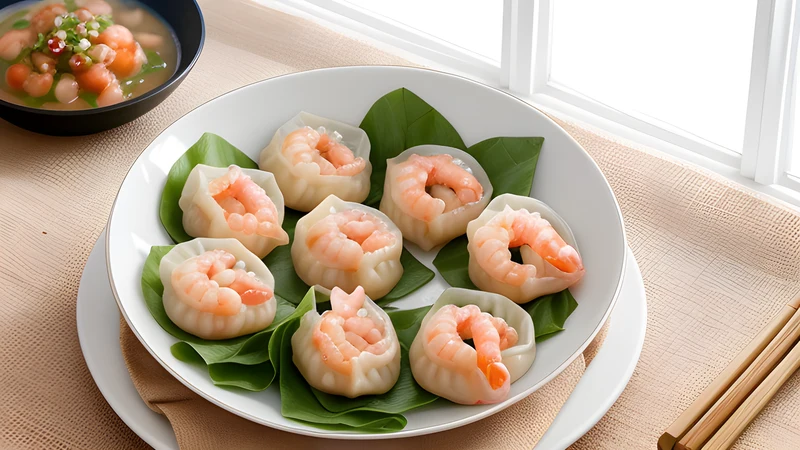
↓ Jump to recipeHar gow are the dumplings that dim sum chefs are quietly judged by. Under the trolley lights they look almost impossible: a pale, translucent crescent so thin you can see the pink prawn curled inside, gathered along one edge into a row of fine pleats, glistening from the steam. Bite one and the wrapper is soft and slightly chewy, the prawn snaps, and a little savoury juice releases. They are the benchmark of a good dim sum kitchen, and the received wisdom is that they are far too difficult to make at home. That is only half true — the wrapper is unusual and takes a couple of goes to get the hang of, but nothing about it is beyond a home cook with a free afternoon and a bit of patience. The twist that gets you the famous texture is deceptively simple: chop half the prawns to a paste and leave half in chunks.
Har Gow: Prawn and Chive Dumplings
Ingredients
- For the wrapper: 100g wheat starch (tang mian)
- 40g tapioca starch
- 1/4 tsp fine salt
- 170ml boiling water
- 1 tsp neutral oil, plus more for the work surface
- For the filling: 300g raw peeled prawns, deveined
- 30g pork fat or 1 tbsp neutral oil (for succulence)
- 40g bamboo shoots or water chestnut, very finely diced
- 2 tbsp finely chopped Chinese chives or spring onion green
- 2 tsp Shaoxing rice wine
- 1 tsp toasted sesame oil
- 1 tsp caster sugar
- 1/2 tsp fine salt
- 1/4 tsp white pepper
- 2 tsp cornflour
Method
- Make the filling first. Roughly chop half the prawns to a coarse paste and cut the other half into 1cm pieces — the paste binds, the pieces give snap. Pat everything very dry.
- Mix the prawns with the finely diced pork fat, bamboo shoots, chives, Shaoxing wine, sesame oil, sugar, salt, white pepper and cornflour. Stir in one direction until sticky, then chill for 30 minutes.
- For the wrapper, whisk the wheat starch, tapioca starch and salt in a heatproof bowl. Pour in all the boiling water at once, stirring hard with a spatula until it clumps into a shaggy dough.
- Cover and leave 2 minutes, then add the oil and knead the warm dough on an oiled surface for 2 to 3 minutes until smooth and pliable, like soft plasticine. Keep it covered — it dries fast.
- Roll the dough into a log and cut into 24 pieces. Roll each into a ball, then press or roll into a thin round about 8cm across on an oiled surface. A flat cleaver blade smeared with oil, pressed and twisted, gives the classic thin round quickly.
- Put a heaped teaspoon of filling in the centre of a round. Fold into a half-moon and pleat only the front edge — 7 to 10 fine pleats folded toward the centre — pressing them onto the flat back edge to make the classic ridged crescent.
- Sit each finished dumpling on a small square of baking paper. Keep them covered as you go.
- Bring a steamer to a rolling boil. Steam the dumplings, spaced apart, over high heat for 6 to 7 minutes until the wrappers turn translucent and the filling is pink and firm.
- Rest 1 minute before lifting them off — the wrappers are fragile straight from the steam. Serve hot, with chilli oil or light soy on the side.
The jewel of the dim sum trolley
Har gow — ha gao in Mandarin, meaning “prawn dumpling” — come from the dim sum tradition of Guangdong province and Hong Kong, the culture of yum cha, “drinking tea”, where small steamed and fried dishes are eaten in the late morning alongside endless pots of tea. Dim sum is a social meal, leisurely and convivial, and har gow sit near the top of its hierarchy: a so-called “big four” standard, alongside siu mai, char siu bao and the custard bun, by which a teahouse is measured. Tradition even holds that a properly made har gow should have at least seven pleats, and the best chefs manage ten or more, each fold pressed by hand at speed.
The translucent wrapper is a relatively modern invention, dating to the early twentieth century, and it depends on a particular ingredient: wheat starch, the pure starch left when the protein (gluten) is washed out of wheat flour. Because there is no gluten to turn it opaque and chewy, a wheat-starch dough steams up glassy and tender, which is exactly the quality that lets the prawn show through. Har gow belong to the same steaming tradition as the char siu bao steamed BBQ pork buns, and if you have already tackled pan-fried pork and chive potstickers, you will find the filling and folding instincts carry straight over, even though the dough is a different animal.
The wheat-starch wrapper
This is the part that is genuinely different from any Western dough, so it helps to know what is going on. Wheat starch has no gluten, so it cannot be kneaded to elasticity in the ordinary way; instead it is cooked, gelatinised by pouring boiling water over it, which turns the starch into a workable, translucent dough. That is why the water must be at a rolling boil and go in all at once — lukewarm water leaves the starch grainy and the dough impossible to roll thin. The tapioca starch mixed in adds stretch and gives the cooked wrapper its characteristic slight chew and shine.
Work the dough while it is still warm, because it stiffens and cracks as it cools; keep the ball and any offcuts under a bowl or cling film at all times. An oiled surface and oiled hands stop it sticking. To shape the rounds, the traditional method is to press a lightly oiled flat cleaver or a metal dough scraper onto a ball and twist, which flattens it into a thin disc in one movement; a small rolling pin works too, just keep everything oiled and move quickly. The wrappers want to be thin enough to see through but not so thin they tear when filled. Your first few will be clumsy and that is entirely normal — this is a feel you build, and even the ugly ones taste right.
Filling for snap and juice
A good har gow filling has a specific texture: it should be springy and bouncy with a clean snap, holding together while still giving distinct bursts of prawn. The way to get it is to treat the prawns two ways. Chop roughly half of them to a coarse paste, which binds the filling and gives it that cohesive, resilient bite; cut the other half into small pieces, which give the little bursts of whole prawn you feel between your teeth. Stirring the mix in one direction until it turns sticky works the proteins together, the same trick that gives the potsticker filling its bounce, and a rest in the fridge firms it for wrapping.
Two small additions do a lot. A little finely diced pork fat (or, if you would rather, a spoon of oil) melts as the dumplings steam and keeps the lean prawn succulent, which is the classic dim sum secret to a filling that is not dry. And a scattering of finely diced bamboo shoot or water chestnut adds a cool, crisp crunch that plays against the tender prawn. Pat everything thoroughly dry before mixing — wet prawn makes a watery filling that leaks and softens the wrapper. The cornflour binds any stray moisture and helps the filling set as it cooks.
Pleating and steaming
The signature har gow shape is a crescent pleated on one side only. Lay a round in your palm, spoon the filling into the centre, fold into a half-moon, and then pleat just the front sheet of pastry, folding small tucks toward the middle and pressing each onto the plain back edge. The back stays smooth, the front becomes a ridged fan, and the dumpling curves into its crescent. Aim for seven pleats and be delighted with any number — a smooth, well-sealed half-moon still steams up beautifully and tastes identical, so treat the pleats as a flourish to enjoy for their own sake.
Steam over a full, rolling boil so the dumplings cook fast; slow steam makes the wrapper gluey. Space them apart, because they expand slightly and the wrappers stick to one another and to the steamer — a square of baking paper under each, or a lining of lettuce leaf, prevents disaster. Six or seven minutes over high heat is enough; the wrapper turns clear and the prawn goes pink and firm. Let them sit for a minute before you lift them, as the hot wrapper is delicate and tears if you rush, then serve at once while they are glossy and hot.
Make-ahead, storage and serving
Har gow are at their best straight from the steamer, when the wrapper is tender and the prawn juicy, so they reward being cooked to order. You can shape them ahead and freeze them raw on a lined tray before bagging; steam from frozen with an extra couple of minutes. The wheat-starch dough does not keep well once mixed, so make it fresh each time. Leftover steamed har gow can be resteamed briefly the next day, though the wrapper firms up a little on chilling.
Serve them as the centrepiece of a home dim sum spread, with chilli oil, light soy or a little Chinkiang vinegar on the side, and steamed greens and jasmine tea to go round. A batch of these, some potstickers and a plate of edamame with chilli and sea salt makes a generous, hands-on feast that turns a slow Sunday into an occasion. They look and taste like a restaurant made them, which — once you have got the wrapper under your hands — is a quietly enormous thing to be able to say.
Variations
For a prawn-and-pork filling, replace a third of the prawn with fatty minced pork for a richer, more robust dumpling. Add a little finely grated ginger or a few drops of chilli oil to the filling for warmth. Fold in some finely chopped coriander for a fresher, more fragrant version. And if the wheat-starch wrapper defeats you on a busy day, the same prawn filling is excellent in shop-bought round dumpling wrappers, either steamed as here or pan-fried as potstickers — less glamorous, still delicious.
Related Content