Halloumi Fries with Hot Honey
A squeaky Cypriot cheese, fried hard, hit with a chilli-steeped honey while the crust is still audible
Contents
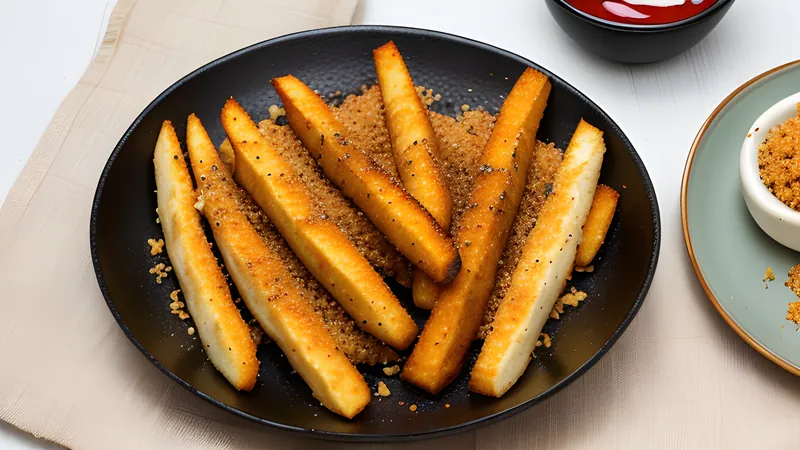
↓ Jump to recipeHalloumi is a cheese built to survive heat that would liquefy almost anything else, and frying it hard until the crust turns deep gold and genuinely crisp is the best use of that resilience there is. The honey here isn’t a sweet finish for its own sake — it’s steeped with chilli flakes until it carries real heat, so it hits that crackling crust and slides straight into the salty, rubbery-firm interior underneath, sweet and hot and salty all at once, before the squeak has any chance to go quiet.
Halloumi Fries with Hot Honey
Ingredients
- 250g runny honey
- 1-2 tsp chilli flakes (adjust to taste)
- 1 tsp cider vinegar
- 2 blocks (500g total) halloumi, well drained
- 60g cornflour
- 1/2 tsp smoked paprika
- 1/4 tsp black pepper
- Vegetable or sunflower oil, for frying (about 2cm depth)
- Fresh thyme leaves, to finish
- Lemon wedges, to serve
Method
- Warm the honey gently in a small pan over low heat until just runny, then stir in the chilli flakes and cider vinegar. Take off the heat and let it steep for at least 20 minutes so the chilli's heat and colour infuse through.
- Pat the halloumi very dry with kitchen paper, then slice each block into batons about 1cm thick and 6-7cm long.
- Mix the cornflour, smoked paprika and black pepper in a shallow dish.
- Toss the halloumi batons through the seasoned cornflour, coating all sides and shaking off the excess.
- Heat the oil in a heavy frying pan over medium-high heat until a pinch of cornflour dropped in sizzles immediately, around 180°C.
- Fry the halloumi in batches, not crowding the pan, for 2-3 minutes per side until deep golden and audibly crisp at the edges.
- Lift onto a wire rack or paper towels to drain briefly, but don't let them sit long before serving; halloumi's squeak and crust fade fast as it cools.
- Arrange on a plate, drizzle generously with the warm hot honey, scatter with thyme leaves, and serve immediately with lemon wedges.
The story: the cheese that refuses to melt, and why that matters
Halloumi’s defining trait — its unusually high melting point — comes from how it’s made. Unlike most cheeses, which are set with rennet from raw milk and would collapse into a pool of fat under high heat, halloumi is made by heating the curds in hot whey after they’ve formed, a step that denatures the proteins in a way that lets the cheese hold its shape at temperatures that would liquefy mozzarella or cheddar. That process, along with the traditional folding of the warm curd in half (the fold is still visible as a crease in most blocks), is centuries old on Cyprus, where the cheese was traditionally made from a mix of goat’s and sheep’s milk, though most modern commercial halloumi, including the export version sold across UK and European supermarkets, is made largely or entirely from cow’s milk.
The cheese earned European Union Protected Designation of Origin status in 2021, meaning only cheese made in Cyprus, to a defined recipe, can legally be sold as halloumi within the EU — a recognition of a product that had, by that point, been a national fixture for centuries, traditionally eaten grilled or fried at breakfast alongside watermelon, whose sweetness cuts through the cheese’s saltiness the same rough way honey does here. Halloumi’s ability to be fried or grilled without melting is precisely what makes it useful across so many cuisines beyond Cyprus itself — it turns up grilled whole on Greek and Lebanese meze plates, pan-fried in Turkish kitchens, and, more recently, breaded and deep-fried as “halloumi fries” on pub and bar menus across Britain, a format that has very little to do with traditional Cypriot cooking but has become genuinely popular in its own right.
Hot honey itself is an American bar-food import rather than a Mediterranean tradition, popularised over the last decade or so as a topping for fried chicken and pizza, and it works here for the same reason it works there: honey’s viscosity means it clings to a hot, crisp surface rather than running straight off, carrying chilli heat and sweetness together in a way a dry chilli flake sprinkled on top never quite achieves.
Why hot honey and not just chilli oil
Chilli oil is the obvious alternative here, and it’s worth explaining why honey wins for this particular dish. Halloumi’s brine leaves it genuinely salty, closer to a hard feta than a mild mozzarella, and honey’s sweetness does more to balance that saltiness than oil’s heat alone would — oil adds fire but no counterweight, while honey adds fire and a sweetness that rounds the salt off rather than fighting it. The viscosity matters too: warm honey is thick enough to sit on top of a crisp, ridged surface rather than running straight through it and pooling underneath the way a thinner chilli oil tends to. Steeping rather than boiling the chilli flakes in the honey is deliberate as well — a hard boil can scorch the chilli and turn the honey bitter, while a gentle warm-and-steep pulls colour and heat out gradually without cooking the honey’s flavour away.
Getting a genuinely crisp crust
The single biggest risk with fried halloumi is water. Halloumi is packed and sold in a salty brine, and any residual moisture left on the surface turns to steam the instant the cheese hits hot oil, which stops the cornflour coating from crisping properly and can make the oil spit alarmingly. Patting the batons dry with kitchen paper, pressing rather than wiping, for a good few seconds per side, is not optional here — it’s the difference between a crust that shatters and one that stays soft and pale.
Cornflour rather than plain flour is doing specific work in the coating: cornflour crisps harder and stays crisper for longer once fried, because it doesn’t contain the gluten-forming proteins that make a flour coating turn slightly chewy and soft as it cools. A light, even coating is enough — press too thick a layer on and it can taste raw and starchy rather than crisp, since the frying time here (2-3 minutes a side) is short enough that a thick coating won’t fully cook through.
Oil temperature is the other lever. Too cool, and the coating soaks up oil rather than crisping, leaving the fries greasy and pale; too hot, and the coating burns before the halloumi inside has had a chance to soften slightly and warm through. Around 180°C — hot enough that a pinch of the cornflour coating sizzles and colours within a couple of seconds of hitting the oil — is the right zone, and frying in batches rather than crowding the pan keeps the oil’s temperature from dropping too far when the cold cheese goes in.
The recipe
Serves 4 as a snack. Prep 15 minutes, cook 15 minutes.
For the hot honey: 250g runny honey, 1-2 tsp chilli flakes, 1 tsp cider vinegar.
For the halloumi: 2 blocks (500g) halloumi, 60g cornflour, 1/2 tsp smoked paprika, 1/4 tsp black pepper, oil for frying.
To finish: fresh thyme, lemon wedges.
- Warm the honey gently, stir in the chilli flakes and vinegar, and let it steep at least 20 minutes.
- Pat the halloumi very dry and slice into batons.
- Mix the cornflour, smoked paprika and pepper in a shallow dish.
- Toss the batons through the seasoned cornflour, shaking off excess.
- Heat the oil to around 180°C.
- Fry in batches for 2-3 minutes per side until deep golden and crisp.
- Drain briefly on a rack or paper towels.
- Plate immediately, drizzle with hot honey, scatter with thyme, and serve with lemon wedges.
Tips, substitutions and storage
If chilli flakes aren’t to hand, a fresh red chilli, deseeded and very finely sliced, steeped in the warm honey the same way, gives a fresher, slightly grassier heat than dried flakes. Adjust the quantity up or down depending on how hot your particular chillies or flake blend runs — taste the honey once it’s steeped and before it goes anywhere near the fries, since it’s much easier to add more heat than take it away. A neutral, mild honey — clover or a basic blended supermarket honey — works better here than a strongly flavoured single-origin one like heather or chestnut, since a honey with its own dominant flavour competes with the chilli rather than simply carrying it.
Halloumi fries don’t hold well once cooked; the crust softens within 15-20 minutes as residual steam from the cheese works its way back out through the coating, so this is very much a fry-to-order, eat-immediately dish rather than one to make ahead for a party. The hot honey, on the other hand, keeps in a sealed jar at room temperature for weeks, and it’s worth making a larger batch to have on hand for drizzling over other things — a hunk of crusty bread, a wedge of watermelon greek salad, or scrambled eggs.
If halloumi isn’t available, firm paneer fries the same way and takes a similar coating well, though it lacks halloumi’s distinctive salt and squeak, so season the coating a touch more assertively to compensate. Look for blocks labelled as traditional Cypriot halloumi where possible, since the PDO-protected version tends to have a firmer texture and a cleaner, more mineral saltiness than some of the mass-produced cow’s-milk-only versions, which can taste flatter and squeak rather less convincingly in the pan.
Variations
A squeeze of fresh lemon juice stirred into the hot honey just before serving brightens the whole thing and cuts some of the honey’s stickiness, which some palates prefer to the straight sweet-hot version. For a herbier finish, swap the thyme for chopped fresh oregano, which leans closer to the herbs actually used across Cypriot and Greek cooking. And served alongside a plate of prawn saganaki with feta, the halloumi fries make a genuinely convincing start to a wider Mediterranean spread, salty cheese and salty prawns both benefiting from something sweet and hot cutting across the table. A scattering of toasted sesame or nigella seeds over the finished fries, pressed into the coating before frying rather than added after, gives a third texture beyond the crisp coating and the soft interior, and it’s a trick worth borrowing from the sesame-crusted halloumi served at some Levantine restaurants.
Fry it hard, dry it first, and get the honey on while the crust is still loud.
Related Content