Hainanese Chicken Rice with Ginger-Scallion Oil
Poached chicken, schmaltz rice, and three sauces that argue on the plate
Contents
↓ Jump to recipeThere is a version of this dish being cooked, right now, in a hawker centre in Singapore where the stall owner has made nothing else for thirty years. That fact should probably put me off writing about it. Instead it does the opposite. Hainanese chicken rice is one of those deceptively plain plates that rewards precision the way a good roast dinner does: three or four humble components, each one cooked with more care than it looks like it deserves, arriving together as something far greater than the sum.
My one small liberty is toasting the rice in the rendered chicken fat with a knotted pandan leaf before it ever meets the stock. It is barely a twist at all. It simply makes the rice taste more emphatically of the thing it is meant to taste of.
Hainanese Chicken Rice with Ginger-Scallion Oil
Ingredients
- 1 whole chicken, about 1.6kg
- 6 spring onions
- 60g fresh ginger, plus 40g extra for the oil
- 2 tbsp fine sea salt, plus 1 tsp
- 1 pandan leaf, knotted (optional)
- 350g jasmine rice
- 3 garlic cloves, finely chopped
- 2 tbsp rendered chicken fat or neutral oil
- 80ml neutral oil, for the ginger-scallion oil
- 2 red chillies
- 2 tbsp lime juice
- 1 tbsp caster sugar
- 2 tbsp dark soy sauce, for serving
- 1 cucumber, sliced
Method
- Rub the chicken inside and out with 2 tbsp salt, then rinse. Stuff the cavity with 2 bruised spring onions and 30g sliced ginger.
- Lower the chicken into a pot just wide enough to hold it, cover with cold water by 2cm, and bring to a bare simmer. Poach at 80C for 35 minutes, never letting it boil.
- Lift the chicken into a bowl of iced water for 10 minutes, then rest on a rack. Keep the poaching stock hot.
- Rinse the rice until the water runs clear and drain well. Fry the garlic and 20g grated ginger in the chicken fat for 1 minute, add the rice and toast for 2 minutes.
- Tip the rice into a pot with 500ml of the hot poaching stock, the pandan leaf and 1 tsp salt. Simmer covered for 12 minutes, then rest off the heat for 10.
- For the ginger-scallion oil, mix 40g grated ginger and 4 finely sliced spring onions with 1/2 tsp salt. Heat 80ml oil until shimmering and pour over; it will hiss and bloom.
- Blend the chillies, lime juice, sugar and 3 tbsp hot stock into a loose chilli sauce.
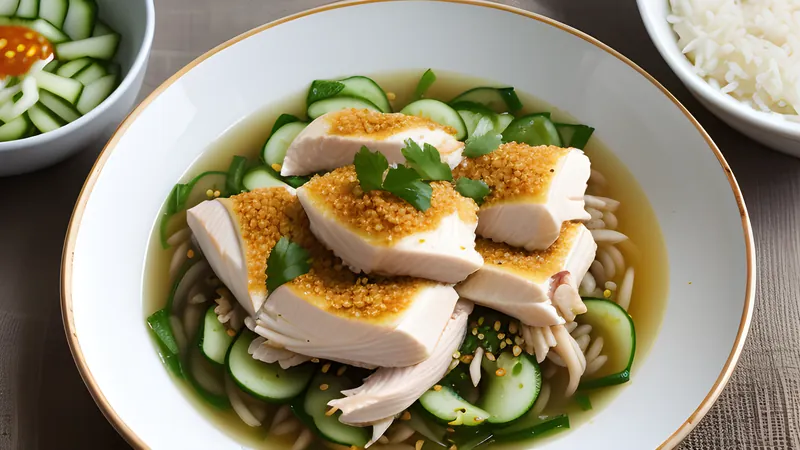
- Carve the chicken. Serve with the rice, cucumber, the three sauces and a bowl of the hot broth.
Where the dish comes from
The name points to Hainan, the island province off China’s southern coast, where a dish called Wenchang chicken set the template: a lean free-range bird, gently poached, served with rice cooked in the poaching fat. Immigrants carried it south through the Nanyang in the early twentieth century, and it took root in Singapore and Malaysia, where cooks adapted the bird to what they had and sharpened the condiments to local taste.
By the 1950s it had become a hawker staple, sold by men who wheeled carts through Chinatown with a poached chicken hanging from a hook. Singapore now treats it as something close to a national dish, which means everyone has an opinion and most of those opinions are about the chilli sauce. The Singaporean style leans hot and citrus-sharp; the Malaysian version often sits sweeter and thicker. What unites every good plate is restraint in the poaching. Boil the bird hard and you have chicken soup with a sad grey carcass floating in it. Coax it, and the flesh stays translucent at the bone.
The poach is the whole game
Everything here hinges on temperature. Chicken protein sets around 60 to 65C, and the moment you push a whole bird past a rolling boil you squeeze the water out of the muscle and the meat turns stringy. What you want is the surface of the stock trembling, the odd lazy bubble breaking, and nothing more. On my hob that sits somewhere around 80C. If you have a probe thermometer, use it; if you do not, watch the water like it owes you money.
Start the chicken in cold water so it heats through evenly, salt it hard first to season the skin and firm the flesh, and give it a full ten minutes in iced water afterwards. That cold shock does two things: it stops the residual heat overcooking the meat, and it sets the skin into the slightly gelatinous, cool-slippery texture that marks the real thing. Rest it on a rack so the skin dries and tightens. A bird poached like this carves into slices that are pale, juicy, and faintly pink at the joint, which is exactly right.
Keep every drop of that poaching liquid. It is now a light, savoury stock doing three jobs: cooking the rice, loosening the chilli sauce, and filling the little bowl of broth that comes alongside.
Rice that tastes of chicken
Wash the rice until the rinsing water runs from cloudy to clear, which strips the loose surface starch and stops the grains clumping. Drain it properly. Then fry your garlic and ginger in the rendered fat you skimmed from the top of the stock, add the rice, and toast it for a couple of minutes until the grains turn from chalky to faintly translucent at the edges and smell nutty. This is the step people skip, and it is the difference between rice that carries the dish and rice that just sits there.
Cook it in the hot stock rather than water, at a ratio slightly drier than usual because the toasted grains drink less. Twelve minutes covered, then ten minutes off the heat with the lid on, so the steam finishes it and the bottom does not catch. The pandan leaf is optional and unmistakable if you have it: grassy, faintly coconut, the smell of a Southeast Asian rice pot. Fluff with a fork and you should have separate, glossy, deeply savoury grains.
The three sauces
A plate of chicken rice lives or dies by its condiments, and there are three. The ginger-scallion oil is my favourite thing on the plate and the one I make most often for other meals entirely. Grate the ginger fine, slice the spring onions thin, salt them, and pour shimmering-hot oil over the top so it blooms and hisses. The heat cooks out the raw bite and leaves a fragrant, spoonable green oil that I would happily eat on plain toast.
The chilli sauce wants heat, acid and a little sweetness, blended loose with a splash of the hot stock so it pours rather than sits. And the third is simply good dark soy sauce, thick and slightly sweet, spooned over the chicken. Together they cover every corner: fresh and pungent, hot and sharp, dark and umami. Give everyone their own little dishes and let them argue it out.
Tips, swaps and getting ahead
- Salt the water for the ice bath too. A teaspoon in the iced water keeps the skin seasoned rather than leaching flavour out.
- No whole chicken? Four large bone-in thighs poach beautifully in 22 to 25 minutes and are more forgiving of a slightly enthusiastic simmer.
- Rice cooker friendly. Toast the rice in a pan, then transfer everything to the cooker with the measured stock and let it do the timing for you.
- Make ahead. The ginger-scallion oil keeps three days in the fridge and the chilli sauce two. The chicken is best poached the same day, but leftovers, sliced cold, make a superb version of the classic Singaporean fridge raid.
- The broth. Simmer the stripped carcass in the leftover stock for another twenty minutes with a little white pepper for a second, deeper bowl of broth.
The plate, assembled
Presentation matters more here than the plainness suggests. Mound the rice to one side, fan the sliced chicken over or beside it, and tuck cool cucumber slices underneath the meat so they catch the juices. The little dishes of sauce go around the edge, the bowl of broth alongside. Eat it the proper way: a slice of chicken dragged first through dark soy, then a dab of chilli, a forkful of that fragrant rice, a spoon of hot broth to reset the palate. The cucumber is there to cut the richness and cool the chilli, so do not treat it as garnish.
One thing worth saying about temperature: this dish is meant to be eaten warm rather than piping hot. The chicken is cool-slippery, the rice warm, the broth hot, and that spread of temperatures across a single plate is part of the pleasure. Resist the urge to microwave the chicken back to steaming. It wants to be just above room temperature, its skin set and its flesh yielding.
If you like this kind of gentle, precise cooking where the technique does the heavy lifting, it sits close to a good Thai steamed fish with lime, chilli and garlic, which shares the same trust in a light hand and sharp condiments. And when you have leftover poached chicken and cold rice, there is no better next-day home for them than a proper Yangzhou fried rice with char siu and prawn, which turns the remnants into a second dinner. Cook the chicken slowly, keep the stock, and toast the rice: get those three things right and the plate looks after itself.
Related Content