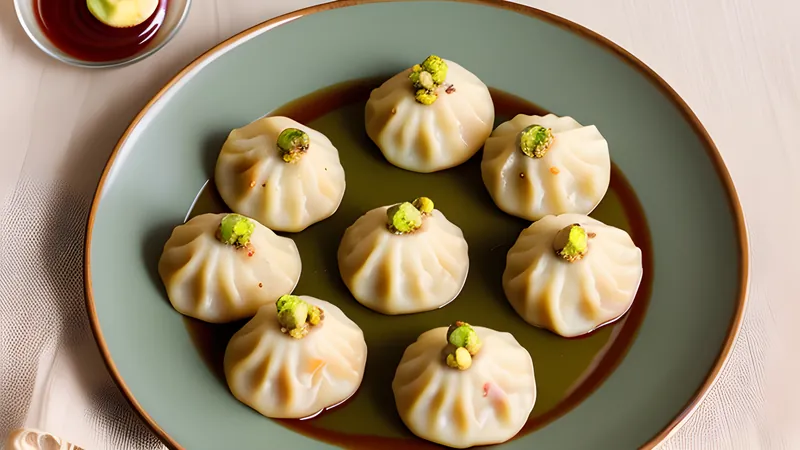
Gulab Jamun in Cardamom-Rose Syrup
Milky fried dumplings soaked in a saffron-scented cardamom-rose syrup
Contents
↓ Jump to recipeGulab jamun are small fried dumplings made from a milk-solid dough, soaked until they are heavy and glistening with syrup, and they are one of the most reliably crowd-pleasing sweets across South Asia. My twist works the perfumed end of the dish harder than most recipes bother to: a proper cardamom-rose syrup steeped with saffron, and a dough built from milk powder rather than fresh khoya, which makes the whole thing achievable in a home kitchen without a day spent reducing milk on the stove. The other twist is not an ingredient at all — it is temperature control in the fryer, which is the single detail that decides whether these come out silky through to the centre or raw and doughy inside a burnt shell.
Gulab Jamun in Cardamom-Rose Syrup
Ingredients
- 150g full-fat milk powder
- 30g plain flour
- 1/4 tsp bicarbonate of soda
- 2 tbsp ghee, melted, plus extra for kneading
- 60-80ml whole milk, to bind
- 500ml sunflower or vegetable oil, for deep-frying
- 400g caster sugar
- 400ml water
- 8 green cardamom pods, lightly crushed
- Generous pinch of saffron threads
- 1 tbsp rose water
- 1/2 tsp lemon juice
- Dried rose petals and slivered pistachios, to serve
Method
- Make the syrup first: bring the sugar, water and crushed cardamom pods to the boil in a wide pan, stirring until the sugar dissolves, then simmer for 8 minutes until very slightly syrupy.
- Stir in the saffron, rose water and lemon juice, then take off the heat and keep warm, covered.
- Whisk the milk powder, plain flour and bicarbonate of soda together in a bowl.
- Rub in the melted ghee with your fingertips until the mixture looks like breadcrumbs.
- Add the milk a tablespoon at a time, gathering the mixture into a soft, smooth dough that just holds together without cracking. Do not knead hard or work it for long.
- Divide the dough into 20 pieces and roll each into a smooth ball with no visible cracks, keeping your palms lightly greased with ghee.
- Heat the oil in a deep, heavy pan to 150C. Test with a small piece of dough: it should sink, then rise slowly to the surface after 15 to 20 seconds without browning immediately.
- Fry the balls in batches of 5 or 6, without crowding the pan, turning them gently and constantly with a slotted spoon for 8 to 10 minutes, until evenly deep mahogany brown all over.
- Lift out with a slotted spoon, drain briefly, and drop straight into the warm syrup.
- Leave to soak, submerged, for at least 2 hours at room temperature before serving, spooning syrup over the top halfway through.
- Serve warm or at room temperature, scattered with rose petals and slivered pistachios.
A sweet with a Persian name and a subcontinental home
The name itself tells you where this dessert has travelled from: gulab is Persian for rose, and jamun is the name of a dark, plum-like Indian fruit the finished dumplings resemble in colour and shape. The dish’s ancestor is thought to have arrived with Persian and Central Asian influence during the medieval period, related to a fried, syrup-soaked sweet called luqmat al-qadi still eaten across the Middle East, and it took its current form of milk-solid dough soaked in rose and cardamom syrup somewhere in the kitchens of Mughal India.
Today gulab jamun is close to a national sweet across India, Pakistan, Bangladesh and Nepal, and it is genuinely everywhere at once: wedding sweet trays, Diwali boxes, temple offerings, restaurant dessert menus, tins bought from any halwai (sweet shop) on the way home. It is served warm as often as at room temperature, sometimes with a scoop of vanilla ice cream melting into the syrup in more modern presentations, though the traditional version is simply the dumpling itself, syrup pooled beneath it in a small steel bowl.
Traditionally the dough is made from khoya, milk reduced by slow, patient simmering until nearly all its water has evaporated and what remains is a dense, slightly granular solid — the process alone can take well over an hour of near-constant stirring and scraping. Milk powder, which is essentially milk that has already had its water removed via spray-drying, gets you to almost the same place with a whisk and a few minutes, which is why it has become the standard shortcut in home kitchens worldwide, not just an inferior substitute.
Why the dough handling and the oil temperature decide everything
The dough itself is deceptively simple — milk powder, a little flour for structure, a touch of raising agent, bound with melted ghee and milk — but two things go wrong constantly, and both are about restraint rather than skill. The first is overworking it. Knead this dough the way you would bread, developing it hard and long, and you toughen whatever gluten the small amount of flour offers, giving you dense, chewy jamun instead of the soft, almost custardy texture you want. Gather it gently, just until it holds together smoothly with no dry patches or cracks, and stop.
The second, and the bigger one, is cracked balls. Any crack in the surface of a rolled ball is a place where hot oil will force its way in during frying, and the dumpling splits open in the pan rather than swelling into a neat, smooth sphere. Keeping your palms very lightly greased with ghee as you roll, and rolling with a light, continuous pressure rather than squeezing, is what keeps the surface unbroken.
Oil temperature is where most first attempts genuinely fail, and it is worth understanding why. Gulab jamun need to cook through to a dense, fully hydrated centre while their outside develops deep colour and a very slightly firm crust — and that takes time, roughly eight to ten minutes per batch. Fry them at a typical deep-frying heat of 180C and the outside will scorch to black within two or three minutes while the inside is still raw milk powder paste, dense and chalky rather than tender. The fix is to fry low and slow, around 150C, which gives the heat time to travel all the way to the centre of each ball before the surface goes past a rich mahogany brown. Test the oil with a small offcut of dough before you commit a whole batch: at the right temperature it sinks, then rises slowly over 15 to 20 seconds without colouring immediately. If it colours in under 10 seconds, the oil is too hot; let it cool for a minute and test again. Keep the balls moving gently and constantly with a slotted spoon throughout, which both cooks them evenly on every side and helps them swell into a rounder shape as they fry.
The recipe
Make the syrup first. Bring 400g sugar, 400ml water and 8 lightly crushed cardamom pods to the boil, stirring to dissolve, then simmer for 8 minutes until very slightly syrupy. Stir in a generous pinch of saffron, 1 tablespoon rose water and 1/2 teaspoon lemon juice, then take off the heat and keep warm, covered.
Whisk 150g milk powder, 30g plain flour and 1/4 teaspoon bicarbonate of soda together, rub in 2 tablespoons melted ghee until it looks like breadcrumbs, then work in 60-80ml milk a tablespoon at a time until you have a soft, smooth dough that holds together without cracking. Divide into 20 pieces and roll into smooth balls with lightly greased palms.
Heat 500ml oil to 150C in a deep pan. Fry the balls in batches of 5 or 6, turning constantly with a slotted spoon, for 8 to 10 minutes until evenly deep mahogany brown. Drain briefly and drop straight into the warm syrup. Leave to soak, fully submerged, for at least 2 hours before serving warm or at room temperature, scattered with rose petals and slivered pistachios.
Getting the syrup right
A one-string syrup is the traditional target: dip two fingers in, press them together, and pull apart to see a single thin thread of syrup form between them, indicating the sugar has concentrated enough to soak into the fried dumplings without turning watery. Eight minutes of gentle simmering after the sugar dissolves gets you close, but syrup consistency varies with your pan and heat, so trust the string test over the clock. A syrup that is too thin will not be absorbed properly and the jamun will taste bland at the centre; too thick and it crystallises on the surface and refuses to soak in at all — the small hit of lemon juice at the end is there specifically to prevent that crystallisation by breaking up the sugar structure.
Soaking hot jamun straight into hot syrup is a common instinct, and it is worth resisting: dropping fried-hot dumplings into fully hot syrup can cause them to toughen on the outside before syrup penetrates, so let the syrup drop to warm rather than boiling before the jamun go in, and give them a proper two-hour soak, spooning syrup over the exposed tops halfway through so every dumpling saturates evenly, not just the submerged half.
Tips, storage and variations
Gulab jamun keep beautifully, submerged in their syrup in an airtight container, in the fridge for up to a week — if anything, they improve over the first day or two as the syrup penetrates fully to the centre. Bring them back to room temperature or warm gently before serving, since cold syrup mutes the cardamom and rose. They do not freeze well once soaked, as the texture turns grainy on thawing, but you can freeze the fried, unsoaked balls and drop them straight into hot syrup from frozen, adding a few extra minutes to warm through.
For variations, a few strands of saffron rubbed into the dry dough gives the jamun themselves a golden tint rather than relying on the syrup alone for colour and fragrance. Stuffed jamun, with a small piece of pistachio or a drop of rosewater-scented khoya pressed into the centre before rolling, are a lovely variation for a celebration table. If cardamom and rose are a register you enjoy, my saffron and cardamom rice pudding (firni) draws on exactly the same spice pairing in a cold, set pudding, and a glass of mango lassi with cardamom and lime alongside makes a properly fragrant end to an Indian meal.
Related Content