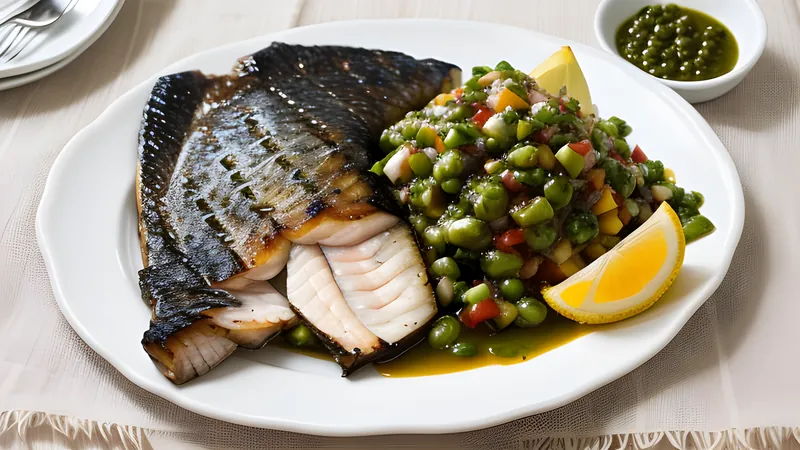
Grilled Whole Sea Bass with Salsa Verde
A charred fish and a sharp green sauce
Contents
↓ Jump to recipeA whole fish on the grill is one of those dishes that looks like a restaurant flex and takes about fifteen minutes of actual work. Sea bass is the easiest one to start with: the flesh is forgiving, the bones lift away in two clean fillets, and the skin crisps into something you will fight over. The twist here is small and worth it — I char the lemon on the grill before it goes anywhere near the plate, which swaps the harsh nose of raw citrus for something rounder and faintly caramelised. That charred lemon then goes into the salsa verde, so the sauce carries a little smoke of its own.
Grilled Whole Sea Bass with Salsa Verde
Ingredients
- 1 whole sea bass, about 500–600g, scaled and gutted
- 1 tbsp olive oil, plus more for the sauce
- 1 lemon, halved
- Flaky sea salt and black pepper
- A few sprigs of thyme or parsley for the cavity
- 1 large bunch flat-leaf parsley (about 30g)
- 2 tbsp capers, drained
- 4 anchovy fillets in oil
- 1 small garlic clove
- 1 tbsp red wine vinegar
- 1 tsp Dijon mustard
- 6 tbsp extra-virgin olive oil
Method
- Heat a griddle pan or barbecue until very hot. Pat the sea bass dry and slash the skin three times on each side, down to the bone.
- Rub the fish with 1 tbsp olive oil and season the skin and cavity well with flaky salt. Tuck thyme or parsley into the cavity.
- Grill the lemon halves cut-side down for 3–4 minutes until charred, then set aside.
- Lay the fish on the grill and cook undisturbed for 6–7 minutes, until the skin lifts cleanly. Turn once and cook another 5–6 minutes, until the flesh at the thickest point is opaque.
- Finely chop the parsley, capers, anchovies and garlic together on a board. Scrape into a bowl.
- Stir in the vinegar, mustard and 6 tbsp olive oil. Squeeze in the juice of one charred lemon half and season with pepper.
- Rest the fish for 2 minutes, then spoon the salsa verde generously over the top and serve with the second charred lemon half.
Why a whole fish beats fillets
Cooking a fish on the bone does two useful things. The bones conduct heat gently and evenly, so the flesh nearest them stays moist while the outside takes on colour. And the skin, left whole and intact, acts as a jacket — it shields the delicate meat from the fierce direct heat of the grill and renders into a crisp layer as it cooks. A fillet, by contrast, has thin edges that overcook before the middle is done, and no skin on the underside to protect it.
The other advantage is flavour. There is a well-known bit of cook’s lore that the sweetest meat sits closest to the bone, and with fish it holds up. The collar behind the gill and the cheeks are the two best bites on the whole animal, and you only get them if you cook the fish whole. Ask your fishmonger to scale and gut it for you, leaving the head on. A 500–600g bass feeds two generously, or one very happy person with leftovers picked straight from the frame.
Sea bass has been prized around the Mediterranean since antiquity. The Romans called it lupus, the wolf, for the way it hunts, and Pliny the Elder rated the ones caught between the two bridges of the Tiber above all others. For centuries it was a wild, seasonal luxury; the farmed European sea bass that fills the fish counter now only became widespread in the 1980s, when hatcheries in Greece and Italy cracked the breeding cycle. That is why it is affordable enough for a Tuesday, and why the classic treatments are all so restrained. When a fish is this good, you grill it and get out of the way.
Getting the skin to crisp
The single most common grilled-fish disaster is the skin welding itself to the bars and tearing when you try to turn it. Three things prevent this, and all of them matter.
First, the fish must be dry. Pat it thoroughly with kitchen paper, inside and out. Any surface water turns to steam and steam is the enemy of a crisp, releasing skin. Second, the grill must be genuinely hot — hold your hand a few centimetres above it and you should manage barely two seconds. A cool grill lets the skin stick and stew. Third, and this is the part people rush: leave it alone. When the skin is properly seared it releases itself. If it resists when you slide a spatula under, it is not ready, so give it another thirty seconds and try again.
Slashing the skin three times down to the bone helps the fish cook evenly and gives the salt somewhere to go. Season the skin heavily with flaky salt just before it hits the heat — earlier and the salt draws out moisture you have worked to remove.
The salsa verde
Salsa verde is the green backbone of Italian cooking, a raw sauce of herbs, capers, anchovy and oil that turns up beside boiled meats in Piedmont, over grilled fish on the coast, and stirred through potatoes everywhere in between. The name simply means green sauce, and every region argues about the details — bread or no bread, mint or no mint, garlic crushed or barely there. What holds it together is the balance of three sharp things (capers, vinegar, anchovy) against a lot of soft green parsley and good oil.
Chop it by hand. A food processor bruises the parsley and turns the whole thing into a dull khaki paste that tastes of nothing but oil. On a board, with a heavy knife, you keep the herbs bright and the texture loose and spoonable. Pile the parsley, capers, anchovy and garlic together and rock the blade through until everything is fine but still has a bit of body, then move it to a bowl before you add the liquids.
Anchovy is doing quiet, essential work here. It dissolves completely and leaves no fishy note — what it leaves is savoury depth, the umami that makes you go back for another forkful without quite knowing why. If you genuinely cannot abide it, a splash of fish sauce or a scrap of miso does a similar job, but the classic route is best. The charred lemon juice, squeezed in at the end, lifts everything and ties the sauce to the smoke on the fish.
Reading the fish for doneness
Sea bass cooks fast and the window between perfect and dry is narrower than people expect. The clearest test is at the thickest part, just behind the head. Slide a small knife in along the backbone: the flesh should be opaque and pull away from the bone in a clean flake. If it still looks glassy and clings, it needs another minute or two. A whole 550g fish over a hot grill usually wants six or seven minutes on the first side and five or six on the second, but trust your eyes over the clock — barbecues and griddle pans run at wildly different temperatures.
Once it is done, give it two minutes to rest. The flesh firms up slightly and the last of the heat finishes carrying through, which makes the fish much easier to lift off the bone in whole fillets.
Serving, storage and variations
To serve, I bring the fish to the table whole with the salsa spooned down its length and the second charred lemon half alongside. Lift the top fillet away from the bones, then peel the whole skeleton up from the tail to reveal the bottom fillet clean underneath. Boiled new potatoes and a plain green salad are all you need; this is a supper that wants nothing complicated around it. If you like a starchier plate, a spoonful of the same salsa verde is glorious stirred through warm potatoes.
The salsa verde keeps in the fridge for two or three days, though the colour dulls; a fresh squeeze of lemon and a stir wakes it back up. The fish is best eaten straight away, but any leftover meat picked from the frame is lovely the next day folded through pasta or piled onto toast.
For variations, this method works just as well with bream, red mullet or a couple of small mackerel, though oily fish like mackerel want an even hotter grill and a slightly shorter time. If the weather rules out the barbecue, a ridged griddle pan on the hob does the job, or roast the fish at 220°C for about eighteen minutes. And if you want to lean into the sharp-green theme, the same sauce is what I reach for with a plate of lamb chops with salsa verde — proof that one good green sauce earns its keep across the whole week. On a night when you want the sea without the ceremony of a whole fish, a bowl of garlic-butter prawns with sourdough scratches the same itch in half the time.
Good fish, hot grill, sharp sauce. Everything else is just tidying up.
Related Content