Ghee-Layered Paratha, Folded and Griddled
A whole-wheat North Indian flatbread built from folded, ghee-brushed leaves and cooked crisp on a tawa
Contents
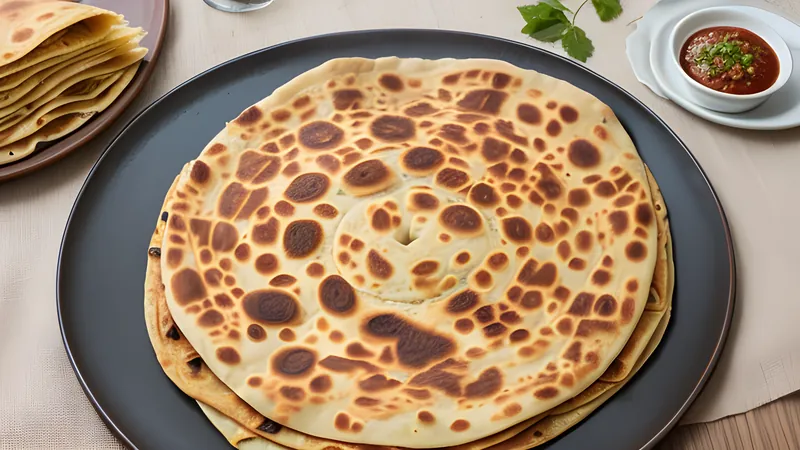
↓ Jump to recipeA good lachha paratha announces itself when you tear it: the whole-wheat round should come apart in a hundred short, ghee-slicked leaves, not in a clean bready snap. This is North India’s flaky griddle bread, the one that turns up beside a rich dal makhani or a plate of curried chickpeas, and its layers are built by hand from a single rolled disc that gets brushed, pleated like a paper fan, coiled and rolled again. It sounds fiddly. It is really just folding, and once your hands learn the motion it takes minutes.
Ghee-Layered Paratha, Folded and Griddled
Ingredients
- 300g chapati flour (atta), plus extra for dusting
- 50g plain flour
- 1 tsp fine salt
- 1 tbsp neutral oil
- 210ml water, lukewarm
- About 80g ghee, melted, for brushing and cooking, plus more to finish
- 2 tbsp fine semolina, for dusting the layers (optional but recommended)
Method
- Mix the atta, plain flour and salt in a bowl. Add the oil and most of the water and bring together, adding the rest of the water as needed, into a soft, pliable dough.
- Knead 8 minutes until smooth and supple. Rub the surface with a little ghee, cover, and rest at least 30 minutes.
- Divide into 6 pieces and roll into balls. Take one and roll it out on a floured surface into a large, thin round about 25cm across.
- Brush the whole surface with melted ghee and dust lightly with a pinch of flour and a little semolina, right to the edges.
- Pleat the round into narrow accordion folds, like a paper fan, gathering the whole disc into a long ruffled strip.
- Stretch the strip gently, then coil it into a tight spiral and tuck the end underneath. Press to seal. Rest coils 10 minutes.
- Roll each coil out gently into a round about 18cm across and 4mm thick, keeping the spiral loose so layers stay distinct.
- Heat a tawa or heavy frying pan over medium. Cook the paratha dry for 30 seconds, flip, then brush the top with ghee. Flip again, brush the other side, and cook, pressing with a folded cloth, until deep golden and crisp with visible layers, about 2-3 minutes a side.
- Off the heat, scrunch the hot paratha inward from the edges to loosen the layers. Serve at once.
Lachha means layers
Lachha means coil or ring, and lachha paratha, sometimes called lachhedar paratha, takes its name from the ringed, spiralled layers you can see on its surface. Paratha itself is a vast category across the Indian subcontinent, from the stuffed aloo and gobi parathas of Punjab to the flaky Kerala parotta of the south. The common thread is parat, layers, and atta, the whole-wheat dough that most of them share. Unlike the puffed, deep-fried puri or the lean tandoor-baked naan, the paratha is shallow-cooked on a flat tawa with ghee, which is what gives it that crisp, mottled, richly browned exterior.
The layered version belongs to the world of the dhaba, the roadside eateries of the Grand Trunk Road and beyond, where truckers stop for hot food cooked to order. There, a lachha paratha is a small luxury: whole-wheat and filling like everyday roti, but enriched with ghee and worked into flakes so it eats richer and more special. It is the bread you order when you want the meal to feel like more than fuel.
Technically it is a close cousin of a couple of breads worth knowing. Its fold-and-coil method is the same idea as Malaysian roti canai, which reaches the layers by stretching rather than pleating but coils to the same end. And a lachha paratha is the natural raft for a saucy vegetable dish like sag aloo, the spinach-and-potato standard, torn and used to scoop. If you want another oven-charred flatbread from further west along the old trade routes, lavash makes a good contrast in technique: thin and blistered rather than thick and layered.
Atta, and why it matters
The dough here is mostly atta, Indian whole-wheat flour, which is milled much finer than most Western wholemeal and from a lower-protein, softer wheat. That fine grind is why a chapati or paratha made with atta rolls out smooth and stays soft, where a bread made with coarse wholemeal turns gritty and tears. I cut it with a little plain flour, which adds enough extra gluten strength to hold the layers through folding and rolling without making the bread tough. If you can only get bread-shop wholemeal, sieve out the coarsest bran and add a touch more water, because bran is thirsty and it also cuts the gluten strands that hold your layers together.
Knead the dough soft and supple, then, and here is the small twist that separates a workshop-grade paratha from a decent one, rest it under a film of ghee for at least half an hour. The rest relaxes the gluten so the disc rolls thin without fighting back, and the thin ghee coat both stops a skin forming and starts the enrichment before you have even begun to fold. A rushed, tense dough cannot be pleated finely, and coarse pleats mean coarse layers.
Building the layers
The magic is in the fold, and it is worth understanding rather than just following. Roll a ball into a wide, thin round. Brush the entire surface, edge to edge, with melted ghee, then dust it with a whisper of flour and, my preferred addition, a little fine semolina. The fat is what keeps the layers physically separate as they cook; the flour-and-semolina dust does the same job by absorbing some of that fat and creating a dry barrier between surfaces, so they cannot weld shut. Semolina in particular adds a faint crunch and helps the layers stay crisp.
Now pleat the whole round into narrow accordion folds, like closing a paper fan, so you have a long ruffled strip with dozens of thin ghee-lined creases stacked side by side. Stretch the strip lengthways to make it longer and thinner, then coil it into a tight snail’s spiral, tuck the end under, and press to seal. Every one of those pleats becomes a layer, and the coil arranges them into concentric rings. Rest the coils ten minutes so they will roll out without unwinding.
When you roll the coil flat, be gentle. Press and roll only enough to get an even round about 4mm thick. Bear down hard and you crush the spiral back into a solid mass and lose everything you just built. You want the layers loose, still holding pockets of air and ghee.
Griddling on the tawa
A tawa, the flat Indian griddle, is ideal because its even, gentle heat crisps the paratha through without scorching, but any heavy frying pan works. Start on a dry, medium pan for the first thirty seconds to set the base, then flip and start brushing ghee onto each side as you cook, pressing the bread with a folded cloth or spatula so every part meets the hot metal. Pressing forces the layers to crisp and helps them puff and separate. You are looking for deep golden brown with dark freckles and clearly visible ridged layers, two to three minutes a side.
The finishing move, as with roti canai, is to scrunch the hot paratha inward from its edges the moment it comes off the heat. That crumpling cracks the rings apart and reveals the flaky, ragged interior. A limp, uncrushed paratha is hiding its best feature.
Tips, fixes and make-ahead
If your paratha is bready rather than flaky, you either skimped on ghee between the layers, rolled the coil too flat, or cooked it too slowly so the fat soaked in before the layers set. Be generous with the brush, roll gently, and keep the pan at a confident medium.
If it turns hard and dry, the dough was too stiff or over-floured, or you cooked it too long. Keep the dough soft, and pull the paratha off as soon as it is crisp and coloured.
If the layers won’t separate, your fold was too coarse; make the accordion pleats as narrow as you can manage.
Make-ahead: the dough keeps a day in the fridge. You can also shape the coils, then flatten, stack between sheets of greaseproof and freeze raw; cook from frozen straight on the tawa, adding a minute. Cooked parathas reheat well in a dry hot pan for a minute a side, which even revives the crispness.
Serve them hot, torn by hand, with dal, a dry curry, or just a smear of extra ghee and a spoon of mango pickle. The pleating feels like a chore the first time and like meditation by the third.
Related Content