Georgian Chikhirtma: Lemon-and-Egg Chicken Soup
A tart, silky soup thickened the old way, with browned flour instead of cream
Contents
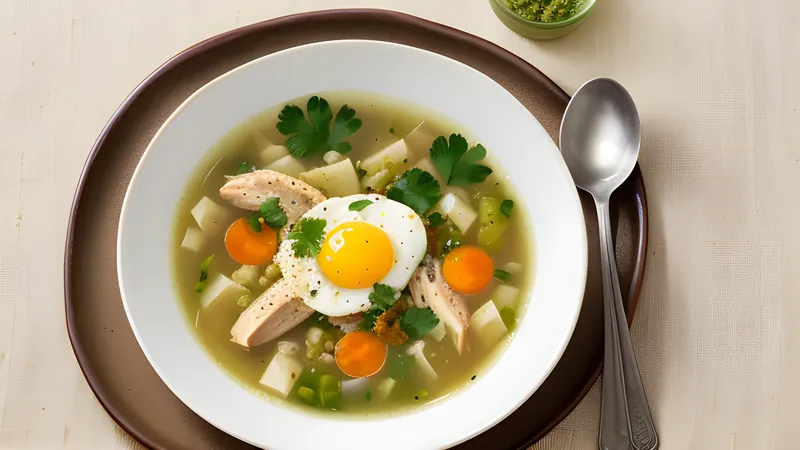
↓ Jump to recipeChikhirtma is what Georgians reach for when someone in the house is under the weather, which is roughly the same job chicken soup does everywhere else in the world, except this version is thickened with a roasted flour-and-butter roux and finished with tempered egg and a full two lemons’ worth of juice. The result is tart enough to wake you up and rich enough to actually feel restorative, which is a harder balance to strike than it sounds - most sick-day soups pick one or the other.
The name comes from chikhiri, an old Georgian word connected to the wine-thinning process, and there’s a version of the dish made with white wine instead of lemon in parts of western Georgia. This is the more common eastern version, built on stock, egg and citrus, and it’s the one you’ll find on menus from Tbilisi to the diaspora restaurants that have opened across Europe over the past decade.
Georgian Chikhirtma: Lemon-and-Egg Chicken Soup
Ingredients
- 1 whole chicken leg (thigh and drumstick), skin on
- 1.4 litres water
- 1 onion, halved, plus 1 onion finely diced
- 2 bay leaves
- 1 tsp black peppercorns
- Sea salt
- 40 g unsalted butter
- 2 tbsp plain flour
- 1 tsp ground coriander seed
- 1/2 tsp ground khmeli suneli (or 1/4 tsp each dried fenugreek leaf and marjoram)
- 3 large eggs
- Juice of 2 lemons (about 60 ml)
- 2 tbsp chopped fresh coriander
- 1 tbsp chopped dried mint, fried briefly in butter, to serve
Method
- Put the chicken leg into a pot with the water, halved onion, bay leaves and peppercorns. Bring to the boil, skim any grey foam, then reduce to a bare simmer and cook uncovered for 35 minutes.
- Lift out the chicken and strain the stock, discarding the solids. You should have roughly 1.2 litres of stock. Once the chicken is cool enough to handle, shred the meat off the bone and discard the skin and bone.
- Melt the butter in the empty pot over medium heat. Add the diced onion and cook gently for 8 minutes until soft and translucent but not browned.
- Stir in the flour and cook, stirring constantly, for 3-4 minutes until it turns a light golden-brown and smells toasted. Add the ground coriander and khmeli suneli and stir for 30 seconds more.
- Gradually whisk in the hot stock, a ladle at a time to begin with, to keep the roux smooth and lump-free. Bring to a gentle simmer and cook for 10 minutes, whisking occasionally, until slightly thickened.
- Return the shredded chicken to the pot and warm through. Reduce the heat to low, so the soup is barely moving.
- In a bowl, whisk the eggs with the lemon juice until fully combined. Ladle a cup of the hot soup into the eggs while whisking constantly, to temper them, then repeat with a second ladleful.
- Pour the tempered egg mixture back into the pot in a thin stream, stirring constantly. Keep the heat low and do not let it boil, or the eggs will scramble. Cook for 2-3 minutes until the soup thickens slightly and turns pale gold.
- Taste and season with salt. Ladle into bowls, scatter with fresh coriander, and finish with the fried dried mint.
Where chikhirtma sits in Georgian cooking
Georgian cuisine is often introduced to newcomers through its showier dishes - khachapuri’s cheese-and-egg boats, khinkali dumplings, the walnut-heavy sauces of satsivi - and chikhirtma tends to get overlooked because it looks, at first glance, like an ordinary chicken soup. It isn’t ranked as a celebration dish the way those others are; it’s closer to what would be called a comfort soup in most households, the thing made when someone’s ill, or the weather’s turned, or there’s a chicken carcass in the fridge that needs using before it goes to waste.
That domestic, everyday status is part of why the recipe varies so much from household to household. Some cooks add a splash of white wine along with, or instead of, the lemon; others skip the roux and rely purely on the egg, closer to the Greek and Turkish versions of the same idea. The version here, with a proper browned roux, is the one most associated with Kartli and Kakheti in eastern Georgia, and it’s the version that gives the fullest-bodied result.
The roux is not optional
Most egg-and-lemon soups around the eastern Mediterranean and Caucasus - avgolemono in Greece, this in Georgia - use egg yolk’s own thickening power and not much else. Chikhirtma is different: it browns flour in butter first, the same base technique that underpins a French velouté, and that roux is what gives the soup its distinct body before the egg ever goes in. Skip it and you’ll have a thinner, less rounded soup that leans entirely on the egg for texture.
Getting the roux right means cooking the flour past the raw, pasty stage into something with actual colour and a toasted, nutty smell - three to four minutes over medium heat, stirring the whole time so it colours evenly rather than catching in one spot. Go too far and it turns bitter; stop too early and the soup will taste faintly of raw flour no matter how long you simmer it afterwards. You’re aiming for the colour of milky coffee, not the deep mahogany of a Cajun roux - this is a much lighter touch.
Whisking in the hot stock gradually, rather than dumping it all in at once, is what keeps the roux smooth. Cold stock or a sudden flood of liquid will seize the roux into lumps that no amount of later whisking fully dissolves. A ladle at a time for the first three or four additions, whisking until each is fully incorporated, gets you a silky base before you can relax and pour in the rest.
Tempering the eggs without fear
The egg-lemon finish is the part that intimidates people who’ve never done it, and it’s simpler than it looks provided you respect one rule: the eggs need to warm up gradually before they meet the full heat of the pot, or they’ll scramble into visible curds rather than dissolving into the soup. Whisking the raw eggs with the lemon juice first actually helps, since the acid firms the proteins slightly and makes them a touch more forgiving of heat, but it’s not a substitute for tempering properly.
Ladle the hot soup into the egg mixture in a thin, steady stream while whisking constantly, not the other way round - you’re bringing the eggs up to temperature bit by bit, and doing it with the eggs as the receiving bowl gives you far more control than trying to drizzle egg into a bubbling pot. Two ladlefuls is usually enough to get the mixture properly warm before you reverse the process and stream the tempered eggs back into the main pot.
Once the eggs go back in, keep the heat low - barely a simmer, ideally not even that - and stir the whole time. The soup will thicken visibly over two to three minutes as the egg proteins set into the liquid rather than clumping. If you see actual solid curds forming, you’ve overheated it; there’s no fixing that batch, but it’ll still taste fine, just with a slightly grainier texture than intended.
Building the stock properly
A whole chicken leg, simmered gently rather than boiled hard, gives you stock with real body and meat you can shred back into the finished soup - buying a leg specifically rather than using odds and ends is worth the small extra cost, since thigh meat stays moist through the simmering time in a way breast meat doesn’t. Skimming the grey foam that rises in the first few minutes of simmering matters more than people think; it’s coagulated protein and impurities, and leaving it in makes for a cloudier, slightly muddier-tasting stock.
Keep the simmer gentle throughout - a hard boil emulsifies fat into the liquid and gives you a greasy-tasting stock rather than a clean one. You want the surface barely trembling, with the occasional bubble breaking through, for the full 35 minutes.
Khmeli suneli and what to do without it
Khmeli suneli is the Georgian spice blend behind most of the country’s savoury cooking - a mix that usually includes dried marjoram, dill, coriander, fenugreek leaf, blue fenugreek, basil and dried marigold petals in varying proportions depending on the region and the maker. It’s increasingly stocked in larger UK supermarkets and easily found online, and it’s worth seeking out if you cook Georgian food more than once, since it turns up in kharcho, satsivi and most of the country’s stews.
Without it, a small pinch of dried fenugreek leaf and dried marjoram gets you most of the way there - fenugreek leaf in particular has a distinctive, slightly bitter, curry-leaf-adjacent aroma that’s hard to replace with anything else in a standard spice rack, so it’s the one substitution worth actually tracking down rather than skipping.
The dried mint finish
Fried dried mint is a small step that makes a disproportionate difference. Dried mint, briefly warmed in a spoonful of butter until it turns fragrant and slightly darker, has a completely different character to fresh mint - deeper, almost savoury, closer to oregano than to the bright top notes of a fresh leaf. It’s a common finishing touch across Georgian and wider Caucasus cooking, scattered over beans, soups and cooked vegetable dishes alike, and it plays particularly well against the tartness of the lemon here. Don’t skip it in favour of fresh mint; the flavour just isn’t the same, and fresh mint tends to wilt and blacken unattractively on a hot soup rather than sitting on top as a fragrant garnish.
Variations and serving
A splash of dry white wine, added along with the stock, gives an alternative reading of the dish closer to the western Georgian style, and it’s worth trying once you’ve made the classic version to see which you prefer. Some households add a small handful of rice at the same point as the stock, simmered until tender, to bulk the soup out into more of a main course.
Serve chikhirtma with warm flatbread or a slice of Georgian shotis puri if you can find it, for scooping and mopping. A simple side of pickled vegetables - a Georgian table rarely goes without some form of pickle - cuts nicely against the richness of the roux and egg.
Storage and reheating
Chikhirtma doesn’t freeze well once the egg has gone in - the texture turns watery and separates on thawing, the same problem that affects most egg-thickened sauces and soups. It keeps in the fridge for two days, though, and reheats gently on the stove over low heat, stirring often and never letting it come back to a full boil. If you want to make it ahead, cook the soup up to the point just before adding the tempered eggs, refrigerate the base, and finish the egg-lemon step fresh when you’re ready to serve.
If you’re planning to feed a crowd, the stock and shredded chicken can be made a day in advance and refrigerated separately from the roux base, which speeds up the final assembly considerably.
For another approach to the same egg-and-lemon idea, look at Avgolemono: Greece’s Silky Egg-and-Lemon Soup, which skips the roux entirely and relies on rice starch instead - a useful comparison for seeing how two neighbouring cuisines solve the same tempering problem differently. And for another dish built around a slow-simmered chicken stock, see Lemon Chicken Noodle Soup.
Related Content