Gallo Pinto with Salsa Lizano
Costa Rica's speckled rice and beans, and a fried egg on top
Contents
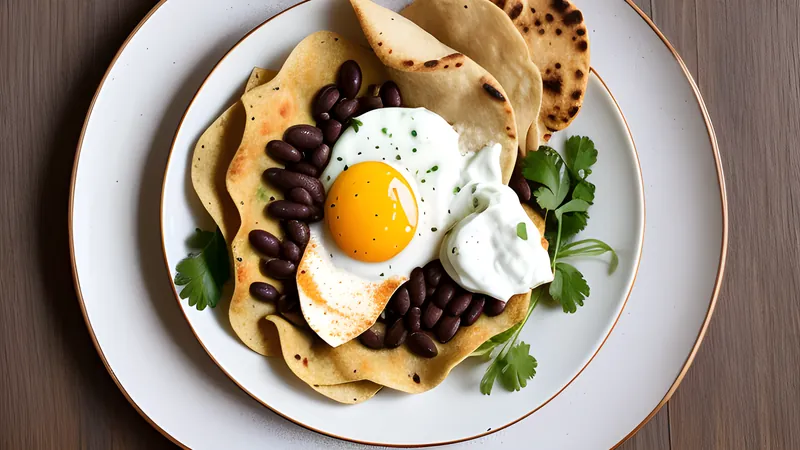
↓ Jump to recipeAsk a Costa Rican what they had for breakfast and the answer, more often than not, is gallo pinto. Rice and beans fried together with onion, pepper and coriander until the grains turn a mottled purple-grey, served with a fried egg and a scrape of soured cream: it is the plate that starts the day from San José to the smallest village, eaten at dawn before work and again, unhurried, on a Sunday. The name means “spotted rooster”, a nod to the speckled look the beans give the rice. It is humble, thrifty, deeply comforting food, and it hangs entirely on two things: cold rice and a bottle of Salsa Lizano.
My only real intervention is to toast the rice a little harder than some cooks do, pressing it into the hot pan so patches catch and crisp, the way the best fried rice always has a few browned, chewy grains. That toasted edge is what turns leftovers into something you would happily cook on purpose.
Gallo Pinto with Salsa Lizano
Ingredients
- 3 tbsp neutral oil, plus a little more for the eggs
- 1 medium onion, finely diced
- 1 red pepper, finely diced
- 3 garlic cloves, finely chopped
- 400g cooked black beans, drained but with 4 tbsp of their cooking liquid reserved
- 500g cooked long-grain rice, cold (ideally cooked the day before)
- 3 tbsp Salsa Lizano (see notes for a substitute)
- 0.5 tsp fine salt, plus more to taste
- 4 tbsp fresh coriander, chopped, plus more to finish
- 3 spring onions, thinly sliced
- 4 eggs, to serve
- Warm corn tortillas, soured cream and sliced avocado, to serve
Method
- Heat 3 tbsp oil in a large, wide frying pan over a medium heat. Add the onion and red pepper with a pinch of salt and cook for 6 to 8 minutes until soft and beginning to colour.
- Add the garlic and cook for 1 minute until fragrant.
- Add the drained black beans with their reserved cooking liquid and 2 tbsp of the Salsa Lizano. Cook for 3 to 4 minutes, mashing a few beans against the pan, until the mixture looks glossy and most of the liquid has gone.
- Add the cold rice, breaking up any clumps with your hands as it goes in. Fry, tossing and pressing, for 5 to 6 minutes until the rice is heated through and lightly toasted in places and the whole pan has turned a speckled purple-brown.
- Stir in the remaining 1 tbsp Salsa Lizano, the coriander and half the spring onions. Taste and adjust the salt.
- In a separate pan, fry the eggs in a little oil until the whites are set and crisp at the edges but the yolks still run.
- Divide the gallo pinto between plates, top each with a fried egg, scatter with the remaining spring onion and more coriander, and serve with tortillas, soured cream and avocado.
Rice, beans and a wartime condiment
Gallo pinto belongs to the great Latin American tradition of rice and beans, which stretches from the moros y cristianos of Cuba to the casamiento of El Salvador. Costa Rica and Nicaragua both claim it as a national dish, and cheerfully argue about who did it first. The Nicaraguan version leans on red beans and tends to be drier; the Costa Rican one uses black beans and, crucially, Salsa Lizano. That bottle is the dividing line, and it is the whole personality of the Tico plate.
Salsa Lizano is a thin, tangy, faintly sweet brown sauce that has been made in Costa Rica since 1920. It sits somewhere in the family of British brown sauces, seasoned with cumin, turmeric, black pepper and a whisper of chilli, and it is on every table in the country. Costa Ricans put it on everything, but its spiritual home is gallo pinto, where it does the work that soy sauce does in fried rice, giving savoury depth, colour and a gentle acidic lift that keeps a plate of starch from feeling heavy.
The dish is inseparable from the soda, Costa Rica’s small family-run diner. A soda breakfast of gallo pinto with eggs, fried plantain and a strong coffee is one of the great cheap meals of Central America, and it is the reason the country consistently reports some of the highest breakfast-satisfaction and, only half-jokingly, some of the highest happiness scores anywhere. There is something to be said for a nation that agrees on breakfast.
Why yesterday’s rice is the secret
Freshly cooked rice is the wrong tool for this job, and it is worth understanding why. Warm rice is soft and full of surface moisture, so when it hits a hot pan it clumps, steams and turns to mush instead of frying. As cooked rice cools in the fridge, the starches undergo retrogradation: the gelatinised starch molecules recrystallise and firm up, the grains dry out slightly and separate, and the surface toughens just enough to take colour without collapsing. This is the same science behind good egg fried rice, and it is why every cuisine that fries rice insists on cold, day-old grains.
If you have forgotten to cook rice the day before, spread freshly cooked rice on a tray in a thin layer and let it cool completely, then chill it uncovered for an hour or two. It won’t quite match genuinely day-old rice, though it fries far better than warm rice straight from the pan.
The beans matter too. You want them cooked soft but still whole, and you want some of their inky cooking liquid, because that liquid carries starch and flavour and is what glazes the rice and gives gallo pinto its characteristic sheen. Draining beans bone-dry and adding water instead is a false economy. If you are using tinned beans, use the liquid from the tin, or a splash of it, rather than throwing it away.
Cooking it
Get your sofrito base right first: onion and red pepper softened properly in a good slug of oil until sweet and just colouring, then the garlic for a minute. Add the beans with their liquid and a couple of tablespoons of Lizano, and let it cook down until glossy, mashing a few beans against the pan to thicken things and help everything cling to the rice later.
Now the rice goes in cold, broken up with your fingers as it lands so there are no clumps. This is where you commit to the toasting. Spread the rice across the pan, let it sit for a moment to catch, then toss and press again, for a good five or six minutes, until the whole pan has turned that unmistakable speckled purple-brown and you can smell the grains starting to toast. Finish with the last of the Lizano, the coriander and the spring onions.
The fried egg on top is not optional in my house. Fry it in a separate pan so the white crisps and lacy at the edges while the yolk stays liquid, then set it on the pinto so the yolk breaks and runs into the rice like a sauce. A scrape of soured cream, some avocado and a warm tortilla, and you have the full Tico breakfast.
Tips, swaps and make-ahead
No Salsa Lizano? It is increasingly easy to find online and in Latin American shops, and it keeps for ages, so it is worth ordering a bottle. In a pinch, a workable stand-in is 2 tablespoons of Worcestershire sauce loosened with 1 tablespoon of water and a pinch each of ground cumin and turmeric. It won’t be identical, though it lands in the right postcode.
Bean choice: black beans are the Costa Rican standard, but this works with pinto or red beans if that is what you have. The dish shifts towards its Nicaraguan cousin, and no worse for it.
Vegan version: the pinto itself is naturally vegan. Skip the egg and soured cream, or top with a spoonful of pico de gallo and some avocado instead.
Leftovers reheat beautifully in a hot pan, crisping up even further the second time. Gallo pinto is a leftovers dish by design, so a big batch on Sunday feeds you through the week.
If you like your breakfast built on beans and eggs, this shares a table with huevos rancheros and its charred salsa and refried beans, and it scratches the same weeknight itch as a breakfast burrito with crispy potato and chipotle. If it is the fried, crispy, day-old texture you are after, migas with tortilla, egg and chorizo works the same magic from a Tex-Mex direction.
Gallo pinto is a lesson in how far cold rice, a tin of beans and one very good bottle of sauce can carry you. It costs almost nothing, comes together in twenty minutes, and it explains, better than any statistic, why so many Costa Ricans look forward to breakfast.
Related Content