Fish Pie with a Cheddar Mash Crust
A proper fish pie under a golden lid
Contents
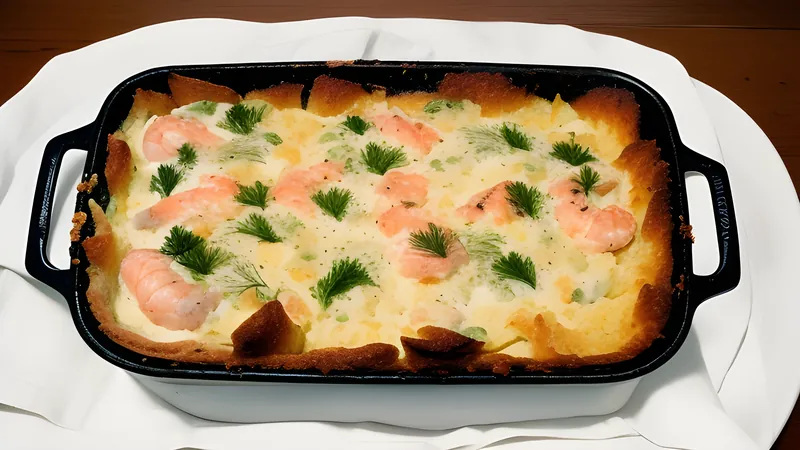
↓ Jump to recipeFish pie is the dish I make when the week has been long and I want the kitchen to smell like reassurance. It is a genuinely humble thing — poached fish, a béchamel loosened with the poaching milk, a lid of mash — and it rewards the smallest attention to detail out of all proportion to the effort involved. My one twist is the crust: I fold a good handful of mature cheddar into the mash and scatter more on top, so the lid bakes into a savoury, craggy sheet of gold rather than the pale plain potato of the nursery version. It gives the whole pie a backbone.
Fish Pie with a Cheddar Mash Crust
Ingredients
- 300g smoked haddock (undyed)
- 300g salmon fillet, skinned
- 150g raw peeled prawns
- 600ml whole milk
- 1 bay leaf
- 50g butter, plus more for the mash
- 50g plain flour
- 2 tsp Dijon mustard
- A good grating of nutmeg
- 2 tbsp chopped parsley
- 2 tbsp chopped dill
- 3 eggs (optional), soft-boiled and quartered
- 900g floury potatoes (Maris Piper or King Edward)
- 75ml warm milk for the mash
- 100g mature cheddar, grated
- Salt and white pepper
Method
- Peel and cut the potatoes into even chunks. Boil in salted water for 15–18 minutes until tender, then drain and steam-dry.
- Meanwhile, lay the haddock and salmon in a wide pan, pour over the 600ml milk, add the bay leaf and bring gently to a bare simmer. Poach for 4 minutes, then lift the fish out and strain the milk into a jug.
- Melt 50g butter in a saucepan, stir in the flour and cook for 2 minutes. Gradually whisk in the warm poaching milk to make a smooth sauce; simmer 3–4 minutes until thick.
- Off the heat, stir in the mustard, nutmeg, parsley and dill. Season with salt and white pepper.
- Flake the poached fish into large chunks into a baking dish, scatter over the raw prawns and the quartered eggs if using. Pour over the sauce and fold gently.
- Mash the drained potatoes with butter and the 75ml warm milk until smooth. Season, then beat in half the cheddar.
- Spoon the mash over the filling and rough up the top with a fork. Scatter over the remaining cheddar.
- Bake at 200°C for 30–35 minutes, until the top is golden and the sauce bubbles up at the edges. Rest 10 minutes before serving.
A pie built on thrift
The British fish pie is a child of the fishing ports and the make-do kitchen. Before refrigeration, smoked and salted fish were how you carried the catch inland and made it last, and a pie was how you stretched a modest amount of fish to feed a family, bulked out with potato and bound in a milk sauce that used up the poaching liquid. Nothing was wasted: the milk that cooked the fish became the sauce, the trimmings went in, and the crust was whatever starch was cheapest.
Smoked haddock is the soul of it. The cold-smoked, undyed fish from the north-east coast and the Scottish ports carries a gentle woodsmoke that perfumes the entire pie, and it is the one ingredient I would not swap. Look for the pale, natural-coloured fillets rather than the fluorescent yellow-dyed ones, which are coloured with annatto and often more harshly smoked. A mix of fish gives the best result — the haddock for smoke, salmon for richness and colour, and prawns for sweetness and a bit of bite. That trio is my standard, but any firm white fish, a bit of undyed cod, or a handful of mussels all belong here.
The sauce is the whole game
A fish pie lives or dies by its sauce, and the sauce lives or dies on one decision: poach the fish in the milk first, then build the béchamel from that infused milk. This is the step people skip, and it is the difference between a pie that tastes of the sea and one that tastes of wallpaper paste. As the fish poaches, it releases its flavour — and in the case of the haddock, its smoke — into the milk. Strain that milk and whisk it into your roux and every spoonful of sauce carries the fish through it.
Poach gently. You want the milk barely trembling, never at a rolling boil, and only four minutes — the fish will finish cooking in the oven, so it should still be underdone when you lift it out. Overcook it now and it turns dry and chalky by the time the pie is baked.
For the roux, cook the butter and flour together for a full two minutes before you add any liquid. Raw flour tastes of raw flour, and that pasty edge never quite leaves a sauce that was rushed. Add the warm milk gradually, whisking hard between additions, and let the finished sauce simmer for a few minutes to thicken properly — it should coat the back of a spoon and hold a line when you draw a finger through it. Mustard, nutmeg and a generous amount of fresh dill and parsley go in off the heat. The nutmeg is traditional and does something almost magical with milk and fish; do not leave it out.
Building and baking
Flake the poached fish into large chunks straight into your baking dish. Big pieces are what you want — they hold their shape and give you those satisfying forkfuls of distinct fish rather than a homogenous mush. Scatter the raw prawns among them; they will cook through perfectly in the oven’s heat. Soft quartered eggs are a classic addition that I love for the way they enrich the whole thing, though they are entirely optional. Pour over the sauce and fold it through gently so you do not break up the fish.
Season the filling before the mash goes on, tasting the sauce as you go. Smoked haddock brings its own salt, so hold back until you have checked — an over-salted filling has nowhere to hide under a bland potato lid. A grind of white pepper rather than black keeps the pie looking clean and pale, a small vanity that matters less than the seasoning itself but is a nice habit to keep.
The mash needs to be dry and firm enough to hold its shape on top of a wet filling. Steam-dry the drained potatoes for a minute or two over the low heat before mashing — a wet mash slides off and sinks. Beat in butter, warm milk (cold milk seizes the starch and turns mash gluey) and half the cheddar. Spoon it over the filling in dollops and only then spread it, so you do not drag the sauce up into the potato, then rough the surface up thoroughly with a fork. Those peaks and ridges are what catch the heat and crisp, and the remaining cheddar scattered over them turns properly golden and lacy.
Bake at 200°C until the top is deep gold and, crucially, until you can see the sauce bubbling up around the edges of the dish. That bubbling is your signal that the filling is piping hot all the way through and the prawns are cooked. Then — and this takes discipline — let it rest for ten minutes. A fish pie taken straight from the oven is a molten landslide; ten minutes lets the sauce settle enough to hold a slice.
Make-ahead, storage and variations
This is a superb make-ahead dish. Assemble it completely, cool, cover and keep in the fridge for up to a day; add ten minutes to the baking time if it goes in cold. It also freezes well before baking — freeze it solid, then bake from frozen at 180°C for around an hour, covering the top with foil if the cheese browns too fast. Leftovers keep for two days and reheat happily in a hot oven, though not quite so gracefully in a microwave, where the mash goes soft.
For variations, a layer of wilted spinach under the fish is lovely and makes it feel like a whole meal in one dish. A little grated lemon zest in the sauce brightens everything. If you want a smokier pie, swap some of the plain salmon for hot-smoked, and if you are cooking for a crowd, everything scales up cleanly into a bigger dish. Serve it with nothing more than buttered peas or a sharp green salad to cut the richness.
One more note on the cheese. Mature cheddar is doing double duty: half of it melts into the mash and seasons it from within, the other half browns on the surface. A younger, milder cheese browns less and tastes of little, so reach for something with real age and bite. A few of you will want to gild it further with a scrape of Parmesan over the top for extra colour, which I have no argument against.
If this has you in a fish-and-potato mood, the same love of a golden potato top runs through my duchess potatoes, piped and golden, and for a lighter, faster seafood supper on another night I would point you straight at garlic-butter prawns with sourdough. This pie, though, is the one for a cold evening when you want to be looked after.
Related Content