Fish Head Curry, Singapore-Style
The great cross-cultural curry of Singapore, tamarind-sour and coconut-rich
Contents
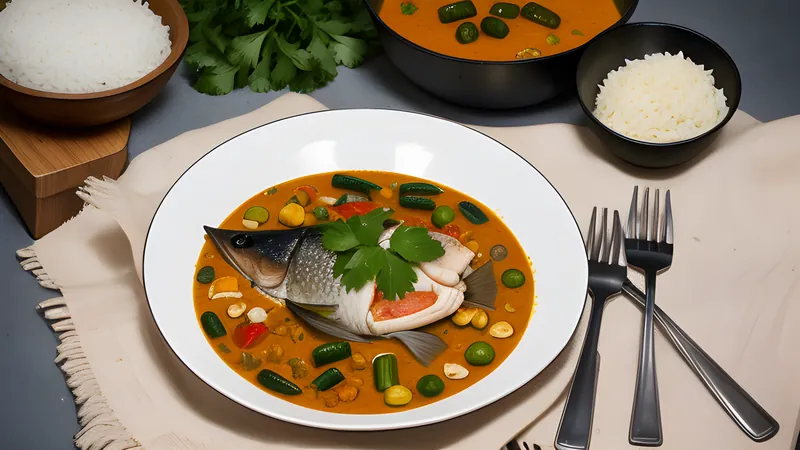
↓ Jump to recipeFish head curry is one of those dishes that could only have been born in a port city where cultures live on top of one another. The story usually credited is that of a Keralan cook named M.J. Gomez, who in 1949 ran a restaurant in Singapore and noticed that his Chinese customers prized the fish head above all other cuts, as the sweetest, gelatinous, most prestigious part. So he took the South Indian fish curry of his home coast and built it around a whole head. A Malayali gravy, a Chinese reverence for the head, tamarind and coconut from the Malay kitchen, all in one clay pot. It became a Singaporean institution, eaten by everyone, claimed by nobody in particular.
I understand the flinch. A fish head staring up from a pot is a lot to ask of a squeamish cook. But the head carries the best eating on the whole fish: the cheeks are two nuggets of dense, sweet meat, the collar behind the gills is rich and fatty, and the gelatine that cooks out of it gives the gravy a body no fillet can match. Ask your fishmonger to scale, gut and halve a head for you; a large snapper, grouper or sea bream head runs about a kilo and feeds four when there’s rice and gravy to go round.
Fish Head Curry, Singapore-Style
Ingredients
- 1 large fish head (snapper, grouper or sea bream), about 1kg, cleaned and halved
- 2 tbsp tamarind paste, loosened in 200ml warm water
- 3 tbsp vegetable oil
- 1 tbsp brown mustard seeds
- 20 fresh curry leaves
- 1 large onion, sliced
- 4 garlic cloves, minced
- 3cm ginger, minced
- 3 tbsp fish curry powder (or 2 tbsp Madras curry powder plus 1 tsp ground fenugreek)
- 1 tsp ground turmeric
- 2 tomatoes, cut into wedges
- 2 green chillies, slit lengthways
- 400ml coconut milk
- 200ml water
- 8 okra, tops trimmed
- 1 small aubergine, cut into batons
- 1 tbsp sugar
- 1.5 tsp salt, plus more to taste
- Steamed rice, to serve
Method
- Rub the fish head halves with a little salt and turmeric and set aside. Loosen the tamarind in warm water, then strain out the seeds and fibres, keeping the sour liquid.
- Heat the oil in a wide pot or wok. Add the mustard seeds and, when they pop, the curry leaves; they will crackle. Add the onion and fry 8 minutes until soft and golden at the edges.
- Add garlic and ginger, cook 2 minutes, then stir in the curry powder and turmeric. Fry 1 minute, splashing in a little water so the spices don't catch, until the oil takes on colour.
- Add the tomatoes, green chillies, tamarind liquid, coconut milk and water. Bring to a gentle simmer and cook 5 minutes to marry the gravy.
- Slide in the fish head halves, cut-side down, spooning gravy over them. Add the okra and aubergine around the fish. Simmer gently, uncovered, for 15–18 minutes, basting the head, until the cheeks are opaque and the vegetables tender. Do not stir hard or the head breaks up.
- Stir in the sugar and salt, taste, and balance the sour-salt-sweet. Rest off the heat for 5 minutes, then serve with plenty of steamed rice.
The balance that makes it Singaporean
A great fish head curry lives or dies on the tension between sour and rich. Tamarind brings the sour, coconut milk brings the rich, and the whole art is holding them in balance so neither wins. Too much coconut and the curry turns cloying and dull; too much tamarind and it’s harsh. You want each spoonful to arrive sour and bright, then bloom into coconut warmth, then finish with a curry-leaf hum. A teaspoon of sugar at the end is not there to sweeten so much as to round the edges, the same way a pinch of sugar tames an over-sharp tomato sauce.
My one steer, and it’s a small heresy, is to toast the fish curry powder in the oil until it smells nutty and the oil stains red before any liquid goes near it. Curry powder simmered raw into a wet gravy stays dusty and flat. Frying it first, splashing in a spoon of water if it threatens to catch, cooks out the raw edge and blooms the spice into the fat. This bhuna step, borrowed straight from the Indian side of the dish’s parentage, is the difference between a gravy that tastes of powder and one that tastes of curry.
Tempering: where the flavour starts
The dish opens with a tarka, the South Indian technique of blooming whole spices in hot oil. Brown mustard seeds go in first and pop like tiny fireworks, which is your signal the oil is hot enough; then a fistful of fresh curry leaves, which crackle and release a citrus-savoury aroma that no dried leaf comes close to. Fresh curry leaves are worth hunting down at an Asian grocer and they freeze well, so buy a bag and stash it. This tempered oil is the flavoured foundation everything else is built on.
The onions then fry down slowly, garlic and ginger follow, and only then the spices. Building a curry is a sequence of patient layers, and rushing any one of them shows in the bowl.
A word on the curry powder, since it does so much of the heavy lifting. A dedicated fish curry powder, sold in every Singaporean and South Indian shop, leans harder on coriander, chilli and fenugreek than a general Madras blend, and that gentle bitterness of fenugreek is what stops a coconut gravy turning one-note. If you can only find Madras powder, a teaspoon of ground fenugreek stirred in closes most of the gap.
Cooking the head without wrecking it
A fish head is delicate once it’s cooked and falls apart if you fuss it. Slide the halves in cut-side down and baste rather than stir, spooning the hot gravy over the top so the upper surface cooks in the steam and the aromatics. Fifteen to eighteen minutes at a gentle simmer is plenty; the cheeks turn from glassy to opaque and a chopstick slips easily into the collar meat. Boil it hard and the flesh shreds and the gravy clouds, so keep the heat low and let it be.
The vegetables go in around the head to cook in the gravy. Okra and aubergine are traditional; okra thickens very slightly as it cooks, which suits the dish, and aubergine drinks up gravy and turns silky. Some cooks add lady’s fingers and tomatoes only; others throw in long beans. Keep the pieces large so they don’t disintegrate before the fish is done.
Eating it, and the parts people miss
At the table, the head is communal territory. The cheeks are fought over, the collar is prised out with a spoon, and the truly initiated go for the gelatinous bits around the eye, which are prized in both Chinese and Malay cooking for their silkiness. You don’t have to. But a mountain of steamed rice to soak the sour-rich gravy is not optional, and a few extra slit chillies for those who want more heat.
Tips, swaps and getting ahead
- No whole head? Firm fish steaks on the bone (snapper, monkfish, cod cheeks) make an excellent, less confronting version. Bone-in is important, because the bones give the gravy its body.
- Tamarind depth: use wet tamarind pulp loosened in warm water and strained, rather than the dark concentrate, for a fresher sourness. If you only have concentrate, use half the quantity and taste.
- Make the gravy ahead. The gravy is better after a night in the fridge, so cook it a day early, then reheat gently and add the fresh fish head just before serving; fish reheated hard goes rubbery.
- Balance last, always. Salt, sugar and tamarind all go in at the end, off a full simmer, so you can taste and correct. Coconut milk mutes salt, so you’ll need more than you expect.
If you like the coconut-and-curry-leaf register, nasi lemak with sambal and crispy anchovies is the Malaysian breakfast plate that shares this curry’s whole flavour world, coconut rice with a fierce chilli sambal. And for coconut cooking with seafood from the other side of the world, the callaloo soup with coconut and crab proves how many kitchens arrived independently at the same happy marriage of coconut milk and shellfish.
Fish head curry looks like a dare and eats like a revelation. Cook it once, fight over the cheeks, and you’ll understand why a whole city adopted a Keralan cook’s clever idea and never gave it back.
Related Content