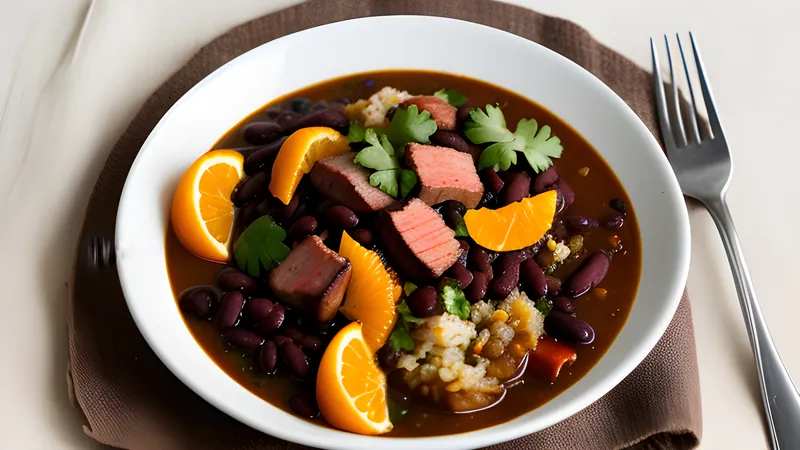
Feijoada with Smoked Pork and Black Beans
Brazil's Saturday-lunch ritual — black beans built in layers of smoke from three different cuts of pork
Contents
↓ Jump to recipeFeijoada is a pot you build in layers, and the twist that separates a good one from a great one is exactly that: staggering three or four different smoked and cured pork cuts into the beans at different points, so each one has time to give up its particular flavour without turning to mush. Ribs, bacon, sausage, sometimes salt-cured beef — each goes in on its own schedule, and after four hours together in the pot, the beans have taken on a depth that no single cut of meat, however good, could deliver alone.
Feijoada with Smoked Pork and Black Beans
Ingredients
- 500g dried black beans, soaked overnight in plenty of cold water
- 300g smoked pork ribs (costela defumada), cut into portions
- 300g smoked bacon or pork belly, in one piece
- 200g smoked pork sausage (linguiça or a good smoked kielbasa), sliced into rounds
- 150g carne seca or salt pork, soaked and rinsed if very salty (optional but traditional)
- 2 bay leaves
- 2 tbsp neutral oil or reserved pork fat
- 1 large onion, finely chopped
- 6 cloves garlic, finely chopped
- 2 tsp sweet smoked paprika
- 1 orange, halved, for cooking whole in the pot
- Fine sea salt, to taste
- Ground black pepper, to taste
- 2 tbsp chopped fresh coriander or flat-leaf parsley
- Cooked white rice, to serve
- Farofa (toasted cassava flour), to serve
- Braised collard greens (couve à mineira), to serve
- Orange segments or slices, to serve
- Hot sauce or malagueta pepper sauce, to serve
Method
- Drain the soaked black beans and rinse well. Put them in a large, heavy pot with the bay leaves and cover with 2.5 litres of fresh cold water. Bring to a boil, skim off any foam, then reduce to a simmer.
- If using carne seca, add it to the beans now, since it needs the longest cooking to soften and lose excess salt. Simmer the beans gently, partially covered, for 1 hour.
- Add the smoked ribs and the piece of smoked bacon or belly to the pot. Continue simmering for a further 1.5 hours, topping up with hot water as needed to keep everything just submerged.
- Meanwhile, heat the oil in a small pan over medium heat. Fry the onion for 6–8 minutes until soft and golden, then add the garlic and smoked paprika and cook for 1 more minute until fragrant.
- Stir the onion mixture into the beans, along with the halved orange (skin and all, to be removed later). Continue simmering for 45 minutes to 1 hour, until the ribs and belly are completely tender and the beans have started to break down and thicken the liquid.
- Add the sliced sausage and cook for a final 20 minutes, until heated through and the beans have thickened to a rich, dark, glossy stew that coats a spoon.
- Remove and discard the orange halves and bay leaves. Lift out the meats, cut the ribs and belly into serving pieces, and return them to the pot.
- Taste and season with salt and black pepper — go carefully, since the smoked meats carry a lot of salt already. Stir through the chopped coriander or parsley.
- Serve in wide bowls or from the pot at the table, with white rice, farofa, braised collard greens, orange slices and hot sauce alongside, in the traditional Brazilian Saturday spread.
Where it comes from
Feijoada is Brazil’s national dish, though its exact origins carry more myth than most food historians are entirely comfortable with. The popular story — that feijoada was invented by enslaved people on Brazilian plantations, cooking discarded pig parts like ears, tails and trotters that plantation owners threw away — has been widely repeated but is contested by Brazilian culinary historians, who point out that bean-and-meat stews with this structure have precedent in Portuguese dishes like cozido and in similar bean-and-pork stews found across Iberian and broader European peasant cooking, brought over during Portuguese colonisation beginning in the sixteenth century. What’s clear is that feijoada, whatever its precise origin, became something distinctly Brazilian by the nineteenth century, and it carries real historical weight either way, tangled up as it is with the memory of slavery, which lasted in Brazil until 1888 — the last country in the Americas to abolish it.
What is certain is feijoada’s role today: it’s a Saturday lunch ritual across Brazil, eaten leisurely over hours with family or friends, traditionally starting late morning and running well into the afternoon, often accompanied by caipirinhas. Rio de Janeiro is particularly associated with the dish, where countless restaurants serve feijoada completa — the full spread with rice, farofa, collard greens and orange — as their signature Saturday offering, and some serve nothing else that day at all. The full spread of accompaniments is not optional garnish; each element does a specific job. The rice and beans together form a complete protein, a nutritional pairing common across Latin American and Caribbean cooking. Farofa, toasted cassava flour, adds crunch and soaks up the rich bean liquid. Braised collard greens, cut into fine ribbons, bring bitterness and freshness against the fattiness of the pork. And orange — served in slices alongside, sometimes cooked briefly in the pot itself — is there for a specific, practical reason: Brazilians have long held that the citrus helps cut the richness of the meal and aids digestion after a genuinely heavy plate of food.
Traditional recipes, and many still served in Rio’s older botecos, go further into the pig than this version does, including ears, tail, trotters and snout for the collagen and gelatinous texture they contribute to the sauce — a legacy either of enslaved cooks working with what plantation kitchens discarded, or simply of a broader, waste-nothing approach to butchery common across older European and Brazilian cooking, depending on which historian you ask. Most home cooks and a good number of modern restaurants have quietly moved away from the offal-heavy version over the past few decades, partly on grounds of taste and partly because those cuts are simply harder to source and prepare well outside Brazil; ribs, bacon and sausage alone give you real depth without demanding a specialist butcher. São Paulo’s version tends to run a little less fatty and a little more restrained with the smoked meats than Rio’s, while further north and inland, feijão tropeiro — a related but distinct dry, crumbly bean-and-bacon dish tossed with cassava flour rather than simmered into a stew — shows how far the basic bean-and-pork pairing spreads across Brazilian regional cooking once you leave Rio’s specific version behind.
The method, explained
The layering of the meats is the single technique that makes or breaks a feijoada, and it comes down to how differently each cut behaves under heat. Carne seca, dried and heavily salted beef, needs the longest soak and the longest simmer of anything in the pot — both to soften back into something chewable and to leach out enough of its curing salt that it doesn’t oversalt the whole dish, which is why it goes in first, alongside the beans themselves, for a full hour before anything else joins. Smoked ribs and a whole piece of smoked bacon or belly go in next, needing roughly ninety minutes of gentle simmering to render their fat properly and turn fall-apart tender — added too early, before the beans have had a head start, they’d overcook into stringiness by the time the beans catch up. Smoked sausage, by contrast, is already fully cooked when it goes into the pot; it only needs twenty minutes to heat through and release some of its paprika-and-garlic fat into the broth, and any longer risks it splitting and turning the beans greasy rather than silky.
The orange added whole to the pot, skin included, is worth understanding rather than skipping. As it simmers for the better part of an hour, the bitter pith and aromatic oil in the peel slowly infuse into the bean liquid, cutting through the richness of three kinds of pork fat with a background bitterness that keeps the dish from tasting flat or one-note. It’s removed and discarded before serving — its whole job is what it leaves behind in the pot.
Getting the beans to the right consistency is largely about time and a heavy pot rather than any trick. Black beans release starch slowly as they cook, and that starch is what should be thickening the broth into something glossy enough to coat a spoon by the end of four hours — if the pot looks thin after three hours, mash a small ladleful of beans against the side of the pot and stir it back in to help the process along, rather than reaching for flour or cornflour, which would dull the flavour.
The overnight soak matters for reasons beyond simply shortening the cooking time. Dried black beans that go straight into the pot unsoaked cook unevenly — the skins soften before the interior does, and a good number burst and turn mealy well before the toughest beans in the batch are properly tender. An 8-to-12-hour soak in plenty of cold water lets the beans rehydrate evenly all the way through, so the whole pot reaches doneness together. It’s also worth holding back on salt until near the end, once the meats have gone in and the beans are most of the way soft: salt added too early, before the bean skins have had time to soften properly in the soak and simmer, can toughen them and slow the softening process, a piece of kitchen folklore that happens to hold up under actual food-science scrutiny. Since the smoked meats already carry a fair amount of salt into the pot on their own, there’s rarely a need to add much before the final seasoning stage anyway.
The recipe
Soak dried black beans overnight, then simmer them with bay leaves in plenty of water, adding carne seca if using at this early stage since it needs the longest cooking. After an hour, add smoked ribs and a whole piece of smoked bacon or belly, and continue simmering gently for ninety minutes, topping up with hot water to keep everything submerged. Fry onion until golden, add garlic and smoked paprika, then stir this into the beans along with a whole halved orange, and simmer for another forty-five minutes to an hour until the ribs and belly are completely tender and the beans have thickened.
Add sliced smoked sausage for a final twenty minutes to heat through, then discard the orange halves and bay leaves, cut the larger cuts of meat into serving pieces and return them to the pot. Season carefully with salt and pepper, mindful of how much salt the smoked meats have already contributed, and finish with chopped coriander or parsley. Serve from the pot at the table with white rice, farofa, braised collard greens, orange slices and a good hot sauce, in the full Brazilian Saturday spread.
Tips, substitutions, make-ahead and storage
Feijoada genuinely improves overnight in the fridge — the beans continue to thicken and the flavours settle, so cooking it a day ahead of a lunch gathering and gently reheating is standard practice in Brazil rather than a compromise. It keeps well refrigerated for four days and freezes excellently for up to three months, since the beans and pork both hold their texture well through freezing and reheating, better than most stews.
If carne seca or a Brazilian butcher isn’t accessible, the dish works perfectly well built from just smoked ribs, smoked bacon and a good smoked sausage — many home cooks in Brazil itself simplify the meat list depending on what’s available. Linguiça is the traditional sausage, but any good-quality, well-smoked pork sausage, including a smoked kielbasa, is a fair substitute. Collard greens can be swapped for cavolo nero or even shredded spring greens, sliced into the finest ribbons you can manage and quickly wilted in a little garlic and oil.
A pressure cooker or electric multi-cooker cuts the timeline dramatically if a full afternoon isn’t available: pressure-cook the soaked beans with the carne seca for about 25 minutes, then add the ribs and bacon and cook under pressure for a further 20, before finishing the sauce, sausage and seasoning uncovered on the stovetop as in the recipe above — you lose a little of the slow-built depth but gain a feijoada in under 90 minutes rather than four hours. However you cook it, resist thinning the finished stew with extra water even if it looks thick in the pot; feijoada is meant to be dense enough that a spoon leaves a trail, and any excess liquid is better simmered off than the beans diluted to compensate.
Variations
Feijoada branca, made with white beans instead of black, is a lighter, less common regional variation found in parts of southern Brazil. Some cooks add a pig’s trotter or ear to the pot for extra collagen and body if the dish is being made for a genuinely large gathering — traditional, if not everyone’s preference today. A vegetarian feijoada, built on the same black beans with smoked paprika standing in for the smoked pork and a splash of liquid smoke, loses the meaty backbone but keeps a surprising amount of the dish’s character.
Feijoada rewards a slow Saturday more than almost anything else in this collection — start it after breakfast, let it run for hours, and gather the table around it the way it’s meant to be eaten. For more from the Brazilian side of the pantry, follow it with pão de queijo alongside for the table, and finish the meal properly with a plate of brigadeiros.
Related Content