English Muffins, Griddled, for Better Eggs Benedict
A wet, slack dough cooked on a dry griddle into nooks and crannies, dusted with semolina
Contents
↓ Jump to recipeA shop English muffin is a sad, uniform disc that tastes of packaging. A homemade one, griddled on a dry pan until the top and bottom go a freckled gold and the middle stays pale and cottony, is a different food entirely, and the difference matters most when you build it into eggs Benedict. The craggy interior, torn open with a fork, is a sponge for hollandaise and yolk. Get the muffins right and Sunday breakfast leaps up a grade. They are made from a wet, almost pourable dough, cooked on the hob, and they involve no oven at all.
English Muffins, Griddled, for Better Eggs Benedict
Ingredients
- 400g strong white bread flour, plus extra for dusting
- 7g fast-action dried yeast (one sachet)
- 1.5 tsp fine salt
- 1 tsp caster sugar
- 220ml whole milk, lukewarm
- 60ml water, lukewarm
- 20g unsalted butter, softened
- Fine semolina or polenta, for dusting
Method
- Warm the milk and water together to blood temperature. Mix the flour, yeast, salt and sugar in a large bowl.
- Add the warm milk and water and the softened butter. Bring together into a very wet, sticky dough; it should be too slack to knead by hand comfortably.
- Beat the dough hard with a spoon, or knead with a stand mixer dough hook, for 6-8 minutes until it is smooth, glossy and stretchy. Cover and prove 1-1.5 hours until doubled and bubbly.
- Dust a tray generously with semolina. Flour your hands and the worktop well.
- Turn the dough out, dust the top with flour, and pat gently to about 2cm thick. Cut out 8 rounds with an 8-9cm cutter, or divide and shape by hand into flat discs.
- Sit the rounds on the semolina, then dust their tops with more semolina. Cover and prove again for 30-40 minutes until puffy and pillowy.
- Heat a dry, heavy frying pan or flat griddle over low-medium heat. Cook the muffins, no oil, for 7-8 minutes a side until deep golden and cooked through, adjusting the heat so the insides set before the crust darkens too far.
- Cool on a rack. To serve, split each muffin around the equator with a fork, not a knife, prising it open to keep the rough nooks and crannies. Toast the cut faces.
Neither English nor a muffin, quite
The naming is a muddle worth untangling. In Britain these are simply “muffins”, the yeasted, griddled kind sold by the Victorian muffin man who walked the streets with a tray on his head and a bell, immortalised in the nursery rhyme. The American term “English muffin” arrived to distinguish them from the sweet, cakey American muffin, which is a different thing altogether. Their ancestor is the wider family of griddle breads that Britain made before every home had an oven, the same tradition that gives us the crumpet and the pikelet, all cooked on a bakestone or a hot iron over the fire.
The muffin’s defining feature, the one the marketers turned into a slogan, is the “nooks and crannies”: an open, ragged internal crumb full of holes that trap butter and toast up crisp. That texture is not decoration; it is the whole design. It comes from a very wet dough that ferments into a bubbly, open structure, and from splitting the muffin by tearing rather than slicing, so you expose the rough torn surface instead of a smooth cut one.
The muffin is a breakfast-table workhorse, and its best-known job is the base of eggs Benedict. If you are building that dish, it sits in the same weekend-breakfast world as a proper bacon, egg and cheese on a proper roll and the cheese-on-toast comfort of Welsh rarebit, all of them arguments for a good bread as the foundation rather than an afterthought.
Wet dough, and why you must resist flour
The single most important thing to understand about English muffins is that the dough should be wetter than you are comfortable with. This is the twist that most home cooks fight against and lose. A slack, sticky, high-hydration dough is what produces the open, holey crumb; a firm dough kneaded until tidy gives you a dense, closed muffin with no crannies at all. So when the dough clings to the bowl and refuses to form a ball, that is correct. Do not add flour to make it behave. Beat it hard with a spoon or a dough hook instead, which develops the gluten enough to trap gas while keeping the dough loose.
Because the dough is too wet to knead conventionally, semolina does the heavy lifting on handling. You dust the tray, the tops and your hands with fine semolina or polenta, and it forms a dry, grippy coat that lets you move the sticky rounds without them welding to everything, and it toasts into the muffin’s signature gritty, pale-gold crust. It is the same trick used under a ciabatta, and if you enjoy wrangling wet doughs, the leap from muffins to a full ciabatta with a wet dough and an open crumb is a short one.
Shaping and the second prove
Once the dough has proved and turned bubbly, turn it out onto a well-floured surface, flour the top, and pat it gently to about 2cm thick. Handle it as little as possible so you keep the air in. Cut rounds with an 8 to 9cm cutter, pressing straight down without twisting, because twisting seals the cut edge and stops the muffin rising evenly. Sit them on the semolina-dusted tray, dust the tops too, cover, and give them a second prove of half an hour or so until they are visibly puffy and pillowy. That second rise is what makes them light; a muffin cooked straight after cutting stays tight and heavy.
Gather the scraps gently, pat out again, and cut more, though the re-worked ones will be a touch denser. Or skip the cutter entirely and divide the dough into eight, shaping each into a flattened disc with floured hands, which wastes nothing.
Griddling low and slow
Cook them dry on a heavy pan or flat griddle over low to medium heat. The temperature is everything. Muffins are thick, and they need to cook all the way through to the centre, which takes seven or eight minutes a side. If the pan is too hot, the crust browns and then burns long before the middle is done, leaving you with a scorched shell around a raw, gummy core. Keep the heat gentle, take your time, and press the muffin lightly now and then. They are ready when both faces are deep golden and the sides feel set and spring back rather than squashing. An instant-read thermometer through the side should show around 96C in the centre if you want certainty.
Cool them fully on a rack before splitting. Warm muffins tear raggedly and steam themselves soggy.
Fork-split, toasted, and Benedict
Now the rule that separates a good muffin from a wasted one: split it with a fork, never a knife. Push the tines in around the equator all the way round, working inward, then pull the halves apart. The fork tears along the natural holes and leaves a rough, cratered surface, where a knife shears it flat and smooth. Toast the cut faces until crisp and golden, and those craters crisp into ridges that hold butter, hollandaise and egg yolk instead of letting them run off.
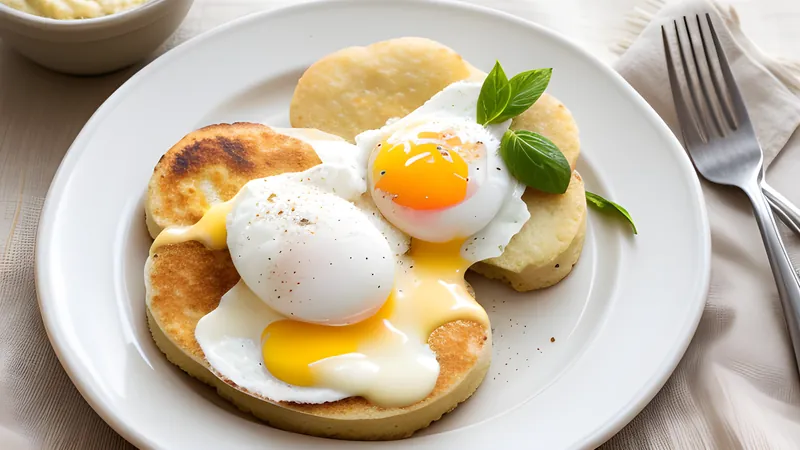
For eggs Benedict, toast the muffin, top each half with a slice of warm ham or wilted spinach, a soft poached egg, and a spoonful of hollandaise, then a dusting of paprika or cayenne. The muffin’s job is structural and it does it well: sturdy enough to hold up under the sauce, ragged enough to soak the good bits.
Tips, fixes and storage
If the crumb is dense and closed, your dough was too dry or over-handled, or under-proved. Keep it wet, be gentle, and let both proves run their full course.
If the outsides burn before the inside cooks, the heat is too high; drop it and cook longer.
If they spread flat instead of rising, the dough may have over-proved and collapsed, or the second prove ran too long; cook them a little earlier next time.
Storage: these keep two days in a bread bag and are built for toasting, so day-old is no hardship. They freeze beautifully, split first so you can toast them straight from frozen, which is the smartest thing you can do with a batch of eight on a Sunday morning. A muffin that started in your own pan, split with a fork and toasted crisp, is reason enough to poach the eggs.
Related Content