Éclairs with Coffee Crème Pâtissière
Long crisp shells, a proper coffee custard, a dark salted glaze
Contents
↓ Jump to recipeAn éclair is a profiterole that has decided to be elegant. Same pastry, same custard family, but stretched into a long, even finger, filled with a proper set crème pâtissière and glazed on top so it gleams under the light. Get the proportions right and it is one of the most satisfying things in a patisserie window. Get them wrong and it is a lopsided tube weeping custard from a cracked seam. The good news is that every one of those failures has a cause you can control.
The coffee here is the point rather than a garnish. A real coffee crème pâtissière, the milk steeped properly so the custard tastes of a good flat white, is worlds away from the flat vanilla-with-a-hint versions. My small extra flourish is a few flakes of sea salt pressed into the dark glaze while it is still tacky, so each bite lands with a tiny savoury spark against the sweet coffee cream.
Éclairs with Coffee Crème Pâtissière
Ingredients
- 75g plain flour
- 60g unsalted butter, cubed
- 150ml water
- 1/2 tsp caster sugar
- 1/4 tsp fine salt
- 2 large eggs, beaten (plus a little extra if needed)
- 350ml whole milk
- 1 tbsp instant espresso powder
- 4 large egg yolks
- 70g caster sugar
- 25g cornflour
- 1 tsp vanilla bean paste
- 20g unsalted butter, for the custard
- 100g dark chocolate (about 60% cocoa), chopped
- 60ml double cream
- 1 tsp instant espresso powder, for the glaze
- flaky sea salt, to finish
Method
- For the custard, warm the milk with 1 tbsp espresso powder until steaming. Whisk the yolks, 70g sugar and cornflour to a pale paste.
- Pour the hot milk over the yolks, whisking, then return to the pan and cook over medium heat, whisking constantly, until it thickens and boils for 1 to 2 minutes.
- Off the heat, beat in the vanilla and 20g butter. Press cling film onto the surface and chill until cold and set.
- For the choux, heat the water, 60g butter, sugar and salt to a rolling boil. Off the heat, beat in all the flour to a smooth ball, then dry over low heat for 1 minute.
- Cool 5 minutes, then beat in the eggs gradually until the paste is glossy and drops in a thick V.
- Pipe twelve 12cm fingers onto a lined tray using a large star nozzle, spaced apart. Smooth the ends with a wet finger.
- Bake at 200C fan for 20 minutes until deep gold and firm. Pierce each end and return for 5 to 8 minutes to dry inside. Cool on a rack.
- Beat the cold custard smooth and pipe it into each éclair through two holes in the base.
- Melt the chocolate, cream and 1 tsp espresso powder gently to a glossy glaze. Dip the tops, let it set slightly, and finish with a few flakes of sea salt.
The word, and the pastry
Éclair means “lightning” in French, and nobody entirely agrees why. The most repeated theory is that they are so good you eat them in a flash; a more convincing one is that the glossy glaze catches the light like a flash of lightning. They emerged in nineteenth-century France, quite possibly from the kitchen of Antonin Carême, the pastry chef who codified so much of the classical repertoire, and were originally called pain à la duchesse before the snappier name won out.
What matters for the cook is that the éclair is a study in evenness. A profiterole can be a rustic blob and still charm you. An éclair is judged on its line: straight sides, a flat base, an even rise, a clean glaze. That discipline is precisely why it is such a good thing to learn. Master the éclair and your piping, your choux and your custard all sharpen at once.
Custard first
Make the crème pâtissière before the pastry, because it needs to chill until properly set. Warm the milk with the espresso powder until it steams, and let it sit for a few minutes so the coffee blooms into it. Meanwhile whisk the egg yolks, sugar and cornflour to a thick pale paste. Pour the hot coffee milk over the yolks in a steady stream, whisking hard the whole time so they temper rather than scramble.
Return the lot to the pan and cook over a medium heat, whisking constantly and getting into the corners, until it thickens dramatically and comes to a boil. Here is the counterintuitive bit: you must let it boil for a full minute or two. Crème pâtissière is thickened with cornflour, and cornflour contains an enzyme that will thin your custard back to soup as it sits unless the boil deactivates it. Undercook it and you will have a runny filling no matter how carefully you made it.
Off the heat, beat in the vanilla and the cold butter for gloss, then scrape it into a shallow dish and press cling film directly onto the surface so no skin forms. Chill it completely. When you come back to it, it will be stiff and a little rubbery; a brisk whisk brings it back to a smooth, pipeable cream.
Piping the shells evenly
The choux is exactly the paste you would make for cream puffs: flour shot into boiled butter and water, dried out over the heat, then loosened with beaten egg until it is glossy and drops in a thick V. The difference is entirely in the piping.
Use a large open star nozzle, which gives ridged sides that rise more evenly and hide small imperfections. Pipe twelve fingers of about twelve centimetres, holding the bag at a low angle and keeping steady, even pressure. Stop the pressure before you lift away to avoid a tail, and dab any peaks flat with a wet finger. If you find your lines wobbling, mark guide lines on the underside of the baking paper with a pencil and pipe along them.
Bake at 200C fan for around twenty minutes until deep gold and firm to the touch, then pierce each end with a skewer and give them a further five to eight minutes in the oven to dry the insides thoroughly. As with all choux, the enemy is trapped moisture: a shell that is pale or damp within will slump. Cool them fully on a rack before filling.
Filling and glazing
Fit a piping bag with a small plain nozzle and beat the chilled custard until smooth. Poke two small holes in the base of each éclair and pipe the coffee cream in from both ends until you feel it fill and the shell grows heavy in your hand. Filling from below keeps the top intact for the glaze and stops the shell going soggy from a split.
For the glaze, melt the chocolate with the cream and the teaspoon of espresso powder over the gentlest heat, or in short bursts in the microwave, stirring until glossy and just pourable. Dip each éclair top-down into the glaze, lift, and let the excess drip back before turning it over. Draw a finger along the edge to neaten the line. While the glaze is still tacky, scatter over a very few flakes of sea salt. Let them set for fifteen minutes before serving.
Getting ahead and troubleshooting
The custard can be made a full day ahead and kept covered in the fridge. The empty shells can be baked a day ahead too and re-crisped for a few minutes in a hot oven, or frozen unfilled. Fill and glaze on the day you want to eat them, ideally within four or five hours, as crème pâtissière will eventually soften the pastry from within.
If your custard turned out lumpy, it caught on the base of the pan; next time keep the whisk moving and the heat moderate. If it went runny after chilling, it never truly boiled. If the shells cracked and split, they were piped unevenly or the oven ran too hot, forcing the rise faster than the structure could set. And if the glaze slid straight off, it was too warm and thin when you dipped, so let it cool to a coating consistency first.
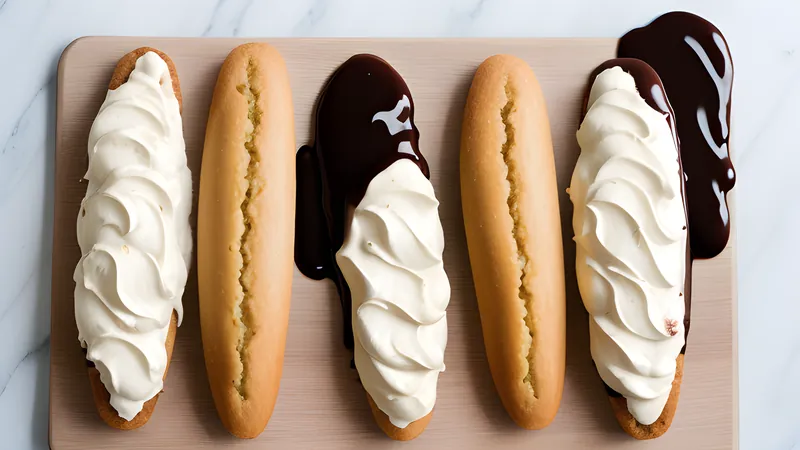
These are the same core skills behind a great many French desserts. The choux is shared with profiteroles with warm chocolate sauce, and once you can make a stable crème pâtissière you are one puff-pastry step from a proper millefeuille with vanilla crème pâtissière. Line your éclairs up on a board, coffee cream inside, dark salted glaze on top, and you will understand why the patisserie charges what it does for something you have just made in your own kitchen.
A few variations
The coffee base takes happily to small changes. Fold a tablespoon of coffee liqueur into the finished custard for an adult version, or steep a crushed cardamom pod in the milk alongside the espresso for a warm, faintly spiced note that flatters the coffee. If you prefer a classic look, swap the dark glaze for a coffee fondant: sift 150g icing sugar, then beat in just enough strong hot coffee, a teaspoon at a time, to make a thick, spreadable icing, and smooth it over the tops with a palette knife. Whichever way you finish them, keep the filling generous and the shells crisp, and these will hold their own against anything in a glass cabinet.
Related Content