Eccles Cakes with Currants and Flaky Butter Pastry
Buttery, sugar-crusted parcels of spiced currants
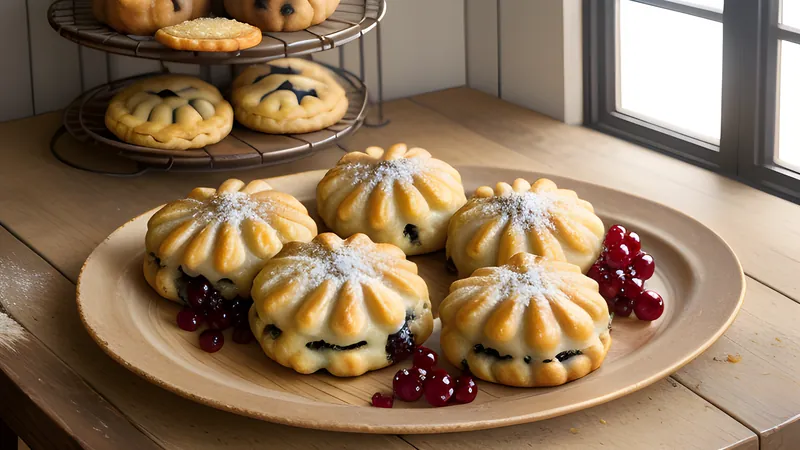
Eccles Cakes with Currants and Flaky Butter Pastry
Ingredients
- 375g all-butter puff pastry (or rough puff, see below)
- 50g unsalted butter
- 75g soft dark brown sugar
- 200g currants
- Zest of 1 orange
- 0.5 tsp mixed spice
- 0.25 tsp ground nutmeg
- 1 tbsp dark rum (optional)
- 1 egg white, lightly beaten, to glaze
- 2 tbsp demerara sugar, to finish
Method
- Melt the butter with the brown sugar, then stir in the currants, orange zest, mixed spice, nutmeg and rum. Leave to cool and thicken.
- Roll the pastry to about 3mm thick and cut out eight 12cm rounds.
- Place a heaped tablespoon of the currant mixture in the centre of each round.
- Gather the edges of the pastry up over the filling and pinch firmly to seal into a parcel.
- Turn each parcel sealed side down and gently flatten with your palm into a disc, letting a few currants show through.
- Cut three short slashes across the top of each, brush with egg white and sprinkle generously with demerara sugar.
- Chill the cakes for 15 minutes, then bake at 200C fan for 18 to 20 minutes until puffed, deep golden and crisp.
- Cool on a wire rack until just warm before eating.
The Eccles cake is one of those defiantly regional British bakes that has somehow never gone national in the way it deserves. Outside the north-west of England you can struggle to find a good one, which is a shame, because at their best they are extraordinary: a flat, blistered disc of impossibly flaky pastry, crusted with crunchy sugar, hiding a dark, spiced, almost boozy heart of buttery currants. Some people call them fly cakes or fly pies on account of the dark fruit showing through the pastry, which is the sort of affectionate, unglamorous name only a genuinely good thing earns.
1 A small cake with a long memory
Eccles cakes take their name from the town of Eccles near Manchester, where they have been sold since at least the late eighteenth century. James Birch is usually credited with first selling them commercially around 1793, and they became closely tied to local religious feast days, to the point where the Puritans at one stage tried to ban them as too frivolous and pagan. They survived, as good cakes do, and the traditional Real Eccles Cake is still made to a guarded recipe. They belong to a small family of British currant pastries that includes the Chorley cake and the Banbury cake, each town quietly convinced its own version is best.
2 The clever twist: orange and a splash of rum
The classic filling is currants, butter, sugar and a little mixed spice, and it is lovely. But I cannot leave well enough alone, and the two additions that have earned permanent places in my version are orange zest and a tablespoon of dark rum. The orange brings a bright, fragrant lift that stops the filling tasting heavy or one-dimensional, and the rum, cooked gently into the buttery currants, gives a deep, faintly caramelised, grown-up note that makes people slow down and wonder what is in there. Neither is traditional. Both are improvements, and I will defend that position firmly.
3 Pastry: buy it or make it
You have two honest choices here. The genuinely time-poor should buy a good all-butter puff pastry, and there is no shame in it; the filling does most of the work. But if you have an hour and the inclination, a quick rough puff is worth the effort and not remotely difficult. You simply rub cold butter into flour leaving some lumps visible, bind it with cold water, then roll and fold it a few times to build flaky layers without the faff of full lamination. Keep everything cold, work fast, and you will get pastry that shatters in a shower of buttery shards.
4 Shaping the parcels
The method is satisfyingly low-tech. Spoon a generous mound of the cooled, thickened currant filling into the centre of each pastry round, gather the edges up and over like a little drawstring purse, and pinch them firmly shut. Then turn the parcel over so the seam is underneath and squash it gently flat with your palm. This is the moment the Eccles cake takes its characteristic shape: a flat disc with the currants pressing up against the thin pastry, a few of them peeking through. Do not overfill or they will burst in the oven, though a little leakage is traditional and tasty.
5 The sugar crust matters
The three slashes cut across the top are not just decoration; they let steam escape so the pastry rises in flaky layers instead of bursting at the seam. Brushing with egg white rather than whole egg, then showering with demerara sugar, gives you that signature crunchy, glittering top that crackles when you bite it. Chill the shaped cakes briefly before baking so the butter is firm and the pastry puffs properly in the heat.
6 Eating and keeping
Eat them just warm, when the pastry is at its crispest and the filling still slightly molten, ideally with a strong cup of tea and, if you want to do it the Lancashire way, a slice of crumbly Lancashire cheese alongside. The salty cheese against the sweet spiced fruit is one of those odd, perfect pairings that sounds wrong and tastes completely right. They keep for a couple of days in a tin and reheat beautifully, though in my house they have never once survived that long.
Related Content