Dutch Baby Pancake with Lemon and Powdered Sugar
A puffed, golden cloud from one hot pan
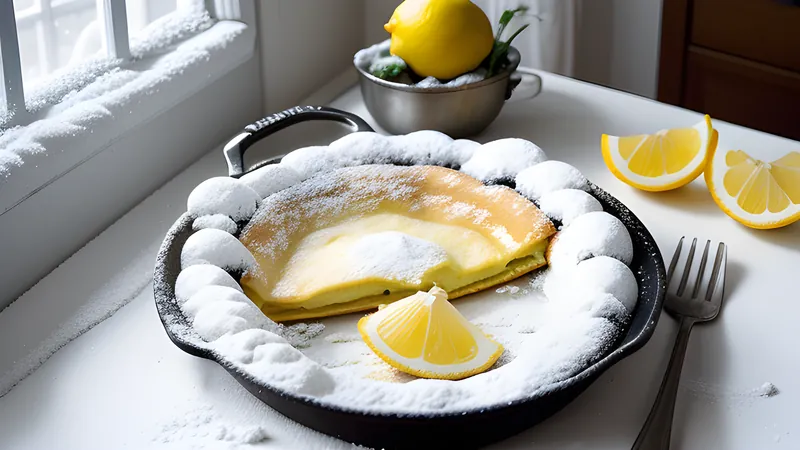
A Dutch baby is the most theatrical thing you can make for breakfast with so little effort. You blend a thin batter, pour it into a screaming hot buttery pan, and twenty minutes later it billows up the sides into a crisp, golden, custardy crater. It collapses the moment it leaves the oven, which is half the fun. A squeeze of lemon, a heavy dusting of icing sugar, and that is breakfast sorted. My one small twist is folding lemon zest into the batter itself, so the brightness runs all the way through.
Dutch Baby Pancake with Lemon and Powdered Sugar
Ingredients
- 3 large eggs, at room temperature
- 80g plain flour
- 120ml whole milk, at room temperature
- 1 tbsp caster sugar
- 0.25 tsp fine salt
- 1 tsp vanilla extract
- Finely grated zest of 1 lemon (the twist)
- 40g unsalted butter
- Icing sugar, to dust
- 1 lemon, cut into wedges, to serve
Method
- Place a 25cm ovenproof frying pan or skillet in the oven and heat to 220C fan.
- Blend the eggs, flour, milk, caster sugar, salt, vanilla and lemon zest until completely smooth, then rest for 10 minutes.
- Carefully add the butter to the hot pan and swirl until melted and foaming, coating the base and sides.
- Pour the batter into the centre of the hot pan and return it to the oven immediately.
- Bake for 18 to 20 minutes, without opening the door, until dramatically puffed and deep golden at the edges.
- Dust generously with icing sugar and serve at once with lemon wedges to squeeze over.
2 The Story
Despite the name, the Dutch baby has nothing much to do with the Netherlands. It is an American invention, generally traced to Manca’s Cafe, a family-run restaurant in Seattle in the early twentieth century. The story goes that it grew out of the German Pfannkuchen, the large oven-baked pancakes of southern Germany, and that the name came from a mangling of Deutsch, the German word for German, into Dutch. One of the owner’s daughters is said to have shrunk the recipe down and called the smaller versions Dutch babies, and the name stuck.
The pancake belongs to the same family as the Yorkshire pudding and the popover: a loose, eggy batter that puffs spectacularly in a hot oven. The science is simple and satisfying. A high proportion of egg and a thin batter, poured into a very hot, well-greased pan, sets quickly at the edges while steam inflates the centre, climbing the sides of the pan into dramatic peaks and valleys. The moment it meets cooler air it sinks, which is exactly as it should be. You are not after a steady, even pancake here; you want that collapsed, lacy crater that traps pools of melted butter and lemon.
It became an American diner and brunch classic, the sort of dish that looks impressive enough for guests but is genuinely easy to throw together before they have finished their first coffee.
3 Method
- Slide a 25cm ovenproof frying pan or skillet into the oven and heat to 220C fan. The pan must be properly hot before the batter goes in.
- Tip the eggs, flour, milk, caster sugar, salt, vanilla and lemon zest into a blender and blitz until completely smooth. Let the batter rest for 10 minutes; this relaxes the flour and helps the rise.
- Carefully pull out the hot pan, add the butter and swirl until it has melted and is foaming, coating the base and right up the sides.
- Pour the batter straight into the centre of the hot pan and return it to the oven at once.
- Bake for 18 to 20 minutes without opening the door. It will puff dramatically and turn deep golden at the edges.
- Dust heavily with icing sugar and serve immediately, with lemon wedges to squeeze over at the table.
4 Tips and Variations
Room-temperature eggs and milk matter more than you might expect, as a cold batter hitting a hot pan rises less enthusiastically. A blender gives the smoothest result, but a good whisk and a bit of patience will do. Above all, do not open the oven door while it bakes; the rush of cool air can deflate it before it sets.
The lemon-and-sugar finish is the classic, but a Dutch baby is a willing canvas. Soft fruit collapses beautifully on top: sliced apples cooked in the butter first, or berries thrown on for the last few minutes. For something more indulgent, serve with crème fraîche and a drizzle of honey. A savoury version with cheese, herbs and a poached egg makes a fine lunch.
It is best eaten the instant it lands on the table, while the edges are crisp and the centre still soft and custardy. It will not wait, and it does not need to.
Related Content