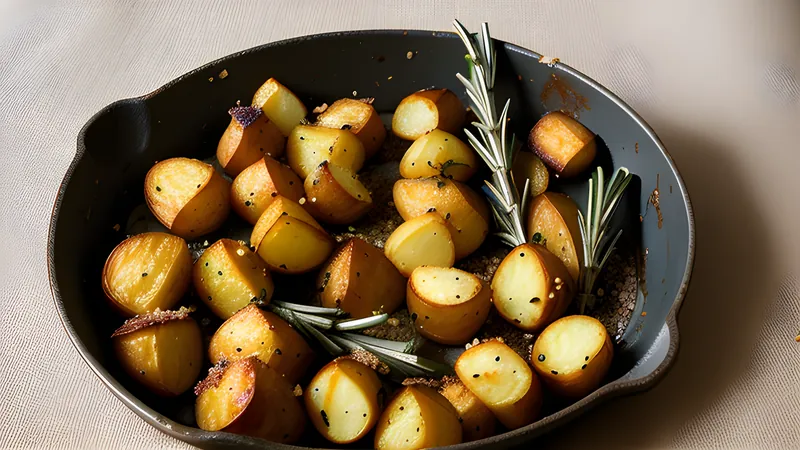
Duck-Fat Roast Potatoes with Rosemary Salt
Fluffed, chilled and roasted hard in rendered duck fat until the crust shatters
Contents
↓ Jump to recipeA proper roast potato is the one dish on the British Sunday table that people will fight over before the meat’s even carved, and the difference between a good one and a great one comes down almost entirely to two things: how you treat the surface of the potato before it goes anywhere near heat, and what fat you roast it in. Duck fat is the answer to the second question and has been for as long as anyone’s been arguing about it — it renders at a higher smoke point than butter, carries more savoury depth than most vegetable oils, and gives a potato the kind of deep, almost meaty crust that oil alone can’t manage. The twist here isn’t the duck fat itself, which plenty of people already reach for. It’s finishing the potatoes with a rosemary salt mixed and scattered on at the very last second, so the herb stays fragrant rather than turning bitter and charred in a hot oven for the best part of an hour. It’s a small change of timing, not a change of ingredients, and it’s the kind of thing that’s easy to miss because most recipes bury the herb in the roasting tin from the start and call it a day. Once you taste the difference side by side, it’s hard to go back to rosemary that’s spent an hour drying out in hot fat.
Duck-Fat Roast Potatoes with Rosemary Salt
Ingredients
- 1.5kg Maris Piper or King Edward potatoes, peeled
- 2 tbsp fine salt, for the parboiling water
- 1/2 tsp bicarbonate of soda
- 100g duck fat (rendered, from a jar or tin)
- 2 sprigs fresh rosemary, plus 1 tbsp finely chopped leaves
- 1 tbsp flaky sea salt
- 1/2 tsp black pepper
Method
- Cut the potatoes into large, even chunks, about 5-6cm across. Rinse briefly under cold water.
- Bring a large pan of water to the boil with 2 tbsp salt and the bicarbonate of soda. Add the potatoes and parboil for 8-10 minutes, until the outer edges are soft enough to smash slightly but the centre still holds its shape.
- Drain thoroughly in a colander, then let them sit and steam-dry for 2-3 minutes.
- Return the potatoes to the empty pan, put the lid on and shake hard 4-5 times to rough up and fluff the outer surface of every piece.
- Spread the potatoes on a tray in a single layer and chill, uncovered, in the fridge for at least 30 minutes, or up to overnight.
- Heat the oven to 220C (200C fan). Put the duck fat and rosemary sprigs into a large roasting tin and heat in the oven for 8-10 minutes until the fat is shimmering hot.
- Carefully tip the chilled potatoes into the hot fat, turning each piece to coat, and spread in a single layer without overcrowding.
- Roast for 45-50 minutes, turning every 15 minutes, until deeply golden and crisp on every side.
- While the potatoes roast, mix the flaky salt with the finely chopped rosemary and black pepper to make rosemary salt.
- As soon as the potatoes come out of the oven, scatter over the rosemary salt while they're still sizzling, and serve immediately.
The fluff-and-chill method
Everything that makes a roast potato genuinely crisp happens before it goes in the oven, and it comes down to maximising rough surface area. Parboiling the potatoes until the outer layer is soft enough to rough up, then draining and shaking them hard in the pan, breaks down that outer layer into a mass of small, ragged starch granules covering every piece. Roasted in hot fat, those ragged edges are what turn into the shattering, craggy crust that makes a good roast potato worth the fuss; a smooth-sided potato chunk, by contrast, roasts into something closer to a boiled potato with a tan. Choose a floury variety for this reason — Maris Piper and King Edward both have a high starch, low moisture content that ruffles easily and roasts up light and fluffy inside, while a waxy salad potato holds its shape too well to ever produce that ragged surface, however hard you shake the pan.
The bicarbonate of soda in the parboiling water is doing real chemistry, not just tradition for tradition’s sake. Bicarb raises the pH of the water, which breaks down pectin in the potato’s cell walls faster than plain water would, meaning the surface softens and ruffles more readily when you shake the pan. Use too much and the potatoes turn slimy and start to properly disintegrate rather than just roughing up at the edges; a level half-teaspoon for a large pan of potatoes is enough to notice the difference without dissolving the potatoes into mush. If you’ve ever parboiled potatoes without bicarb and found the crust merely good rather than genuinely craggy, this is almost always the missing variable — it costs nothing extra and takes no additional time, so there’s little reason to leave it out once you know what it’s doing.
Chilling the potatoes after parboiling, spread out on a tray rather than left in a pile, is the step most home cooks skip, and it matters more than people expect. Cold, dry air pulls surface moisture out of the rough, starchy exterior you just created, and a drier surface is what allows the fat to actually contact and crisp the potato rather than spending its first several minutes in the oven just boiling off residual water. Even thirty minutes in the fridge makes a noticeable difference; if you have the time to chill them for a few hours or overnight, uncovered, the result is drier still and the crust correspondingly crisper. This is also a genuinely useful piece of planning for a Sunday roast, since it means the most time-consuming prep — peeling, cutting and parboiling the potatoes — can happen the night before, leaving you with far less to do while the rest of the meal comes together.
Why duck fat, and how hot it needs to be
Duck fat has a smoke point around 190C and a flavour profile that’s savoury and faintly gamey without being overpowering, which makes it particularly good with a plain, starchy vegetable like potato that has little flavour of its own to compete with. It also solidifies at room temperature, which is why jarred or tinned duck fat looks like a pale, waxy solid until it’s heated — this is completely normal and simply means it needs melting before use, not that anything’s gone wrong with the product.
The fat needs to be properly hot, shimmering and just short of smoking, before the potatoes go in. This is non-negotiable: a cold or lukewarm fat means the potato surface starts absorbing fat rather than frying in it, and you end up with a greasy potato rather than a crisp one. You’ll hear this the moment the potatoes go in — a properly hot tin gives an immediate, aggressive sizzle as the cold, damp potato surface hits the fat; a half-hearted hiss is a sign the fat needs another few minutes in the oven before you commit the potatoes to it. Heating the roasting tin of fat in the oven itself, rather than on the hob, means the whole tin comes up to an even, high heat rather than being hot in the middle and cooler at the edges the way a hob burner often leaves it.
Turning the potatoes partway through roasting matters for the same reason cut-side-down roasting matters with other vegetables: whichever face is touching the hot metal and hot fat is the face that’s browning fastest, and a potato left on one side for the full cooking time will crisp beautifully on the bottom and stay pale on top. Two or three turns over the roasting time, using a fish slice or metal spatula to avoid tearing the crust you’ve already built, gives you an evenly golden potato on every face rather than one good side and three disappointing ones. Resist turning them more often than that, though — every time you disturb the potatoes, you interrupt the browning that’s already underway on whichever face is down, so more frequent turning actually slows the overall crisping rather than speeding it up.
The rosemary salt, and why it goes on last
Rosemary is a tough, resinous herb, and thrown into the roasting tin at the start it will survive the better part of an hour in a hot oven — but by the end, the leaves that were once fragrant and piney have usually turned dry, brittle and slightly bitter, tasting more of charred twig than herb. Whole sprigs added to the fat at the start still contribute useful background aroma, infusing the fat itself as it heats, which is why this recipe keeps that step. But the fresh, bright rosemary flavour that actually reads on the tongue comes from a separate batch of finely chopped rosemary, mixed with flaky salt and black pepper, and scattered over the potatoes in the last few seconds before serving.
This is a small trick borrowed from steak cookery, where a compound or finishing salt is often used precisely because a delicate aromatic loses most of its impact if it’s cooked for the full duration rather than added at the end. The residual heat of the just-roasted potatoes is enough to release the rosemary’s oils and make the kitchen smell like it’s been infused all along, without any of the bitterness that comes from actually cooking the chopped herb for an hour. Flaky sea salt, rather than fine table salt, is worth using here specifically because its larger crystals give a periodic crunch and a burst of saltiness rather than an even, less interesting seasoning throughout. Mix the rosemary salt while the potatoes are still in their final stretch of roasting, so it’s ready to go the instant the tray comes out — the whole point of the technique depends on the potatoes still being hot enough to release the rosemary’s oil, and that window closes fast once they’re sitting on the counter cooling.
Serving and pairing
These are built for a roast dinner, and they hold their own next to almost anything you’d put on a Sunday table. If duck is the theme of the day rather than just the fat, they’re a natural match for pan-seared duck breast with cherry and port sauce, where the potatoes soak up any extra pan juices and echo the same rendered fat that gave them their crust. If you want a lighter, more traditional roast potato for comparison, my crispy roast potatoes recipe uses the same fluff-and-chill method with a plainer vegetable oil, which is worth trying side by side if you’re curious how much of the difference really comes down to the fat.
Variations
No duck fat available. Beef dripping is the closest substitute in both flavour and behaviour, giving a similarly deep, savoury crust; a good olive oil or other vegetable oil will still produce a crisp potato using the same fluff-and-chill method, just with a lighter, less rounded flavour.
Add garlic. A few whole, unpeeled garlic cloves added to the roasting tin alongside the rosemary sprigs will soften and caramelise in the fat over the cooking time, and they’re worth squeezing out of their skins and mashing into any gravy going.
Swap the herb. Thyme behaves the same way as rosemary here — tough enough to survive as a whole sprig in the fat, but best finished as a finely chopped, last-minute salt for maximum fragrance.
Storage
Roast potatoes are always best fresh from the oven, while the crust is still audibly crackling, but leftovers keep in the fridge for up to three days. Reheat them in a hot oven, spread out on a tray rather than crowded into a dish, for ten to fifteen minutes; this re-crisps the surface far better than a microwave, which will turn the crust soft and slightly rubbery. If you’re planning ahead, the potatoes can be parboiled, fluffed and chilled up to a day in advance and kept covered in the fridge, ready to roast fresh when needed — the actual roasting step is the one part of this recipe that doesn’t reheat well, so it’s worth doing last. Duck fat itself is reusable — strain it through a fine sieve after roasting to remove any stray potato crumbs, and it will keep in the fridge for several months, gradually taking on more roasted potato flavour with each use, which is one more reason to buy a jar rather than treat it as a single-use ingredient.
Related Content