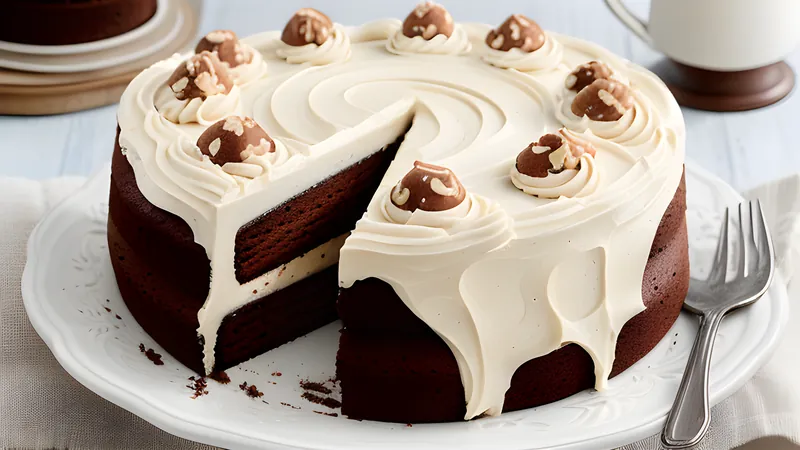
Devil's Food Cake with Fudge Frosting
The darkest, softest chocolate cake, with malt in the fudge
Contents
↓ Jump to recipeDevil’s food cake is the cake that decided plain chocolate cake was not chocolatey enough and did something about it. It is darker, softer and more intensely bittersweet than an everyday sponge, with a crumb so tender it almost dissolves, and a colour that leans towards mahogany. The name is a nineteenth-century American joke: if the pale, ethereal angel food cake was heavenly, then the black, rich, sinful chocolate cake had to be its opposite number. The devil got the better cake.
Where the devil came from
The first printed devil’s food recipes appear in American cookbooks around the turn of the twentieth century, and from the start they were defined by two things: a lot of cocoa, and a reddish-brown colour that came from a chemical quirk. Natural cocoa is acidic, and when you mix it with an alkaline raising agent like bicarbonate of soda, the reaction shifts the cocoa’s pigments towards red-brown and boosts the rise. Early bakers noticed their devil’s food cakes turning a rusty colour and leaned into it, which is also, incidentally, the ancestral link to red velvet, a cake that started life as a close cousin before food colouring took over the job.
What separates devil’s food from an ordinary chocolate cake is the ratio and the method. There is more cocoa, often bloomed in a hot liquid, more bicarbonate to keep the crumb open and dark, and usually buttermilk or coffee for acidity and depth. The result is a cake built for frosting, because the sponge itself is not especially sweet; it wants a rich, fudgy topping to complete it. My version blooms the cocoa in hot coffee, which does not make the cake taste of coffee so much as it makes the chocolate taste more like itself, and it finishes with a fudge frosting spiked with malt.
Devil's Food Cake with Fudge Frosting
Ingredients
- 50g cocoa powder, plus 1 tbsp for the tins
- 180ml hot strong black coffee
- 200g plain flour
- 1.5 tsp bicarbonate of soda
- 0.5 tsp fine salt
- 150g unsalted butter, softened
- 300g dark brown soft sugar
- 3 large eggs
- 1 tsp vanilla extract
- 150ml buttermilk
- For the frosting: 200g dark chocolate (60 to 70%), chopped
- 150g unsalted butter, cubed
- 3 tbsp malt extract or 4 tbsp malted milk powder
- 250g icing sugar, sifted
- 2 tbsp cocoa powder
- 3 tbsp double cream
- Pinch of salt
Method
- Heat the oven to 160C fan. Butter two 20cm sandwich tins and dust with cocoa.
- Whisk the 50g cocoa into the hot coffee until smooth and glossy, then leave to cool to lukewarm.
- Whisk the flour, bicarbonate of soda and salt in a bowl.
- Beat the butter and brown sugar until lightened, about 4 minutes, then beat in the eggs one at a time with the vanilla.
- Add the flour in three goes, alternating with the buttermilk and the cooled cocoa-coffee, beginning and ending with flour. The batter will be loose.
- Divide between the tins and bake for 28 to 32 minutes, until a skewer comes out clean. Cool in the tins for 10 minutes, then turn out.
- For the frosting, melt the chocolate and butter together gently, then stir in the malt extract.
- Beat in the sifted icing sugar and cocoa, then the cream and salt, until glossy and spreadable. Let it cool and thicken for 10 to 15 minutes.
- Sandwich the cooled cakes with a third of the frosting, then coat the top and sides with the rest, swirling as it sets.
Why coffee, and why bloom the cocoa
Cocoa powder holds a lot of its flavour in compounds that are only fully released when they meet hot liquid and a little fat. Pouring hot coffee over the cocoa and whisking it to a paste, a step bakers call blooming, hydrates those compounds and disperses them evenly, so the finished cake tastes rounder and deeper than one where the dry cocoa is simply stirred into the flour. Coffee is the classic bloom for chocolate because its own roasted, slightly bitter notes overlap with cocoa’s, and a small amount simply makes the chocolate taste more like itself. If you would rather leave it out, bloom the cocoa in the same quantity of boiling water and you lose almost nothing.
The acidity matters too. Buttermilk and coffee are both mildly acidic, and that acidity does two useful jobs: it reacts with the bicarbonate of soda to give lift, and it tenderises the crumb by weakening the gluten, which is a large part of why devil’s food is so soft. Keep the oven moderate, at 160C fan, because a gentle heat lets this loose, sugar-heavy batter rise slowly and evenly without doming or cracking.
The malt in the fudge
The frosting is where I make my one small change. A classic devil’s food is finished with either a boiled fudge frosting or a simple chocolate buttercream, both excellent. I fold malt into the melted-chocolate version, either as thick brown malt extract from the baking aisle or as malted milk powder. Malt brings a toasty, slightly savoury sweetness, the flavour of a good chocolate malted milkshake, and it stops the frosting from tipping into one-note sweetness. It also deepens the fudgy texture, because malt extract is a syrup and keeps the frosting glossy and soft rather than crusting hard.
Getting the frosting to the right consistency is the only fiddly part. Straight from melting it will be too runny to hold a swirl, so give it time to cool and thicken; on a warm day this can take twenty minutes. If you overshoot and it sets too firm, warm the bowl briefly and beat in a splash more cream. You want it spreadable and shiny, the texture of soft peanut butter, so it catches the light in swirls on top of the dark cake.
Storage, and making it ahead
The sponges can be baked a day ahead, wrapped well once cool, and they actually improve for a night’s rest, which lets the crumb settle and the flavour mellow. The frosted cake keeps for three or four days under a dome or in a tin, and because the frosting is so rich in butter and chocolate it stays soft rather than drying out. Bring slices back to room temperature before eating, since cold mutes chocolate badly. The unfrosted sponges freeze well for up to three months, wrapped in a double layer; defrost them at room temperature before frosting.
Making it your own
Devil’s food is a generous base for tinkering. A layer of morello cherry jam under the frosting nudges it towards a black forest gateau, while a scrape of orange zest in the batter and a splash of orange liqueur in the frosting gives it a grown-up, chocolate-orange edge. For a salted version, press flaky salt into the frosting as it sets. And if you want the full retro American diner effect, skip the malt and boil up a proper marshmallowy seven-minute frosting instead, piled high and swirled, so the dark cake and the snow-white topping do their angel-and-devil double act on the plate.
Related Content