Dan Dan Noodles with Toasted Rice and Sesame
Chewy noodles, spicy sauce, a nutty crunch
Contents
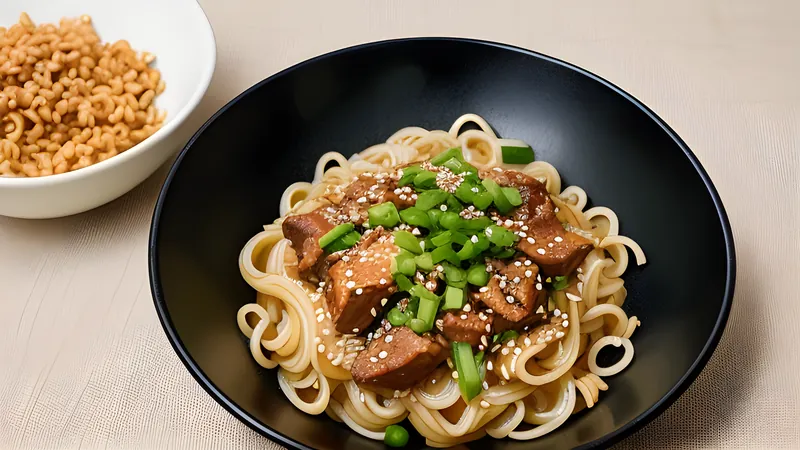
↓ Jump to recipeDan dan noodles live and die by the toss. A pile of noodles sits over a thick, dark sauce and a scatter of crisp pork, and it looks like very little until you mix it, at which point the sesame, chilli and vinegar coat every strand and the whole bowl comes alive. My twist here is a spoonful of toasted, ground raw rice folded through at the end, a technique borrowed from larb and other Southeast Asian dishes but genuinely at home here: it adds a nutty, faintly smoky crunch that plain noodles alone can’t give you, and it soaks up just enough sauce to intensify with every bite.
Dan Dan Noodles with Toasted Rice and Sesame
Ingredients
- 3 tbsp raw white rice
- 400g fresh wheat noodles (or dried, if fresh unavailable)
- 2 tbsp neutral oil
- 150g minced pork
- 2 tbsp ya cai (Sichuan preserved mustard stem), finely chopped
- 1 tsp whole Sichuan peppercorns, toasted and ground
- 4 tbsp sesame paste (or well-stirred tahini)
- 3 tbsp light soy sauce
- 1 tbsp Chinkiang black vinegar
- 2 tbsp chilli oil, plus the crispy bits from the jar
- 1 tbsp chilli flakes (Sichuan or Korean gochugaru)
- 2 garlic cloves, grated
- 1 tsp caster sugar
- 4 tbsp hot noodle cooking water, plus more to loosen
- 4 spring onions, finely sliced
- 2 tbsp roasted peanuts, roughly crushed
Method
- Toast the raw rice in a dry wok over medium heat for 4 to 5 minutes, shaking often, until pale gold and smelling like popcorn, then tip out to cool and grind coarsely in a spice grinder or with a pestle and mortar.
- Heat the neutral oil in the wok over high heat, add the minced pork and stir-fry for 3 to 4 minutes, breaking it up, until crisp and browned.
- Add the ya cai and toasted ground Sichuan peppercorn, stir-fry for 1 minute until fragrant, then tip out and set aside.
- In each of four serving bowls, whisk together 1 tablespoon sesame paste, ¾ tablespoon soy sauce, a small splash of black vinegar, ½ tablespoon chilli oil, ¼ tablespoon chilli flakes, half a grated garlic clove, a pinch of sugar and 1 tablespoon hot noodle water until smooth.
- Bring a large pan of water to the boil and cook the noodles according to the packet, usually 2 to 4 minutes for fresh, until just tender.
- Divide the noodles between the bowls on top of the sauce, without draining them completely dry, so a little cooking water carries through.
- Top each bowl with the pork mixture, a scattering of toasted ground rice, spring onion and crushed peanuts.
- Bring to the table and toss thoroughly before eating, so the sauce coats every strand.
The story
Dan dan mian gets its name from the dan dan, the bamboo shoulder pole that street vendors in Chengdu once used to carry two baskets, one holding noodles and the other holding the sauce, stove and bowls, balanced across the shoulders as they walked the streets calling out for customers. The dish dates to the 1930s, credited to a vendor named Chen Baobao, and it was built from the start to be portable and cheap: a small tangle of thin wheat noodles, no more than a few mouthfuls, dressed in a punchy, oily sauce that didn’t need refrigeration or much equipment to make on the move.
The original Chengdu version is drier and spicier than what most people outside Sichuan encounter, closer to a dressed noodle than a soup, with the sauce clinging tightly rather than pooling. Ya cai, a pickled and dried mustard stem specific to Yibin in southern Sichuan, is the ingredient that separates an authentic bowl from an imitation; it brings a salty, faintly sour depth that no amount of soy sauce can replicate. Outside China, and especially in the West, dan dan noodles often arrive swimming in broth, a format that spread partly through Japanese ramen-ya reinterpretations of the dish, tantanmen, which added a rich pork or chicken stock. Both are legitimate, but they are different dishes wearing the same name, and this recipe sticks to the drier, saucier Chengdu style, where the sauce is concentrated rather than diluted.
Chengdu today still has small stalls that serve dan dan mian for breakfast as much as lunch, ladled from a pot kept warm since the morning, portions small enough that regulars will order two bowls of different toppings rather than one large one. Neighbouring Chongqing has its own noisier, oilier take, leaning harder into chilli oil and often adding a spoonful of peanut butter or crushed peanuts straight into the sauce for body, a variation this recipe borrows a little of at the end with its own scatter of crushed peanuts. The two cities argue about dan dan mian the way Sichuan argues about most things involving chilli and Sichuan peppercorn together, which locals call ma la — numbing and hot — a sensation the peppercorn’s alkylamides trigger directly on the nerve endings of the tongue and lips, distinct from capsaicin’s straightforward burn. Toast whole peppercorns in a dry pan for a minute or two until fragrant and just starting to smoke before grinding, since pre-ground Sichuan pepper loses that citrusy, buzzing quality within weeks of grinding and often sits on shop shelves for far longer than that.
The sesame paste itself is often confused with tahini, and while tahini works fine as a substitute, Chinese sesame paste (zhi ma jiang) is made from toasted rather than raw sesame seeds, which gives it a deeper, more savoury flavour closer to peanut butter than the slightly bitter, grassy note of Middle Eastern tahini. If you can find a jar of the real thing, it’s worth the search.
The method, explained
The toasted rice is the one unusual step here, so it deserves attention. Dry-toasting raw rice in a wok over medium heat drives off moisture and starts the Maillard reaction on the surface of each grain, turning it from chalky white to pale gold and giving off a smell close to popcorn. Grinding it coarsely afterwards, rather than to a fine powder, keeps some genuine bite; too fine and it just disappears into the sauce like breadcrumbs, too coarse and it doesn’t distribute evenly. Aim for something between coarse sand and small gravel. Watch the pan closely in the last minute, since toasted rice goes from perfectly golden to bitter and scorched within about 30 seconds, and there’s no way to rescue it once it tips over.
The rest of the technique is about building a sauce that’s thick enough to cling rather than pool. Sesame paste separates in the jar, oil floating to the top over a stiff paste beneath, so stir it thoroughly before measuring; if you skip this the sauce breaks into an oily, gritty mess when you add the hot water. That hot noodle water matters too, its starch content helps emulsify the sesame paste and chilli oil into something silky rather than clumped, which is why the sauce is built in the serving bowl with a splash of the actual cooking water rather than plain hot water from the kettle.
The pork topping has its own small technique worth getting right. Frying minced pork hard, with no liquid added, until it genuinely crisps rather than just cooking through, drives off enough moisture that the little nuggets pick up a savoury, almost bacon-like edge; a wooden spatula pressed against the mince as it fries helps break it into fine, even crumbs rather than larger clumps that stay soft in the centre. Ya cai should go in only once the pork is properly browned, not before, since it has enough residual moisture from the pickling brine to stop the pork crisping if it goes in too early. A minute of stir-frying together at the end is enough for the pickle’s saltiness to season the meat without cooking off its sourness entirely.
The recipe
Serves 4. Prep 15 minutes, cook 20 minutes.
Dry-toast 3 tablespoons raw rice in a wok over medium heat for 4 to 5 minutes until pale gold and smelling like popcorn, then cool and grind coarsely. Heat 2 tablespoons neutral oil in the wok over high heat, fry 150g minced pork for 3 to 4 minutes until crisp, add 2 tablespoons chopped ya cai and 1 teaspoon toasted ground Sichuan peppercorn, stir-fry a minute more, then set aside.
Divide the sauce ingredients between four bowls: 1 tablespoon sesame paste, ¾ tablespoon soy sauce, a splash of black vinegar, ½ tablespoon chilli oil, ¼ tablespoon chilli flakes, half a grated garlic clove, a pinch of sugar and 1 tablespoon hot noodle water per bowl, whisked smooth. Boil 400g fresh noodles for 2 to 4 minutes until just tender, then lift them straight into the bowls with a little clinging water. Top with the pork mixture, toasted ground rice, sliced spring onion and crushed peanuts. Toss thoroughly at the table before eating.
Tips, substitutions, make-ahead and storage
If you can’t find ya cai, a mix of finely chopped preserved mustard greens (suan cai) and a pinch more soy sauce gets you close, though the flavour will be a touch more sour and less savoury. The pork topping can be made up to 2 days ahead and reheated in a dry pan; the sauce components can be pre-measured into bowls but are best whisked with hot water just before serving, since sesame paste stiffens as it sits. Toasted rice keeps in an airtight container for a couple of weeks and is worth making a double batch of, it’s excellent scattered over larb, salads or roasted vegetables too.
Don’t assemble the noodles in advance; they clump and the sauce loses its glossy pull within about 15 minutes of tossing.
If fresh wheat noodles aren’t available, dried noodles marketed for noodle soup work fine, though check the packet timing carefully since dried noodles vary far more than fresh in cooking time, and an overcooked noodle here has nowhere to hide once it’s coated in a thick, dark sauce. Chinkiang black vinegar is worth seeking out specifically rather than substituting balsamic, which is sweeter and lacks the malty, slightly smoky depth that Chinkiang brings; a well-stocked Asian grocer will usually carry it in a squat black bottle. Leftover chilli oil from a jar of Sichuan-style chilli crisp, complete with its crunchy sediment of fried garlic and shallot, upgrades the sauce considerably over a plain, seedless chilli oil.
Variations
For a soupier version closer to tantanmen, thin the sauce with 150ml hot chicken stock per bowl instead of just noodle water. Vegetarians can swap the pork for finely chopped shiitake fried hard with the ya cai until crisp at the edges. If you want more heat, add a spoonful of chilli crisp with its oil directly to each bowl before tossing.
This sits well alongside mapo tofu for a full Sichuanese spread, or kung pao chicken if you want a second protein-heavy dish on the table. Either way, toss hard, eat fast, and don’t be precious about the mess.
Related Content