Vanilla Creme Brulee
Silky custard under a glassy caramel crack
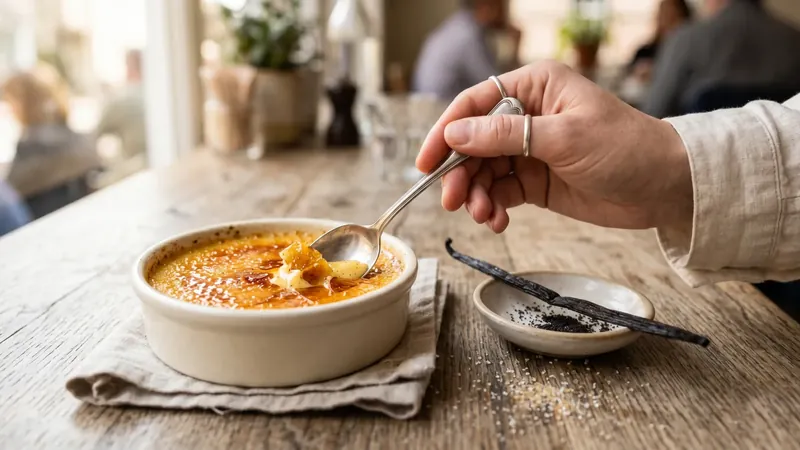
There is real theatre in the moment a spoon shatters the lid of a creme brulee, breaking the glassy caramel to reveal cool, fragrant custard beneath. The twist here is no twist at all but a return to the basics done properly: a genuine vanilla custard, flecked with seeds from a real pod, set gently in a water bath and finished with a torched caramel top that cracks like thin ice. It is unhurried, generous and far simpler than its restaurant reputation suggests.
Vanilla Creme Brulee
Ingredients
- 300ml double cream
- 100ml whole milk
- 1 vanilla pod, split and seeds scraped
- 4 large egg yolks
- 50g caster sugar, plus 4 tbsp for the tops
- Pinch of fine salt
Method
- Heat the oven to 150C/130C fan/gas 2 and sit four ramekins in a deep roasting tin.
- Warm the cream, milk and split vanilla pod with its seeds in a pan until barely steaming, then remove from the heat and leave to infuse for 10 minutes.
- Whisk the egg yolks, 50g caster sugar and salt until pale and slightly thickened.
- Pour the warm cream slowly onto the yolks, whisking constantly, then strain through a sieve into a jug.
- Divide the custard between the ramekins and pour just-boiled water into the tin to come halfway up their sides.
- Bake for 35-45 minutes, until set at the edges but with a faint wobble in the centre.
- Lift the ramekins out, cool to room temperature, then chill for at least 3 hours or overnight.
- Just before serving, scatter 1 tbsp caster sugar evenly over each custard.
- Torch the sugar until it bubbles and turns deep amber, or place under a fierce grill, watching closely.
- Rest for a minute so the caramel hardens into a sheet, then serve at once.
3 The Story
Creme brulee, literally “burnt cream”, belongs to a wide European family of cooked creams finished with a brittle sugar crust. The earliest printed recipe usually credited with the name appears in Francois Massialot’s 1691 cookbook for the French court kitchens, where a custard was set and its surface caramelised with a hot iron. Versions of the same idea turn up across the continent under different names, and the dish has long been the subject of a friendly rivalry over its true homeland, with England’s Trinity College in Cambridge famously serving a near-identical “burnt cream” and Catalonia keeping its own crema catalana, which is thickened with starch and scented with citrus and cinnamon rather than baked in a bain-marie.
What unites all of them is contrast: the cold, soft custard against the warm, glassy caramel. Getting that custard right is the whole craft. Cooking it slowly and gently, surrounded by water, keeps the eggs from scrambling and gives the smooth, trembling set that defines the dish. Straining the mixture removes any threads of cooked egg and the spent vanilla pod, leaving a flawless surface to caramelise.
The hero ingredient is unquestionably the vanilla. Pods are the cured seed cases of a climbing orchid, native to Mexico and now grown chiefly in Madagascar, and their flavour is worlds away from synthetic vanillin. Scraping the tiny black seeds directly into the cream, then steeping the empty pod alongside, draws out both the seeds’ aromatic punch and the gentler, almost floral notes held in the casing. Those visible flecks are the honest signature of a custard made the long way.
The caramel top is best made at the last minute. Sugar scattered too early simply dissolves into the custard, so the lid is torched only when the dessert is about to be eaten, ensuring it stays crisp. A cook’s blowtorch gives the most control, but a very hot grill works if the ramekins are watched without pause. Either way, the reward is that first unmistakable crack.
Related Content