Traditional Cornish Pasty
A crimped parcel of beef and swede
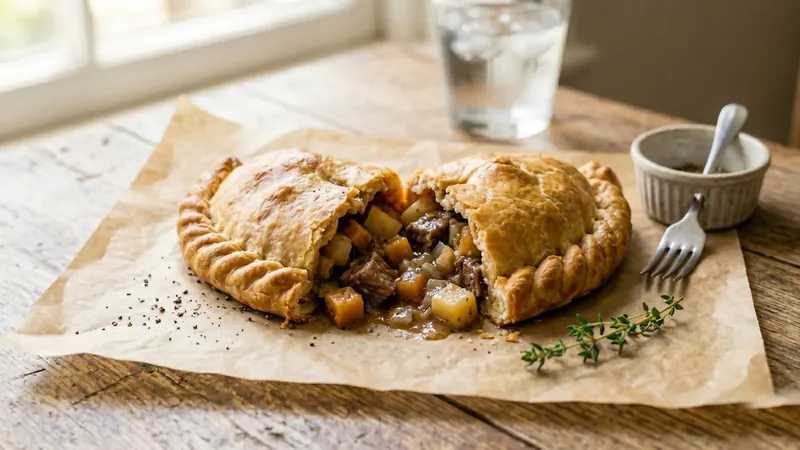
A proper Cornish pasty needs no reinvention, only respect for its traditions: raw beef skirt, swede, potato and onion sealed inside a sturdy shortcrust and baked slowly until the filling cooks in its own steam. The honest twist here is method rather than flavour, a robust, properly crimped crust strong enough to hold everything together and seal in all the savoury juices. Hearty, portable and deeply satisfying, it is a complete meal in a single golden parcel.
Traditional Cornish Pasty
Ingredients
- 500g strong white bread flour, plus extra for dusting
- 120g cold butter, cubed
- 120g cold lard, cubed
- 1 tsp salt
- 175ml cold water
- 350g beef skirt, cut into 1cm pieces
- 200g swede, peeled and finely diced
- 200g potato, peeled and finely diced
- 1 medium onion, finely chopped
- Plenty of salt and black pepper
- 25g butter, in small knobs
- 1 egg, beaten
Method
- Rub the butter and lard into the flour and salt until the mixture looks like coarse breadcrumbs.
- Add the cold water and bring together into a firm dough, then knead briefly until smooth.
- Wrap the pastry and chill for at least 1 hour.
- Mix the beef, swede, potato and onion in a bowl and season very generously with salt and pepper.
- Divide the pastry into four and roll each piece into a circle about 20cm across.
- Pile a quarter of the filling onto one half of each circle, leaving a clear border, and dot with butter.
- Brush the edge with beaten egg, fold the pastry over the filling and press to seal.
- Crimp the sealed edge by folding it over in a rope pattern along the curved side.
- Brush the pasties all over with beaten egg and cut a small steam hole in the top of each.
- Bake at 200C/180C fan/gas 6 for 15 minutes, then lower to 170C/150C fan/gas 3 and bake for 35 more minutes until deep golden.
- Cool for 10 minutes before eating, as the filling stays very hot.
3 The Story
The Cornish pasty is one of Britain’s most fiercely protected regional foods, so much so that it holds protected geographical indication status, meaning that to be sold as a genuine Cornish pasty it must be made in Cornwall to the traditional recipe and shape. That recipe is precise: a filling of beef, swede, potato and onion, seasoned and sealed raw inside shortcrust pastry, then crimped on one side into the distinctive D shape. Anything with a different filling or a top-crimped seam is, strictly speaking, just a pasty.
Its history is bound up with the county’s tin-mining industry. The pasty was the ideal lunch for a miner: a self-contained meal of meat and vegetables wrapped in a tough pastry case that could be carried underground and eaten by hand without cutlery or a plate. The thick, ropey crimp was more than decoration; it formed a sturdy handle that could be gripped with dirty fingers and then discarded, a practical solution in mines where hands might be contaminated. Whether that origin is fully historical or partly folklore, it captures exactly why the pasty is built the way it is.
The filling is famously simple and always raw when it goes in. Beef skirt is the traditional cut, prized because it is full of flavour and breaks down to tenderness over a long, gentle bake without drying out. Swede, often confusingly called turnip in Cornwall, brings a faint sweetness and earthiness, while potato and onion round out a balanced, savoury whole. As the pasty bakes, the vegetables release moisture that steams the meat and creates a natural gravy inside the sealed crust.
The pastry must be robust. A mixture of butter and lard gives both flavour and structure, producing a crust firm enough to hold a generous filling and survive handling, yet still short and tender to eat. Strong bread flour adds the strength the dough needs. Baked low and slow after an initial blast of heat, the pasty emerges deep golden, its contents perfectly cooked within. Eaten warm, it is a complete and thoroughly honest meal.
Related Content