Coconut Pandan Chiffon Cake
A pandan-steeped, coconut-milk chiffon built on egg-foam and a fold, cooled upside down so it doesn't collapse
Contents
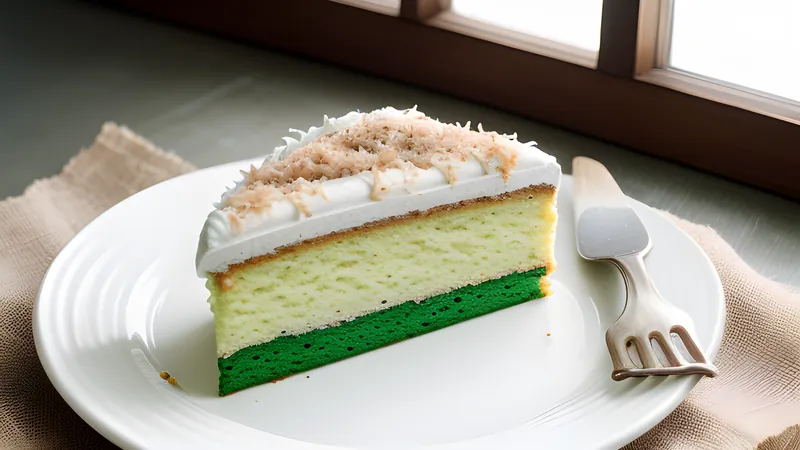
↓ Jump to recipeThis chiffon cake is built entirely on egg foam and a fold, no butter, no creaming, and it stands or falls on how gently you treat the air you’ve whipped into it. Pandan leaves, blitzed and strained into a startlingly green juice, carry a grassy, faintly vanilla-and-coconut fragrance that is distinct from anything in a Western pantry, and I steep it directly into coconut milk so the two flavours arrive together rather than fighting for attention. The cake is baked in an ungreased tin and cooled hanging upside down, which sounds like a fussy ritual until you understand what it’s actually preventing.
Coconut Pandan Chiffon Cake
Ingredients
- 10-12 fresh pandan leaves, or 1 tsp pandan extract
- 120ml coconut milk (full-fat, well shaken)
- 6 large eggs, separated, room temperature
- 150g caster sugar, divided (100g and 50g)
- 80ml neutral oil (sunflower or groundnut)
- 1/2 tsp fine salt
- 150g plain flour
- 1 tsp baking powder
- 1/2 tsp cream of tartar
- 1/4 tsp green food colouring gel (optional, if leaves alone give a pale colour)
Method
- Roughly chop the pandan leaves and blitz with 60ml of the coconut milk in a blender until pulverised.
- Strain through a muslin-lined sieve, pressing hard, to extract the pandan juice; you want about 3 tbsp of intensely green, fragrant liquid. Top up with the remaining coconut milk to 120ml total.
- Preheat the oven to 160C fan (180C conventional, Gas 4). Do not grease the chiffon tin.
- In a large bowl, whisk the egg yolks with 50g of the caster sugar until pale and thick, about 2 minutes.
- Whisk in the oil, salt, and the pandan-coconut milk until fully combined and smooth.
- Sift the flour and baking powder over the yolk mixture and fold in gently until just combined, no dry streaks.
- In a separate, spotlessly clean bowl, whisk the egg whites with the cream of tartar until foamy.
- Gradually add the remaining 100g sugar, a tablespoon at a time, whisking to stiff, glossy peaks that hold a firm curl when the whisk is lifted.
- Fold a third of the whipped whites into the yolk batter to loosen it, then fold in the rest in two more additions, working gently to keep as much air as possible.
- Pour the batter into an ungreased 20cm two-piece chiffon tin with a central funnel, and run a skewer through to pop any large air pockets.
- Bake for 45-50 minutes, until a skewer inserted comes out clean and the top springs back when pressed.
- Immediately invert the tin (resting the funnel over a bottle neck if your tin has no built-in feet) and cool completely upside down, at least 2 hours, before running a knife around the edges to release.
Pandan and coconut, a pairing that runs through a whole region
Pandan, the long blade-shaped leaf of Pandanus amaryllifolius, is one of the defining flavours of Southeast Asian cooking, used across Thailand, Malaysia, Singapore, Indonesia and the Philippines in everything from savoury rice to sweet drinks and cakes. It’s sometimes called Asian vanilla for the way cooks reach for it, wrapped around chicken before grilling, steeped into rice, blitzed into custards, though the flavour itself is nothing like vanilla, more grassy and green with a coconut-adjacent sweetness that seems to have evolved specifically to pair with actual coconut.
The chiffon cake itself has an odd, well-documented American origin: it was invented in Los Angeles in 1927 by Harry Baker, a insurance salesman turned baker, who kept the recipe secret and sold cakes to Hollywood stars and restaurants for two decades before selling the formula to General Mills in 1947. What made it novel was using vegetable oil instead of butter, which stays liquid at room temperature and lets the cake keep an exceptionally light, moist crumb days after baking, unlike a butter sponge which firms and dries as it cools. The technique spread fast once published, and Southeast Asian bakers, particularly in Singapore and Malaysia, adopted it enthusiastically and made it their own with pandan and coconut, to the point that pandan chiffon is now arguably more associated with Singaporean home baking and kaya-toast-adjacent café culture than with its American origin. Bengawan Solo, the Singapore bakery chain, has sold pandan chiffon since the 1970s and it remains one of the most recognisable cakes in the country.
Getting genuine pandan flavour outside Southeast Asia takes a little more effort than most ingredients, and it’s worth understanding why. Pandan’s characteristic aroma comes largely from a compound called 2-acetyl-1-pyrroline, the same molecule responsible for the toasty smell of jasmine rice and fresh bread crust, which is one reason people reach for “vanilla” as a lazy comparison when the truth is closer to fresh-cut grass crossed with warm rice. Fresh leaves, usually sold frozen in bundles at Asian supermarkets outside the tropics, give the truest version of that aroma once blitzed and strained. Bottled pandan extract varies enormously by brand: some are naturally derived and genuinely fragrant, while cheaper bottles are little more than green food colouring with an artificial, almost bubblegum-like flavour that bears only a passing resemblance to the real thing. If you’re buying extract rather than leaves, look for one that lists pandan or screwpine extract rather than “flavouring” alone, and taste a drop before committing a whole bottle to the batter.
The foam, the fold, and why this cake must hang upside down
A chiffon cake gets its structure almost entirely from whipped egg whites rather than from butter and creaming, and understanding that changes how you treat every stage. Egg whites whipped with cream of tartar (a mild acid that stabilises the protein foam and helps it hold more air without collapsing) trap thousands of tiny air pockets in a network of unfolded, re-linked proteins. That foam is fragile. Fold it too roughly into the yolk batter and you knock the air back out, and the cake bakes dense and rubbery instead of cloud-light. Fold it too little and streaks of unmixed white bake into dry, spongy pockets. The technique is to add the whites in three additions, cutting down through the centre and sweeping up the sides in a J-motion, turning the bowl as you go, stopping the moment no dry streaks remain.
The tin is ungreased on purpose. As the cake rises in the oven, the batter needs to grip the sides of the tin and climb, using the pan wall as scaffolding the same way a soufflé needs an unbuttered ramekin to climb straight rather than slide back down. Grease the tin and the batter simply cannot get purchase; it will rise less and often collapse unevenly. The central funnel of a proper chiffon tin does the same job from the inside, giving the batter more surface area to cling to and heating the centre of the cake faster and more evenly than a solid tin would.
Cooling upside down is the step people skip and immediately regret. Straight out of the oven, the cake’s structure is still setting, held up mostly by trapped steam and half-set egg proteins, and it is genuinely too fragile to support its own weight the right way up; it will sink and compress under gravity within minutes, leaving a dense, gummy band at the base. Inverted, gravity works in the cake’s favour instead, stretching the crumb gently as it finishes setting rather than crushing it, which is why a properly cooled chiffon has an even, cloud-like crumb from base to dome. Give it the full two hours; rushing this step is the single most common reason a chiffon cake disappoints.
Reading the finished cake tells you where things went wrong, if they did. A dense, wet streak running through the middle usually means the whites were underwhipped, or folded in too aggressively and knocked flat before the batter went in the oven — aim for peaks that hold a firm curl and still look glossy; a dry, clumpy point that’s lost its sheen is a sign of overwhipping in the other direction. A cake that domes sharply and cracks deeply across the top has usually gone in too hot; a domestic oven that runs hotter than its dial claims (worth checking with a separate oven thermometer) sets the outer crust before the centre has finished rising, so the middle keeps pushing up and splits the surface. A cake that shrinks away from the tin’s sides as it cools, rather than releasing cleanly with a knife, is more often a sign of underbaking than of anything wrong with the tin — give it another five minutes next time and check for a truly clean skewer before pulling it.
The recipe, from leaf to loaf
Blitz roughly chopped pandan leaves with a portion of the coconut milk, then strain hard through muslin to get a concentrated, vivid green juice; top up with more coconut milk to 120ml total. Whisk egg yolks with half the sugar until pale and thickened, then whisk in oil, salt and the pandan-coconut milk. Fold in sifted flour and baking powder just until smooth. Separately, whip egg whites with cream of tartar to soft foam, then gradually add the remaining sugar and whip to stiff, glossy peaks. Fold the whites into the yolk batter in three additions, gently. Pour into an ungreased 20cm chiffon tin, run a skewer through to release big bubbles, and bake at 160C fan for 45-50 minutes until a skewer comes out clean. Invert immediately and cool fully, at least 2 hours, before running a thin knife around the edges and the central funnel to release the cake.
Tips, substitutions, storage
Fresh pandan leaves (sold frozen in most Asian supermarkets outside the tropics) give a genuinely different, greener flavour than bottled pandan extract, but the extract is a fair substitute if leaves aren’t available; use it to taste rather than by strict measure, since brands vary in strength. Don’t skip cream of tartar if you can help it; a squeeze of lemon juice (1/2 tsp) works as a substitute stabiliser if you have neither. The cake keeps beautifully at room temperature, wrapped, for 3 days, actually improving slightly on day two as the crumb settles; it also freezes well, wrapped tightly, for up to a month. Never store it in the fridge uncovered, which dries chiffon out fast.
Variations
For a more tropical finish, top slices with toasted coconut flakes and a drizzle of coconut cream rather than icing, which would mask the pandan. A gula melaka (palm sugar) syrup brushed over the cooled cake, in the style of Malaysian kuih, adds a caramel depth that plays well against the grassy pandan. A smaller batch works well too: halve every ingredient and bake in a 15cm tin for around 35 minutes, checking a few minutes early, for a version that suits a smaller household without the temptation of finishing a full 20cm cake alone over a week.
If you’re building a Southeast Asian spread around it, this cake sits happily alongside mango sticky rice with toasted coconut cream for a full dessert course, and its base technique (oil-based batter, whipped-white lift) has a cousin in butter mochi with brown butter and coconut, if coconut desserts are your particular weakness, as they are mine.
Related Content