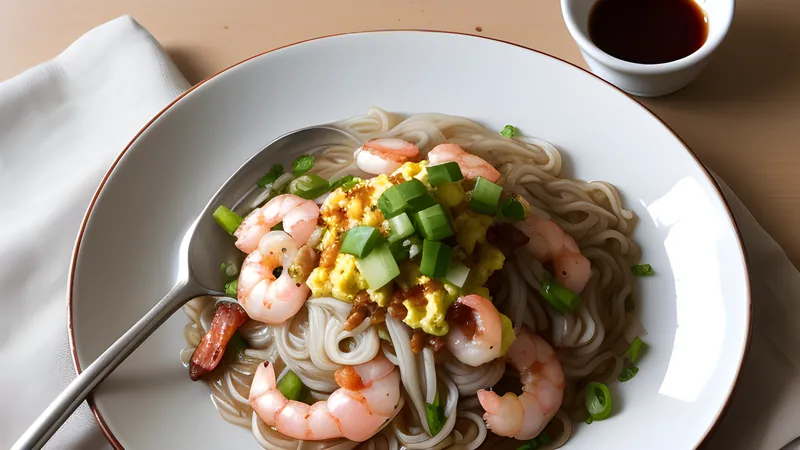
Char Kway Teow with Prawn and Chinese Sausage
Smoky flat rice noodles, prawns and lap cheong, fried hot enough to catch the wok breath
Contents
↓ Jump to recipeChar kway teow is street food that fights you a little, and that is the pleasure of it. In Penang and Singapore the best versions come from a stall where a cook stands over a single roaring wok all night, frying one or two portions at a time, wrist snapping the noodles up into the flame so they catch that elusive scorched aroma the Cantonese call wok hei — the “breath of the wok”. It is smoky and slightly bitter and impossible to fake with a jar, and chasing it at home is the whole game. You will not quite match the stall. You can get astonishingly close, and the trying teaches you more about heat than almost any other dish.
The name means, roughly, “stir-fried ricecake strips”, and kway teow are the noodles: wide, flat, slippery ribbons of rice. Historically this was labourers’ food, cheap and calorific, fried in pork lard and studded with whatever was to hand — cockles, blood, bits of sausage. It has since become one of the defining dishes of Malaysian and Singaporean hawker culture, argued over the way Italians argue over carbonara. My version leans on prawns and lap cheong, the sweet cured Chinese sausage, because that combination is both classic and forgiving, and it renders enough fat and sweetness to carry the smoke.
Char Kway Teow with Prawn and Chinese Sausage
Ingredients
- 400g fresh wide flat rice noodles (or 200g dried, soaked)
- 8 raw king prawns, peeled and deveined
- 1 Chinese sausage (lap cheong), thinly sliced on the diagonal
- 2 eggs
- 150g beansprouts
- 4 garlic cloves, finely chopped
- 3 spring onions, cut into 4cm lengths
- 3 tbsp lard or neutral oil
- 2 tbsp dark soy sauce
- 1 tbsp light soy sauce
- 1 tbsp oyster sauce
- 1 tsp caster sugar
- 1 tbsp sambal or chilli paste, plus more to serve
- 1 tsp fish sauce
- a small handful of Chinese chives, cut into 4cm lengths (optional)
Method
- Mix the dark soy, light soy, oyster sauce, sugar and fish sauce in a small bowl and set it by the stove. Cook one portion at a time, halving the ingredients per batch.
- Loosen and gently separate the rice noodles, warming them briefly if stuck, and prep all remaining ingredients.
- Heat the wok until smoking, add half the lard, then fry half the lap cheong for 30 seconds, add half the garlic for 10 seconds, then half the prawns for about 1 minute until pink; push to one side.
- Crack an egg into the cleared space, let it set for a few seconds, then break the yolk and scramble loosely.
- Add half the noodles and pour half the sauce down the side of the wok; toss and press against the hot metal for about 90 seconds to build char.
- Add half the beansprouts, spring onions, chives and 1 tsp sambal; toss for 30 seconds until just hot.
- Serve immediately with extra sambal, then repeat for the second portion.
The three things that make or break it
Char kway teow is a technique dish, and almost all of its difficulty lives in three decisions.
The noodles. Fresh wide rice noodles are what you want — look for them chilled in Asian supermarkets, sometimes labelled ho fun or sha he fen. They come folded into slabs and often stick together. Microwave them for thirty seconds or steam them briefly to loosen, then gently peel the ribbons apart with your fingers before cooking; forcing cold, stuck noodles apart in the wok tears them into scraps. If you can only find dried, soak them in warm water until pliable but still firm — around 20 minutes — and drain well. The noodles should be at room temperature and separated before they go anywhere near the heat.
The heat. Wok hei is a function of temperature, and a home hob is the enemy. Get your wok or heaviest frying pan as hot as it will physically go — a good few minutes over the biggest burner until it is faintly smoking — and cook in single portions. Two portions at once will crowd and steam and you will get a pale, damp stir-fry with none of the char. Cook one serving, keep it warm, cook the second. This is the single most important rule and the one everyone ignores.
The sauce. It is small in volume and dark and intense, built on dark soy for colour and a molasses depth, light soy for salt, oyster sauce for body and sugar to help it caramelise against the hot metal. Mix it in advance so you are not measuring while the wok screams. My one twist is a teaspoon of fish sauce stirred into the mix — a nod to the cockles and their briny liquor in the original — which adds a savoury undertow that most home versions miss.
Method
Mix the dark soy, light soy, oyster sauce, sugar and fish sauce in a small bowl and set it by the stove. Have every other ingredient prepped, measured and lined up, because the actual cooking takes barely three minutes per portion and there is no time to fetch anything.
Loosen and separate the rice noodles as above. Cook one portion at a time; the quantities below are for a single serving, so halve everything and repeat.
Set the wok over your highest heat until it is smoking. Add half the lard, swirl it round, then add half the sliced lap cheong and fry for thirty seconds until the fat renders and the edges crisp and the pan smells sweet. Add half the garlic, fry for ten seconds until fragrant, then add half the prawns and stir-fry for a minute until they turn pink and just firm. Push everything to one side.
Crack an egg into the cleared space, let it set for a few seconds, then break the yolk and scramble it loosely. Now add half the noodles and pour half the sauce down the side of the wok so it hits the hot metal and sizzles. This is the moment: toss and flip the noodles up out of the pan, letting them fall back and catch the heat, pressing them flat against the metal between tosses for a few seconds at a time to build char. Work fast, for about a minute and a half, until the noodles are glossy, unevenly bronzed and smelling faintly scorched.
Add half the beansprouts, half the spring onions and the chives if using, along with a teaspoon of sambal, and toss for a final thirty seconds — the sprouts should stay crunchy and barely warmed through. Tip onto a plate and cook the second portion. Serve immediately with extra sambal on the side.
Wok hei at home, honestly
You cannot generate true stall-grade wok hei on a domestic hob, because the phenomenon depends on flames licking up over the rim of the wok and igniting the aerosolised oil and soy — a burner far hotter than anything in a home kitchen. What you can do is get most of the way there. Use a carbon-steel wok. Non-stick coatings degrade above the temperatures you need and will never let the pan get properly hot, so they are the wrong tool for this dish. Preheat it far longer than feels sensible. Cook tiny batches. And if you have a gas hob, tilt the wok briefly so the flame catches the edge of the food — a controlled lick of fire that flash-toasts the surface. Keep a lid nearby and your eyebrows out of range. The result won’t rival a Penang stall, though it will be smoky, glossy and better than any takeaway.
Variations and what to drink alongside
The classic Penang additions are blood cockles, stirred in raw at the very end so they barely warm, and Chinese garlic chives; both are worth seeking out if you have a good Asian grocer. A firmer version uses fish cake slices. For a vegetarian rendition, drop the prawns and sausage, fry firm tofu until golden and lean harder on the garlic, sambal and a mushroom sauce in place of the oyster. More egg is never wrong. A wedge of lime on the side cuts the richness.
This belongs to a whole family of fried rice-noodle dishes across Southeast Asia and southern China, and once you have the technique it unlocks its cousins. The closely related beef chow fun with charred rice noodles uses the same wide ho fun and the same hunt for char, swapping prawns and sausage for velveted beef. The Malaysian mee goreng with prawn and tofu takes the wok-hot approach to yellow wheat noodles with a spicier, sweeter sauce. And if you want to practise the high-heat wok toss on something more forgiving first, Yangzhou fried rice with char siu and prawn teaches the same instincts on a grain that will not tear.
A note on lard, and why it matters here
Char kway teow was born in lard and it wants lard. Rendered pork fat has a higher smoke point than most vegetable oils and, more to the point, it carries a savoury flavour that plain oil cannot, coating the noodles with a faint porky richness that is part of the dish’s identity. A stall cook keeps a pot of it bubbling and adds a spoon to every portion; at home, a tub of good lard in the fridge lasts for months and rewards you across a dozen fried dishes. If you would rather not, a neutral oil with a high smoke point — groundnut or refined rapeseed — will fry the noodles perfectly well and take the heat without scorching. What you should not reach for is butter or olive oil, both of which burn long before the wok is hot enough to do its work.
Storage
Char kway teow is a cook-and-eat-now dish; it does not keep. Reheated, the noodles go soft and gummy and the smoke vanishes. What you can do ahead is all the prep — separate the noodles, slice the sausage, peel the prawns, mix the sauce — so that when hunger strikes you are three minutes from a plate. Store the components separately in the fridge for up to a day and cook them fresh. Given how fast the cooking is, there is little reason to make more than you will eat in one sitting, and every reason to eat it straight from the wok while it still carries the breath of the fire.
Related Content