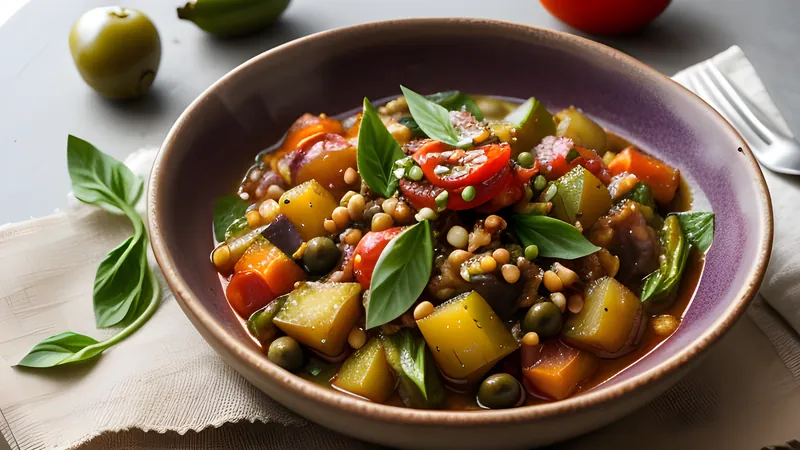
Caponata with Capers, Olives and Pine Nuts
The Sicilian sweet-and-sour aubergine that gets better overnight
Contents
↓ Jump to recipeCaponata is the dish that finally taught me to like aubergine. For years I treated it with suspicion, having eaten too many oily, bitter, undercooked versions, until a Sicilian friend served me a bowl of this at room temperature with good bread and told me she had made it the day before. That was the revelation: caponata is not a thing you cook and eat, it is a thing you cook and then leave alone while the flavours settle, deepen and marry into something far greater than the fried vegetables it started as. Made properly and rested overnight, it is one of the great vegetable dishes of the Mediterranean.
A dish shaped by the whole Mediterranean
Caponata is Sicilian to its core, and Sicily’s kitchen is a record of everyone who ever landed on the island. The sweet-and-sour balance at the heart of the dish, the agrodolce, is Arab in origin, brought during the two centuries of Arab rule from the ninth century onward, along with the sultanas and pine nuts that turn up in the classic version. The technique of pairing sugar with vinegar to preserve and season vegetables is one of the most enduring legacies of that period, and it survives across Sicilian cooking. The olives, capers and tomatoes are the Mediterranean baseline; the tomato itself is a later, post-Columbian arrival that grafted itself onto a much older dish.
Even the name is contested and interesting. Some trace it to caupone, the taverns where a similar dish was served to sailors; others to the capone, a Sicilian name for the mahi-mahi fish that wealthier households once served in a sweet-sour sauce, with the vegetable version emerging as the poor cook’s imitation. There are said to be dozens of regional variants across the island, some with peppers, some with potatoes, some with a scatter of toasted almonds or a whisper of chocolate. The version here is the Palermo-leaning classic, built on aubergine, celery and a properly balanced agrodolce, with one small liberty I will come to.
The clever bit: a whisper of cocoa
My one addition to the traditional formula is a single teaspoon of unsweetened cocoa powder, stirred in near the end. This is not an invention so much as a nod to the old Sicilian aristocratic versions, where bitter chocolate sometimes found its way into the pot. It does not make the caponata taste of chocolate. What it does is deepen the tomato, round off the vinegar’s sharp edge and lend the whole thing a dark, savoury bass note that makes people ask what the secret ingredient is. Leave it out and you have an honest, classic caponata; stir it in and you have one with a little more mystery.
Caponata with Capers, Olives and Pine Nuts
Ingredients
- 2 large aubergines (about 700g), cut into 3cm cubes
- 1 tsp fine salt, for degorging
- 6 tbsp olive oil, plus more as needed
- 1 large onion, finely chopped
- 3 inner celery sticks, sliced 1cm thick, leaves reserved
- 2 garlic cloves, sliced
- 400g tin chopped tomatoes
- 2 tbsp tomato purée
- 3 tbsp red wine vinegar
- 1.5 tbsp caster sugar
- 2 tbsp salted capers, rinsed
- 80g green olives, pitted and torn
- 30g pine nuts, toasted
- 20g sultanas, soaked in warm water
- 1 tsp unsweetened cocoa powder (optional)
- A handful of basil leaves, torn, to finish
Method
- Toss the cubed aubergine with the fine salt and leave in a colander for 30 minutes, then pat thoroughly dry.
- Fry the aubergine in batches in hot olive oil until deep golden on all sides, then drain on kitchen paper.
- In the same pan, soften the onion and celery in a little more oil for 10 minutes until sweet, then add the garlic for a minute.
- Stir in the tomatoes and tomato purée and simmer for 10 minutes until thick and jammy.
- In a small pan, warm the vinegar and sugar until the sugar dissolves to make the agrodolce.
- Return the aubergine to the pan with the capers, olives, drained sultanas and the agrodolce. Simmer gently for 8 to 10 minutes.
- Stir through the cocoa if using, then the toasted pine nuts. Taste and balance the sweet and sour.
- Cool to room temperature, cover and rest for at least a few hours or overnight. Finish with basil and celery leaves to serve.
Why frying beats roasting here
You can roast the aubergine to save oil and effort, and plenty of modern recipes do, but for true caponata I fry it, and it is worth understanding why. Frying in olive oil gives the aubergine a deep, even golden crust and a silky, collapsing interior that holds up when simmered in the sauce. Roasting tends to dry the surface and can leave the flesh either chalky or too soft. The salting step beforehand is not really about bitterness in modern aubergines, which have largely been bred out of it; it is about drawing out moisture so the cubes fry rather than steam, and firming the flesh so it absorbs less oil. Dry aubergine in hot oil browns fast and drinks up far less than damp aubergine in cool oil, which is where the dish’s oily reputation comes from.
The overnight rule
Caponata that has just been made tastes raw and disjointed, the vinegar sharp, the sugar obvious, the vegetables distinct. Give it a night in the fridge and something happens: the sweet and sour fuse, the aubergine soaks up the tomato, the capers and olives spread their brine through everything, and the whole dish arrives at a rounded, harmonious middle. This is a genuinely make-ahead dish, and one that improves for two or three days. Always serve it at room temperature, never fridge-cold, which mutes the flavour, and never piping hot, which is simply not how it is meant to be eaten.
Serving, storing and variations
Caponata is endlessly useful. Serve it as an antipasto with crusty bread to mop the juices, as a side to grilled fish or lamb, spooned over polenta, tossed through pasta, or piled on toasted sourdough with a torn ball of mozzarella. It keeps in the fridge for up to five days and the flavour only improves, though I would eat it within three for the best texture. It does not freeze well, as the aubergine turns watery on thawing.
For variations, roast a couple of red peppers and fold them in for a Catania-style version, add a handful of toasted almonds alongside or instead of the pine nuts, or stir through a spoon of good cocoa and a square of grated dark chocolate for a richer, more baroque caponata. If you like this style of sweet-sour, briny vegetable cooking, it sits beautifully alongside a fennel, orange and black olive salad on an antipasti table, and it shares its love of black olives and bright acid with my watermelon, feta and mint with black olive. For a warm partner, a plate of roasted fennel with Parmesan and lemon rounds out a vegetable-led Sicilian spread.
Related Content