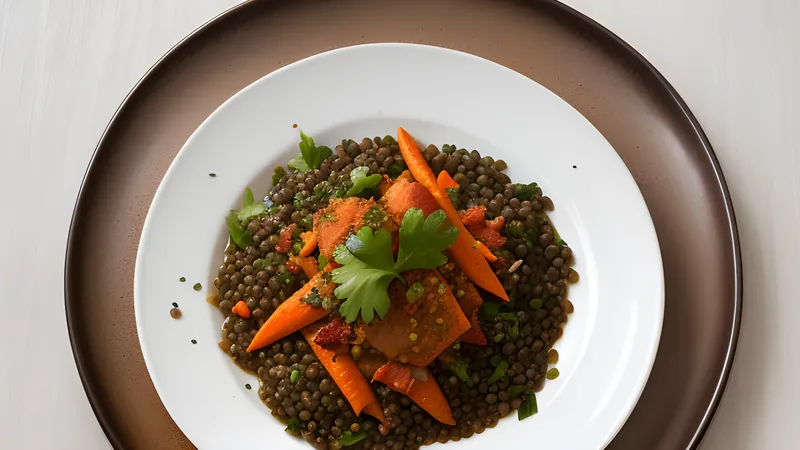
Braised Puy Lentils with Bacon and Bay
The side dish that quietly runs the whole plate
Contents
↓ Jump to recipeMy grandmother’s side of the family ran a smallholding in the Limousin, and the one dish that turns up in every memory I have of her kitchen is a pot of lentils simmering with bacon and bay while something grander roasted alongside it. Nobody ever called it a recipe. It was just what happened to the lentils that lived in the cupboard next to the flour, and it went on the stove almost by reflex whenever the oven was already busy with something else.
That’s still the right way to think about this dish. It’s the thing that makes the meal make sense — the dark, savoury, faintly vinegary counterweight to a roast chicken, a piece of grilled sausage, or a slab of pork belly with the fat rendered off, rather than a meal to stand on its own. Once you’ve made it properly once, you’ll understand why French home cooks treat lentils this way rather than as a health-food obligation squeezed onto the plate out of duty.
Braised Puy Lentils with Bacon and Bay
Ingredients
- 200g Puy lentils (the small green-grey French variety), rinsed
- 150g smoked bacon lardons
- 1 tbsp olive oil
- 1 small onion, finely diced
- 1 carrot, finely diced
- 1 celery stick, finely diced
- 3 garlic cloves, finely chopped
- 2 bay leaves
- 1 sprig fresh thyme
- 700ml chicken stock
- 1 tbsp sherry vinegar
- 1 tsp Dijon mustard
- 1 tbsp cold butter
- Salt and black pepper, to taste
- Small handful flat-leaf parsley, chopped, to finish
Method
- Render the lardons in a heavy-based pot over medium heat, no oil needed, until the fat runs clear and the edges turn golden, about 5 minutes. Lift out with a slotted spoon and set aside.
- Add the olive oil to the bacon fat, then add the onion, carrot and celery. Cook gently for 8 minutes until the onion is translucent. Add the garlic and cook 1 minute more.
- Stir in the rinsed lentils, bay leaves and thyme, then pour over the stock. Bring to a simmer, cover, and cook for 25-30 minutes, until the lentils are tender but still whole and most of the liquid is absorbed.
- Return the bacon to the pot with the sherry vinegar and Dijon mustard, stir through, then take off the heat and beat in the cold butter.
- Discard the bay leaves and thyme stalk, taste and season, scatter over the parsley and serve warm.
Why Puy lentils, specifically
Puy lentils come from the volcanic plateau around Le Puy-en-Velay in the Auvergne, and since 1996 the name has carried a Protected Designation of Origin — genuine lentilles vertes du Puy can only be grown in that specific patch of France, the same way Champagne can only come from Champagne. What you’re buying is not marketing romance, though. The lentils really are different: small, slate-green with faint marbling, and grown in mineral-rich volcanic soil that seems to concentrate their flavour into something earthier and more mineral than an ordinary green lentil.
The practical reason they matter here is structural. Puy lentils hold their shape through thirty-plus minutes of simmering, keeping a slight bite at the centre even once fully cooked. Red lentils collapse into something closer to a purée — lovely for a dal, wrong for this. Standard brown or green lentils from the supermarket will do a passable job if Puy lentils aren’t available, but they turn softer at the edges faster, so start checking for doneness five minutes earlier than the timing below and be ready to pull the pot off the heat the moment they’re right.
Do not add salt to the cooking liquid until the lentils are nearly tender. Salt added early toughens the lentil skins and can leave you with a pot of lentils that never quite gets past al dente, no matter how long you cook them. This is the single most common reason home cooks give up on lentils and blame the ingredient rather than the method — the lentils were never the problem, the timing of the seasoning was.
The AOC status is worth understanding a little further, since it explains why a small bag of Puy lentils costs noticeably more than an ordinary bag of green lentils from the same shelf. Protected Designation of Origin rules require that the lentils be grown, within strict yield limits, on the volcanic soils of a defined zone around Le Puy-en-Velay, at altitude, using methods that have changed little since cultivation there was first documented in the Middle Ages. The volcanic soil is genuinely mineral-rich, high in potassium and phosphorus from centuries-old lava deposits, and it’s this specific geology, not marketing, that gives the lentils their slightly peppery, faintly smoky depth. It’s the pulse equivalent of terroir showing up in a wine, which is a strange thing to say about a lentil until you’ve tasted a proper batch next to a supermarket bag side by side.
The bacon and the bay
Lardons — thick-cut bacon batons, rendered slowly rather than fried hot — are doing three jobs at once here. They render fat that becomes the cooking medium for the vegetables, they contribute smoke and salt that would otherwise need correcting with seasoning alone, and the crisped edges give texture against the soft lentils once everything comes back together at the end. If your supermarket doesn’t stock proper lardons, buy a thick slab of smoked streaky bacon and cut it into batons yourself — it’s a two-minute job with a sharp knife, and the pieces cook far more evenly than thin rashers chopped small, which tend to shrivel into crisps rather than staying meaty.
Bay leaves are one of the few herbs that genuinely need long, slow cooking to give anything up. Thrown into a quick sauce, a bay leaf does almost nothing; simmered for thirty-five minutes in a covered pot, it releases a resinous, slightly medicinal depth that you’d struggle to name if you tasted the dish blind, but that you’d miss immediately if it were gone. Buy bay leaves in small quantities and keep them in the freezer — they lose their oils within about a year on a spice rack and start tasting like dusty cardboard, which is why so many people conclude bay does nothing at all.
Fresh bay, if you can get it from a garden centre or a friend with a tree, is noticeably more potent than the dried leaves sold in jars, carrying a slightly minty, almost eucalyptus edge that dried bay loses entirely over time. One fresh leaf does roughly the work of two dried ones. Either way, always fish the leaves out before serving — the leaf itself stays tough and faintly sharp-edged even after thirty-five minutes of simmering, and biting into a whole one is an unpleasant surprise that a bowl of otherwise soft lentils shouldn’t spring on anyone.
Method
Render the lardons in a heavy-based pot or Dutch oven over medium heat, no oil needed at first, until the fat runs clear and the edges turn golden, about 5 minutes. Lift the lardons out with a slotted spoon and set aside, leaving the rendered fat behind in the pot.
Add the olive oil to the bacon fat, then tip in the onion, carrot and celery — the French mirepoix that underpins half of that country’s savoury cooking. Cook gently for 8 minutes, stirring occasionally, until the onion is translucent and starting to sweeten rather than colour. Add the garlic and cook for 1 minute more, just until fragrant, taking care it doesn’t catch and turn bitter.
Stir in the rinsed lentils, bay leaves and thyme, then pour over the stock. Bring to a simmer, cover, and cook for 25–30 minutes, checking from the 20-minute mark — you want the lentils tender but distinctly whole, not mushy, and most of the liquid absorbed into them. If the pot looks dry before the lentils are tender, add a splash more stock or water; if there’s still a lot of liquid once they’re tender, uncover and let it bubble off for the last few minutes over a slightly higher heat.
Return the bacon to the pot along with the sherry vinegar and Dijon mustard, and stir through. Take the pot off the heat and beat in the cold butter — this is a small version of monter au beurre, the classic French trick of finishing a braise with a knob of cold butter to give it gloss and body without reaching for cream. Taste and season; remember the bacon has already added salt, so go carefully and taste again before reaching for the pepper mill. Discard the bay leaves and thyme stalk, scatter over the parsley, and serve warm.
What it sits well next to
This is designed to be a supporting act rather than the headline. It’s excellent under a roast chicken, since the lentils soak up any juices that escape the bird as it rests, alongside grilled saucisson or Toulouse sausage, or as the base for a piece of pan-seared salmon or duck breast, whose fat runs into the lentils in exactly the way the bacon fat already has. If you want a fuller French spread for a weekend dinner, a bowl of French onion soup to start makes the whole meal feel like a proper bistro night rather than a Tuesday improvisation that happened to go well.
If lentils are your thing and you want to see how differently a cuisine can treat the same pulse, my red lentil and coconut dal uses the split, quick-cooking red variety for something creamy and spiced rather than structured and savoury — worth cooking both in the same month to see how much the variety of lentil actually changes the dish, quite apart from the spicing.
Make-ahead and storage
This is one of those rare braises that’s genuinely better the next day, once the flavours have had time to settle into the lentils overnight in the fridge. Cool completely, then refrigerate in an airtight container for up to 4 days. Reheat gently in a pan with a splash of water or stock to loosen it, since the lentils will have drunk up more liquid as they sat and can turn stodgy if reheated dry.
It also freezes well for up to 3 months, though the texture softens slightly on thawing — still perfectly good, just less distinctly “whole lentil” than fresh. Thaw overnight in the fridge rather than at room temperature, and reheat slowly, stirring in a small extra knob of butter at the end to bring back some of the richness that the freezer tends to flatten out.
Variations
For a vegetarian version, swap the bacon for 2 tablespoons of olive oil plus a teaspoon of smoked paprika stirred in with the garlic, and use vegetable stock in place of chicken. You’ll lose the specific smokiness bacon brings, but the paprika and a good glug of olive oil at the end get you most of the way there.
A dash of red wine — about 100ml, added after the vegetables have softened and reduced by half before the stock goes in — turns this into something closer to a lentil version of coq au vin, deeper in colour and slightly sweet at the edges. If you have a chunk of Parmesan or Gruyère rind knocking about in the freezer, drop it into the pot with the stock; it melts in slowly over the simmer and adds a savoury backbone that’s hard to place on the tongue but very welcome all the same. Leftover lentils also make a surprisingly good cold salad the next day, tossed with a little extra sherry vinegar, olive oil and some torn soft herbs. A poached or fried egg on top turns a portion into a light supper on its own rather than a side dish — the yolk running into the warm lentils does much the same job as the cold butter stirred in at the end, just with even more richness. Duck confit, torn into pieces and warmed through in the last few minutes of cooking, is the more indulgent route if you’re cooking for a special occasion rather than a weeknight, and it turns the whole dish into something a Parisian bistro would happily put on a set menu.
Related Content