Bouillabaisse with Rouille and Croutons
The Marseille fisherman's stew, built on saffron, fennel and a slick of orange zest
Contents
↓ Jump to recipeBouillabaisse has a reputation problem. Say the word and most people picture a stiff, expensive restaurant dish, a special-occasion splurge full of lobster and langoustine that costs a fortune and takes a professional to pull off. That version exists, and it is a tourist invention. The real thing began as the opposite: it was what the fishermen of Marseille cooked on the quayside from the fish nobody would buy - the spiny, bony, ugly rockfish left in the bottom of the net once the good catch had gone to market. This was rubbish-fish stew, cheap and improvised, and that humble beginning is the key to understanding it.
Once you know it is peasant food, the whole dish opens up. You do not need luxury fish. You need cheap, gelatinous, flavourful whole fish for the broth, a good pinch of saffron, fennel and orange to perfume it, and a fierce garlicky rouille to finish. The technique that turns a pile of fish heads into something glorious is where the real skill lives, and it is entirely learnable at home.
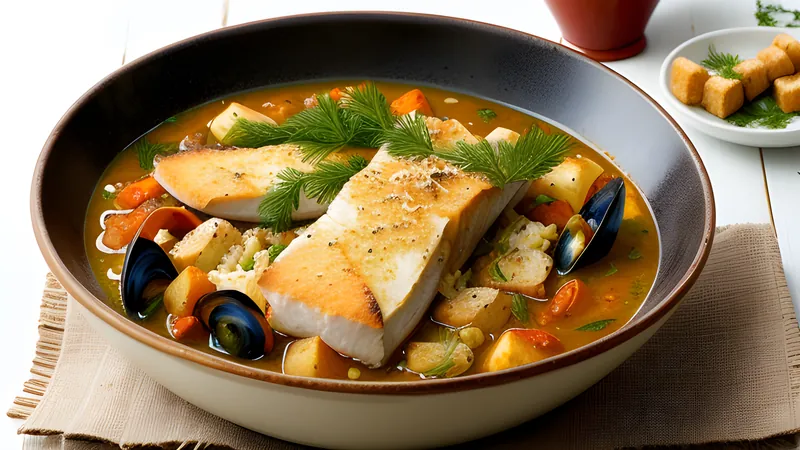
Bouillabaisse with Rouille and Croutons
Ingredients
- 1.5 kg mixed whole white fish and bones (gurnard, red mullet, conger, monkfish, sea bass), gutted and scaled
- 6 tbsp olive oil
- 2 onions, chopped
- 1 fennel bulb, chopped, fronds reserved
- 1 leek, sliced
- 6 cloves garlic, crushed
- 2 strips of orange peel, pared with a peeler
- 1 x 400 g tin chopped tomatoes
- 2 tbsp tomato purée
- 1 large pinch saffron threads (about 0.5 g)
- 1 bay leaf, 2 sprigs thyme
- 1 tbsp pastis or Pernod (optional)
- 1.5 litres boiling water
- 600 g firm fish fillet (monkfish, gurnard, sea bass), cut into chunks
- 12 mussels, scrubbed (optional)
- Salt and black pepper
- For the rouille: 1 egg yolk, 1 garlic clove, 1 small cooked potato, pinch saffron, 0.5 tsp cayenne, 150 ml olive oil, squeeze of lemon
- 1 baguette, sliced and toasted, to serve
Method
- Fillet the whole fish, or ask the fishmonger to, keeping every scrap of head, bone and trimming. Cut the firm fillet into large chunks and chill until needed. Reserve the heads and bones for the broth.
- Heat the olive oil in a very large pot over medium heat. Add the onions, fennel and leek and cook for 10 minutes until softened but not coloured. Add the garlic and cook 1 minute more.
- Add the fish heads and bones and stir for 5 minutes so they start to break down. Add the orange peel, tomatoes, tomato purée, saffron, bay leaf, thyme and pastis (if using).
- Pour in the boiling water, season with salt, bring to the boil and simmer hard for 30 minutes, mashing the bones occasionally with a wooden spoon to extract all their flavour.
- Strain the broth through a colander into a clean pot, pressing hard on the solids to squeeze out every drop, then pass it once more through a sieve for a smoother finish. Discard the bones. Taste and adjust seasoning.
- For the rouille, pound the garlic, saffron and cayenne to a paste, mash in the cooked potato and egg yolk, then whisk in the olive oil drop by drop as for a mayonnaise until thick. Season and sharpen with lemon.
- Bring the strained broth back to a gentle boil. Add the firm fish chunks and cook for 5 minutes, add the mussels (if using), cover and cook 3-4 minutes more until the fish is just opaque and the mussels have opened.
- Serve the broth and fish in wide bowls, with toasted baguette spread with rouille floated on top, and the reserved fennel fronds scattered over.
What the name tells you
Bouillabaisse comes from the Provençal bouiabaisso, from bolhir (to boil) and abaissar (to lower or reduce) - “boil and lower”. That is a cooking instruction hiding in the name: bring the broth to a hard, rolling boil, then lower the heat, or in the older reading, boil it hard to reduce it down. The vigorous boil is deliberate and important, because it emulsifies the olive oil into the fish broth, giving bouillabaisse its characteristic slightly thickened, cloudy, unified body. A fish soup simmered gently stays thin and separated; one boiled hard comes together.
Marseille takes its bouillabaisse seriously enough that in 1980 a group of the city’s restaurateurs signed a formal “charter” laying down what a real one must contain - a minimum number of specified local rockfish, saffron, the proper service ritual. That charter is worth knowing about and worth ignoring at home, since half the fish on the list barely exist outside the Mediterranean. The principle to keep is the one underneath the rules: a broth from many small whole fish, aromatic with saffron and fennel, served in two acts.
The broth is the whole dish
Everything good here comes from the broth, and the broth comes from parts most recipes throw away. Fish heads and bones are packed with gelatine and flavour, and it is the heads especially - the cheeks, the collar, all that collagen - that give the broth its body. Ask your fishmonger for a bag of white fish frames and heads; they cost almost nothing and are often free. Gurnard, an ugly, cheap, firm fish, is the ideal Mediterranean-style base if you can find it, along with anything from red mullet to conger eel to the frames off a sea bass.
Sweat the vegetables first without colouring them, then add the bones and let them break down before the liquid goes in - a few minutes of stirring the heads in the hot pot starts releasing their flavour. Then boil hard for half an hour, mashing the bones against the side of the pot as they soften to extract every scrap. Crucially, use boiling water rather than cold: adding cold water to a hot fish pot can turn the broth muddy, while boiling water keeps it clean. Strain it hard, pressing the solids, then pass it once more for a silky finish. What you are left with should taste intensely of the sea, deep orange-gold from the saffron and tomato.
Saffron, fennel and the orange trick
Three aromatics define a Provençal fish broth. Saffron is the costly one and there is no substitute for its particular honeyed, hay-like perfume and the colour it lends; use a proper pinch and let it steep in the hot broth to draw out both. Fennel - the bulb in the base and, if you can get it, a little dried fennel stalk - gives the aniseed note that runs all through Marseillais cooking, reinforced by an optional splash of pastis.
The orange peel is the small clever twist, and it is authentically local. A couple of strips of orange zest, pared thin with a peeler to avoid the bitter pith, steep in the broth and add a barely-there citrus warmth that lifts the whole thing and stops the richness cloying. You will not taste “orange” as such; you will taste a broth that seems brighter and more rounded than it has any right to be. Fish it out before serving. This is a genuine Provençal habit, and once you have done it you will want to add a strip of orange to every fish soup you make.
Rouille: the garlic-chilli mayonnaise
Rouille means “rust”, for its colour, and it is the sauce that makes bouillabaisse. Think of it as a fierce cousin of aïoli - a garlic mayonnaise stained red-gold with saffron and cayenne and given body with a little cooked potato or soaked bread. It goes on toasted baguette, floated on the broth, where it melts slowly into the surface and enriches every spoonful.
Make it as you would a mayonnaise, and the same rules apply: everything at room temperature, and the oil added drop by drop at first so the emulsion takes. If it splits - grainy, oily, refusing to thicken - do not throw it out. Start again with a fresh yolk in a clean bowl and whisk the split mixture into it slowly, and it will come back together. The potato makes rouille more forgiving and more stable than a straight mayonnaise, which is why home versions often include it. Season it hard; rouille should be punchy enough to stand up to a whole bowl of rich broth, with real garlic heat and a proper hit of cayenne.
Serving: the two acts
Traditionally bouillabaisse is served in two courses from the one pot, and it is a lovely piece of theatre worth keeping. First the broth is ladled out over the rouille-topped croutons and eaten as a soup. Then the fish and any shellfish come to the table on a separate platter, dressed with a little broth, to be eaten as the main event. Serving it this way lets the broth shine on its own and keeps the fish from overcooking while it sits in hot liquid.
The fish itself needs almost no cooking. Add the firm chunks to the barely-boiling strained broth and give them five minutes, add mussels for the last three or four until they open, and stop the moment the fish turns opaque. Fish poached in fish broth this good needs no more than that; overcook it and it turns from silky to cottony, wasting the best part.
Doing it at home without the fuss
You do not need the full charter’s worth of species. A broth built from whatever cheap white fish frames your fishmonger has, plus a couple of firm fillets to poach at the end, makes a genuinely excellent version. Skip the mussels if you like, or add a few clams. What you must not skip is the hard boil, the saffron, the orange peel and the rouille - those four are the difference between a good fish soup and something that tastes of the Marseille quayside.
Make the broth a day ahead if it helps; it keeps two days in the fridge and freezes for three months, and it only deepens for the rest. Poach the fresh fish to order when you reheat the broth to serving temperature. The rouille keeps two or three days covered in the fridge. Leftover broth without fish makes a superb base for a quick soup or a risotto later in the week.
For another great tomato-and-seafood stew from the other side of the Atlantic, built on the same idea of a fragrant broth loaded with fish, see Cioppino: San Francisco’s Tomato Seafood Stew. And if the garlicky, saffron-tinged rouille appeals, it shares its DNA with the poached-egg garlic soup in Sopa de Ajo: Castilian Garlic Soup with a Poached Egg.
Related Content