Black Sticky Rice Pudding with Coconut
Purple-black glutinous rice under salted coconut cream
Contents
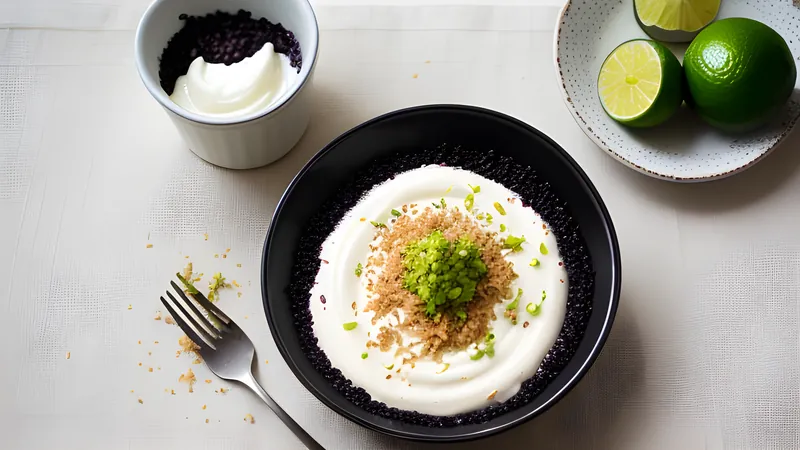
↓ Jump to recipeFew puddings look as dramatic as this one for as little effort. Black glutinous rice, simmered slowly with water and a knot of pandan, releases its deep indigo colour into the pot until the whole thing turns a glossy, inky purple, and against it a pour of salted white coconut cream looks like the moon over a dark sea. It is chewy, gently sweet and profoundly comforting, a breakfast in some households and a pudding in others, and my one liberty is a whisper of lime at the end that cuts through the richness and makes the coconut taste even more of itself.
Black Sticky Rice Pudding with Coconut
Ingredients
- 180g black glutinous (sticky) rice
- 1 litre water, plus more for soaking
- 1 pandan leaf, knotted (optional)
- 0.25 tsp fine salt (for the rice)
- 80g palm sugar, chopped, or soft light brown sugar
- 150ml coconut cream
- 0.25 tsp fine salt (for the coconut topping)
- 1 tsp cornflour
- 1 lime, for zest and juice
- 1 tbsp toasted coconut flakes, to finish
Method
- Rinse the black rice in a couple of changes of water, then soak it in plenty of cold water for at least 4 hours or overnight.
- Drain the rice and put it in a pan with the 1 litre of water, the knotted pandan leaf and 0.25 tsp salt. Bring to the boil, then simmer gently, stirring now and then, for 40 to 50 minutes until the grains are tender and chewy and the liquid is thick and deep purple.
- Stir in the palm sugar and cook for a further 5 minutes until dissolved and the pudding is glossy. Discard the pandan. Add a splash of water if it is too thick.
- Make the topping: whisk the cornflour into a spoon of the coconut cream, then warm the rest of the coconut cream with the 0.25 tsp salt until steaming.
- Whisk in the cornflour slurry and cook for 1 to 2 minutes until it thickens to a pourable, single-cream consistency. Do not boil hard.
- Spoon the warm black rice into bowls.
- Pour over the salted coconut cream, then add a fine grating of lime zest and a small squeeze of lime juice.
- Scatter with toasted coconut flakes and serve warm.
The rice that is not black and not really rice pudding
Black sticky rice, sometimes sold as black glutinous rice or forbidden rice, is a wholegrain variety whose bran layer is coloured by anthocyanins, the same purple-red pigments found in blackcurrants and red cabbage, which is why the cooking water turns violet rather than truly black. Being a wholegrain, it keeps its bran and its nutty bite, and being a glutinous variety, it is high in the sticky starch amylopectin, which gives the cooked grains their characteristic chew and makes the pudding cling together without turning to mush.
The dish is a fixture across Southeast Asia. In Thailand it is khao niaow dam, in Indonesia and Malaysia bubur pulut hitam, eaten warm for breakfast or as a sweet at any hour, always with coconut. What I find quietly brilliant about it is the restraint: the rice is barely sweetened, so most of the sugar sensation comes at the moment the salted coconut cream meets it in the bowl. It belongs to the same coconut-and-palm-sugar family as my Coconut Sago Pudding with Palm Sugar and the banana-laced Chè Chuối: Vietnamese Banana and Tapioca, and if you already keep pandan and palm sugar for those, you are most of the way to this one.
The twist: salt and a squeeze of lime
The coconut topping is where this pudding lives or dies, and two things make mine sing. The first is salt, a proper quarter-teaspoon whisked into the coconut cream, which turns a sweetish white sauce into something savoury and rounded that throws the sweetness of the rice into relief. The second, and the small twist that is mine, is lime: a fine grating of zest and a modest squeeze of juice over the finished bowl. Coconut is rich and can sit heavily on the palate, and a little acid lifts it, brightens the whole dish and stops the fourth spoonful tasting like too much. It is a tiny gesture that people notice without being able to name.
I also thicken the coconut cream very slightly with a teaspoon of cornflour. Traditionally the coconut is served just warmed and pourable, which is lovely, but a hint of starch gives it enough body to drape over the rice and pool rather than sink straight through, so you get that clean visual contrast of white on purple and a little sauce in every spoon.
Cooking the rice, and why it takes patience
The single most important step happens before any heat: soaking. Black glutinous rice has a tough, intact bran layer, and without a good soak of at least four hours, ideally overnight, it takes an age to soften and cooks unevenly, chalky in the middle and blown on the outside. Soaking hydrates the grain right through so it cooks evenly to that perfect tender chew, and it also shortens the simmering time considerably.
Cook it low and slow with plenty of water, stirring now and then to stop it sticking, and be patient; forty to fifty minutes is normal, and older rice can take longer still. You are looking for grains that are soft and chewy with no hard core, sitting in a thick, almost porridge-like purple liquid. Only add the sugar once the rice is fully tender, because sugar added early can toughen the grains and slow their softening. A knotted pandan leaf in the pot, if you can find one, perfumes the whole thing with a grassy, vanilla-like scent that is worth the hunt at an Asian grocer; frozen pandan leaves work perfectly.
For the topping, warm the coconut cream gently and do not let it boil hard, since coconut cream can split into oily and solid fractions when overheated, leaving you with a greasy, curdled sauce. A steaming, barely-there simmer is all it needs to thicken with the cornflour.
Tips, storage and getting ahead
If your pudding is gluey and pasty, either the rice was overcooked or stirred too vigorously, knocking the starch out of the grains; a gentler hand keeps them distinct. If it is watery, simmer it uncovered for a few more minutes to drive off liquid, remembering it thickens further as it cools. If the grains stay stubbornly hard, the rice was old or under-soaked, so add a splash more hot water and keep going.
The rice keeps beautifully in the fridge for three or four days and in fact deepens in flavour, and it reheats well with a splash of water to loosen it, which makes it a brilliant make-ahead. Cook a big pot and eat it through the week for breakfast. The coconut topping is best made fresh, though it will keep a day; warm it gently and whisk to bring it back together. It also freezes, the rice at least, for up to a month.
Breakfast pudding, and the anthocyanin question
I think of this as one of the great breakfast puddings, and I am not being fanciful. Because the rice is barely sweetened and wholegrain, a warm bowl with its salted coconut and lime sits somewhere between porridge and dessert, and it holds you through a morning far better than anything paler. In much of Southeast Asia that is exactly how it is eaten, ladled warm from a pot at a market stall before the day gets going, the sweetness kept modest so it does not tip into treat territory.
The purple colour is worth a second glance for the cook. Those anthocyanin pigments are pH-sensitive, which is the same chemistry that turns red cabbage blue in alkaline water, so the acid in your lime juice will nudge the colour a shade more red and vivid where it lands. It is a small, pretty piece of kitchen science and a good reason to add the lime at the table rather than stirring it in early, where it would dull evenly through the pot. Cook the rice in an unreactive pan, too, since a scratched aluminium pot can react with the pigments and give the pudding a faintly metallic, greyed cast.
Variations
Sliced ripe banana or mango folded through, or laid on top, is the classic and turns it into something close to a whole meal. A spoon of toasted peanuts or sesame seeds adds crunch against the soft rice. For a richer pudding, stir a little coconut cream through the rice itself as it finishes, as well as over the top. And if you cannot find black glutinous rice, a mix of white glutinous rice with a handful of the black stirred in still gives you the chew and a paler, lilac colour, though the flavour is milder.
Serve it warm, the coconut cream poured on at the table so everyone gets that first moment of white meeting purple, with the lime alongside for people to add their own. It is a pudding that has fed Southeast Asian mornings and evenings for generations on almost nothing, and the small squeeze of lime is my quiet contribution to a dish that hardly needed improving.
Related Content