Bibimbap with Crisp Rice Crust and Gochujang Butter
Dolsot-style, with a scorched rice bottom and a fierce, buttery sauce
Contents
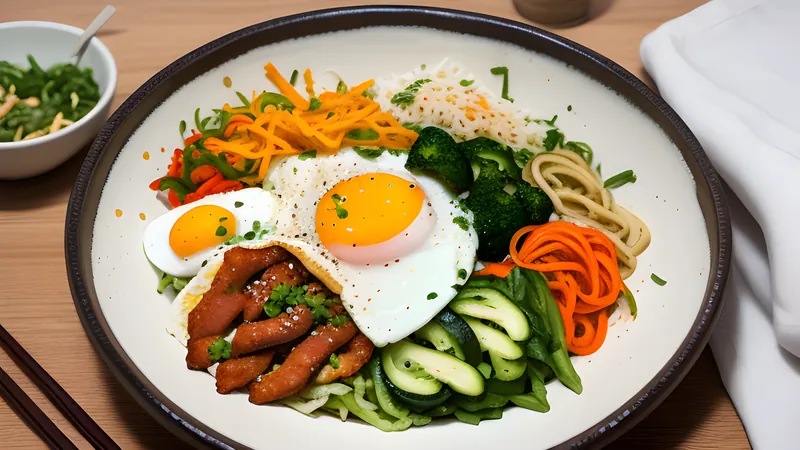
↓ Jump to recipeBibimbap means “mixed rice”, and most versions are content to let a spoonful of gochujang and a fried egg do the mixing. This one insists the rice itself earns its place, pressed hard into a scorching pan until the base turns into a sheet of crisp, nutty crust the way it would in a proper stone dolsot, and finished with a gochujang butter that turns the usual dab of chilli paste into something glossier and rounder. Stirred together at the table, the crust breaks into shards through the rice rather than staying a single crisp disc, which is exactly the point — texture in every spoonful, not just on the surface.
Bibimbap with Crisp Rice Crust and Gochujang Butter
Ingredients
- 300g cooked short-grain rice, cooled to room temperature
- 2 tbsp neutral oil, divided, plus more for the pan
- 1 tsp sesame oil, for the rice
- 200g beef sirloin or ribeye, thinly sliced against the grain
- 1 tbsp soy sauce
- 1 tsp brown sugar
- 1 garlic clove, finely grated
- 150g spinach, washed
- 1 tsp sesame oil, for the spinach
- 150g bean sprouts
- 1 carrot, julienned
- 100g shiitake mushrooms, sliced
- 2 eggs
- 3 tbsp gochujang
- 30g unsalted butter
- 1 tsp honey
- 1 tsp rice vinegar
- 1 tbsp toasted sesame seeds, to serve
- 2 spring onions, finely sliced, to serve
Method
- Marinate the sliced beef in the soy sauce, brown sugar and grated garlic for 15 minutes at room temperature.
- Blanch the spinach in boiling water for 30 seconds, refresh in cold water, squeeze dry and toss with a little sesame oil and a pinch of salt.
- Blanch the bean sprouts for 2 minutes, drain, refresh, and season with a pinch of salt and a few drops of sesame oil.
- Stir-fry the carrot in a little oil over high heat for 2 minutes until just softened, season with salt, and set aside.
- Stir-fry the shiitake in a little oil over high heat for 3 minutes until browned, season with salt, and set aside.
- Stir-fry the marinated beef in a hot pan for 2 to 3 minutes until browned but still juicy, and set aside.
- Make the gochujang butter: melt the butter in a small pan over medium heat, whisk in the gochujang, honey and rice vinegar, and cook for 1 minute until glossy. Keep warm.
- Heat a heavy ovenproof bowl or small cast-iron pan over medium-high heat with 1 tablespoon of oil, swirling to coat the base and sides.
- Toss the cooled rice with 1 teaspoon sesame oil, then press it firmly into the hot pan in an even layer. Leave undisturbed for 4 to 5 minutes until a deep golden crust forms on the base.
- While the rice crusts, fry the eggs in a separate pan in the remaining oil, sunny side up, for 2 to 3 minutes until the whites are set and the yolks still runny.
- Arrange the beef, spinach, bean sprouts, carrot and mushroom in sections on top of the crusted rice, without stirring.
- Top with the fried egg, drizzle the gochujang butter over everything, and scatter with sesame seeds and spring onion.
- Bring to the table still sizzling and stir everything together at the table just before eating.
Rice as the centre of the dish, not the base of it
Bibimbap’s modern form is often traced to Jeonju, a city in North Jeolla Province long regarded as Korea’s food capital, though the practice of mixing rice with leftover banchan (side dishes) to avoid waste is old and was likely common across the peninsula in various forms well before any city claimed it. Jeonju’s specific contribution was refinement: a wide, shallow brass or stone bowl, a careful balance of five or more namul (seasoned vegetables) chosen partly for colour, and a insistence on using bean sprouts grown locally in the region’s mineral-rich water, which Jeonju cooks still credit for a particular crunch and sweetness.
The stone-bowl version, dolsot bibimbap, is the one this recipe is chasing. A heavy dolsot, preheated hard, is used both to serve the dish and to keep cooking the rice against its sides after the ingredients are added, so the bottom layer of rice turns into nurungji — the Korean term for the crisp, toasted rice crust that forms at the base of a pot, which is prized enough on its own that it is often served separately, soaked in hot water, as a light dessert or digestif called sungnyung. Getting nurungji at home without an actual dolsot means finding a substitute that holds heat as aggressively: a heavy cast-iron pan or a thick ovenproof stoneware bowl preheated on the hob does the job.
Outside Jeonju, bibimbap takes on genuinely different personalities across Korea. Jinju, on the south coast, makes a version called Jinju bibimbap traditionally served with a side of raw beef tartare (yukhoe) rather than cooked beef, and a small bowl of clear beef broth alongside rather than mixed in. Hoe-dupap, popular in coastal towns, swaps the cooked beef for raw sliced fish and a sharper vinegar-gochujang dressing (chogochujang), eaten cold in summer. Andong, further inland, has a version built around heotjesatbap, literally “mock ancestral-rite rice”, made without meat and dressed with soy sauce rather than gochujang, a legacy of Confucian ritual food that couldn’t include the paste. None of these change the core logic — rice, a spread of individually seasoned vegetables, a protein, an egg, a chilli element to bind it — but they’re a reminder that “bibimbap” is really a method as much as a fixed recipe, one this crisp-crust, gochujang-butter version leans into rather than departs from.
Why the crust needs stillness, and what the butter is doing
Rice crusting works on the same principle as a good pan-seared steak: contact and time, undisturbed. Pressed rice against a very hot, lightly oiled surface starts drying and toasting at the point of contact within the first minute, but it takes four to five minutes of complete stillness for that toasting to travel deep enough into the grain layer to produce a crust that holds together as a sheet rather than crumbling into scattered crisp grains. Stir or shift the rice even once during that window and you break the crust as it forms, ending up with unevenly browned bits instead of one coherent layer. Cooled, day-old-feeling rice (even if it was only cooked and spread out to cool an hour earlier) works better than rice straight from the cooker, because the surface starch has had time to firm up rather than staying tacky, which lets it separate into individual toasted grains rather than fusing into a gluey mat.
Gochujang on its own is thick, sticky and can taste one-note — sweet-hot with a slight fermented tang, but flat once it hits heat unless balanced against something. Melting it into brown butter with a little honey and rice vinegar rounds it out considerably: the butterfat coats the palate and mellows the chilli’s sharp edges, the honey pulls the sweetness forward rather than leaving it buried, and the vinegar keeps the whole thing from tasting heavy. The result pours rather than clumps, which matters when you are trying to get an even coating across a wide bowl of rice and vegetables rather than one concentrated dollop in the centre.
Not all gochujang behaves the same way once it hits butter, so it’s worth knowing what you’re buying. Tubs sold as “mild” in Western supermarkets are often sweeter and thinner than what a Korean household would use as a matter of course, which can leave the finished butter tasting more like a chilli jam than a proper condiment; a jar labelled with a heat level of 2 or above, sold in a Korean grocer, gets closer to the fermented depth this dish wants. Check the ingredient list too: proper gochujang is fermented from glutinous rice, fermented soybean powder (meju), and gochugaru, and that fermentation is what gives it a savoury backbone underneath the sweetness and heat, something a quick blend of chilli powder and sugar can’t fake, even if it’s coloured and packaged the same way.
Assembling it properly
Each vegetable is cooked separately here, briefly and simply seasoned on its own, which is standard bibimbap practice and worth not skipping even though it means more pans. Cooking everything together in one pan blurs all the individual flavours and textures into a single stir-fry; kept apart, the spinach stays cool and mineral, the carrot stays sweet and just-tender, the mushroom stays deeply savoury, and the beef stays distinctly caramelised, so the bowl reads as five or six clear flavours rather than one muddy one. Arrange them in discrete sections rather than piling them centrally — it looks better, and it means whoever is eating can see and choose what they’re getting a bit more of before the whole thing gets stirred together.
The egg goes on last, always sunny side up with a runny yolk, because that yolk is doing real work: once the bowl is stirred at the table, it breaks and coats the rice in a light, glossy richness that ties the gochujang butter, the vegetables and the crust together into one sauce.
Tips, substitutions and storage
No cast-iron or stone bowl: a heavy stainless steel frying pan preheated for a full 3 minutes over medium-high heat before the rice goes in will produce a reasonable crust, though it will not hold the heat as long once at the table. Vegetarians can swap the beef for pan-fried firm tofu, marinated the same way and given an extra minute per side to colour properly. Leftover rice and vegetables (kept separate) hold in the fridge for up to 2 days; reheat the vegetables briefly in a pan and press freshly warmed rice into a hot pan again for the crust rather than trying to recrisp already-cooled rice, which never works as well the second time.
Know the difference between a good crust and a burnt one before you commit to the full four or five minutes undisturbed. A properly toasted nurungji smells nutty and faintly of popcorn, and when you finally lift a corner with a spatula it should come away in one sheet, deep gold to light brown, not black. If you catch a sharp, acrid smell before the timer’s up, the pan is too hot; pull it straight off the heat rather than pushing through, since burnt rice tastes bitter in a way no amount of gochujang butter can cover. A little practice with an empty test pan, just rice and oil, no toppings, is a genuinely useful way to learn your own hob’s timing before you commit a full dinner’s worth of vegetables to it. Make sure the rice itself is properly seasoned with a pinch of salt in the sesame oil toss beforehand too — an underseasoned crust is one of the more common ways this dish falls flat, since the crust carries a disproportionate amount of the dish’s flavour once everyone starts breaking through the layers.
Variations
A vegetable-only bibimbap drops the beef and adds a sixth namul — courgette, julienned and briefly stir-fried, is traditional and works well here. For those who want more heat, stir a finely chopped fresh chilli into the gochujang butter along with the honey and vinegar. If short on time, the crust step can be skipped entirely and the rice simply steamed and mixed straight into the bowl — it is still bibimbap, just without the dolsot’s signature crackle.
This one pairs naturally with other Korean staples built on contrast and char — the same charred-then-mixed instinct runs through japchae with charred vegetables and sesame, and if the gochujang butter here wins you over, it turns up again, brown-buttered a different way, in tteokbokki with gochujang and brown butter. Once you’ve had the crust, plain steamed-rice bibimbap can feel like it’s missing something.
Related Content