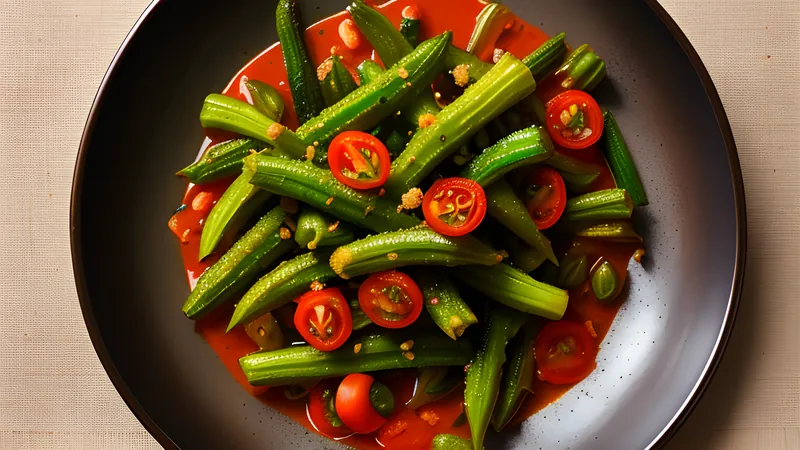
Bhindi Masala: Okra Without the Slime
Dry-fried okra with onion, tomato and amchur, cooked hot and left alone
Contents
↓ Jump to recipeOkra has a reputation problem, and it’s almost always earned by the way it’s been cooked rather than anything wrong with the vegetable itself. Cut it, throw it into a wet curry or a crowded, steamy pan, and its natural mucilage — the same slippery compound that makes okra useful for thickening gumbo — turns the whole dish gluey and unpleasant. Bhindi masala, done the way it’s actually cooked in most Indian households that make it well, sidesteps that entirely. The okra is fried hot and dry until the slime cooks itself away, then finished in a spiced onion-tomato base with a sharp, fruity hit of amchur. Get the first stage right and the rest of the dish is genuinely easy. I avoided cooking okra for years because every version I’d tried, mostly in overcrowded restaurant kitchens where a wet curry base and a busy pan are unavoidable, came out exactly as slimy as its reputation suggested. It wasn’t until I watched a friend’s mother cook it at home, frying the okra completely dry and alone before anything wet touched it, that I understood the entire problem was sequencing, not the vegetable.
Bhindi is the Hindi and Urdu word for okra, and this dry-style preparation — sometimes called bhindi ki sabzi — is a staple side dish across North Indian home cooking, served alongside dal, rice and roti rather than as a headline dish in its own right. It’s exactly the kind of vegetable side that restaurant menus rarely do justice to, because the quick, high-volume cooking of a busy kitchen is precisely the wrong environment for the slow, patient, dry-frying that okra actually needs.
Bhindi Masala: Okra Without the Slime
Ingredients
- 500g fresh okra, washed and completely dried
- 4 tbsp neutral oil (mustard oil if you have it)
- 1 tsp cumin seeds
- 1 large onion, thinly sliced
- 3 garlic cloves, finely grated
- 1 tbsp ginger, finely grated
- 2 tomatoes, finely chopped
- 1 tsp ground turmeric
- 1 tsp ground coriander
- 1/2-1 tsp chilli powder, to taste
- 1 1/2 tsp amchur (dried mango powder)
- 1 tsp fine salt, plus more to taste
- 1 tsp garam masala
- 2 tbsp chopped fresh coriander, to finish
Method
- Wash the okra well ahead of cooking and pat completely dry with a tea towel; any surface water is the enemy here. Trim the tops and tails, then cut into 2cm rounds.
- Heat 2 tbsp of the oil in a large, wide non-stick or well-seasoned pan over medium-high heat. Add the okra in a single layer, working in two batches if needed to avoid crowding the pan.
- Fry the okra for 8-10 minutes, stirring only every 2 minutes or so, until it's browned in spots and no longer slimy when you touch it with a spoon. Remove and set aside.
- Add the remaining 2 tbsp oil to the same pan and add the cumin seeds; let them sizzle for 20 seconds until fragrant.
- Add the sliced onion and fry over medium heat for 8-10 minutes until softened and golden brown at the edges.
- Stir in the garlic and ginger and cook for 1 minute until fragrant.
- Add the chopped tomatoes, turmeric, ground coriander and chilli powder. Cook for 6-8 minutes, mashing the tomatoes down, until the mixture separates from the oil at the edges of the pan.
- Return the fried okra to the pan along with the amchur and salt. Toss gently to coat, taking care not to overwork or crush the pieces, and cook for 2-3 minutes to heat through.
- Sprinkle over the garam masala and fresh coriander, toss once more, and serve immediately.
Why okra goes slimy, and how to stop it
Okra’s mucilage is a soluble fibre that sits just under the skin and inside the pod, and it’s released whenever the vegetable’s cell walls are broken by cutting, and especially by moisture and heat working together. Add wet, just-washed okra straight to a hot pan, or worse, into a simmering liquid, and you give that mucilage every condition it needs to leach out and turn slick and stringy. This is exactly why okra has a reputation for ruining stews when it’s added carelessly, and exactly why so many people who’ve only had bad okra assume the vegetable is simply unpleasant by nature. It’s worth saying plainly: there’s nothing wrong with okra as an ingredient. Gumbo relies on that same mucilage deliberately, using it as a natural thickener for the stew. The difference between a good dish and a bad one is simply whether the cook wants that slickness or is fighting against it, and bhindi masala is firmly in the second camp.
The fix starts before the pan is even hot: dry the okra completely after washing. Water sitting on the surface is the single biggest trigger for excess slime, so wash the pods well ahead of time and let them air-dry, or pat them dry with a tea towel, until there’s no visible moisture left anywhere on the skin. Cutting a still-damp pod all but guarantees a stringy, sticky mess the moment it hits oil. If you’re buying okra rather than growing it, choose pods that are firm, bright green and snap cleanly when bent rather than folding limply — older, softer pods tend to carry more moisture and more developed mucilage than young, fresh ones, and no amount of drying technique will fully compensate for a poor-quality starting pod.
The second half of the fix is technique in the pan: high heat, a wide surface, and minimal stirring. A crowded pan traps steam around the okra, and that trapped moisture works exactly like the water on unwashed pods, drawing mucilage out as the okra effectively steams rather than fries. Cook in a wide, uncrowded pan, in batches if your pan isn’t big enough to hold everything in a single layer, and let the okra sit largely undisturbed for a minute or two between stirs rather than moving it constantly. Frequent stirring breaks up the pods’ developing surface and reintroduces exactly the kind of agitation that releases more mucilage; a few confident stirs every couple of minutes, rather than a constant fidget, gives the surface time to sear and dry out before it’s disturbed again.
You’ll know the okra is ready to move on to the next stage when it’s stopped looking wet and glossy and started looking matte, lightly browned in spots, and when a spoon dragged through it doesn’t pull long strings. That last test is the most reliable one — if you see stringy threads following the spoon, the okra needs more time in the dry, hot pan before anything wet, like tomatoes, goes anywhere near it. Be patient at this stage even if it feels like it’s taking longer than a normal stir-fry — most of the recipe’s total cooking time is spent here, and it’s time well spent, since nothing you do later in the pan can undo a batch of okra that went in still holding its slime.
Building the masala
Once the okra has done its work in the pan on its own, the second half of the dish is a fairly standard North Indian onion-tomato masala, and it’s worth taking the time to get each stage properly cooked rather than rushing through it. The onion needs a genuine eight to ten minutes over medium heat to soften fully and pick up real browning at the edges — a pale, half-cooked onion tastes raw and sharp in the finished dish, while a properly softened, golden one contributes sweetness and depth that underpins everything added afterwards.
Ginger and garlic go in only once the onion is properly cooked, because both burn quickly and turn bitter if they hit the pan too early and sit over high heat for the full onion-cooking time. A minute is enough for both to lose their raw harshness and turn fragrant.
The tomatoes are cooked down until the oil visibly separates at the edges of the pan — a classic marker in Indian home cooking for a properly cooked masala base, since it signals that the water content of the tomatoes has cooked off and the remaining pulp is now concentrated enough to properly coat whatever’s added to it. Rush this stage and you end up with a wet, raw-tasting sauce that dilutes the crisp, dry-fried okra you worked to get right in the first stage. A pinch of extra salt at this point, before the okra goes back in, helps draw out the last of the tomatoes’ liquid faster and speeds the separation along, though don’t oversalt, since the dish gets a final seasoning check right at the end.
Amchur, the twist
Amchur, dried and ground unripe mango, is the ingredient that lifts this particular version of bhindi masala above a plain onion-tomato preparation. It contributes a sharp, fruity sourness that’s brighter and more citrus-like than tamarind and less aggressive than a squeeze of raw lemon juice, and because it’s a dry powder rather than a liquid, it adds acidity to the dish without adding any extra moisture — which matters enormously in a recipe built around keeping the okra as dry as possible. Adding it towards the end, once the okra is back in the pan, means its sourness stays bright rather than mellowing out over a long simmer, and gives the finished dish a distinct tang that plain bhindi masala can otherwise lack.
If you can’t find amchur, a small squeeze of lemon juice added at the very end is the closest substitute, though it should go in off the heat and in a small enough quantity that it doesn’t reintroduce the moisture problem you’ve spent the whole recipe avoiding. Tamarind concentrate is another common substitute in some households, though it carries more moisture than amchur and needs adding more cautiously for the same reason.
Serving and pairing
Bhindi masala belongs on a thali or a shared table rather than eating alone, and it pairs naturally with dishes from the same repertoire. Serve it alongside dal tadka or, for the fuller vegetarian spread, with saag paneer and plain basmati rice or roti — the dry, spiced okra is a good textural contrast to both, since neither of those dishes is dry the way this one is. It’s also an easy match for garlic butter naan, where the bread does the job of mopping up whatever spiced oil is left in the pan once the okra’s gone.
Variations
Add a souring agent earlier. Some regional versions use a small amount of tamarind paste alongside or instead of amchur, added at the same late stage, for a deeper, more tamarind-forward sourness rather than amchur’s brighter fruitiness.
Stuff it. Bharwa bhindi slits each pod lengthways and stuffs it with a dry spice mix before frying, a variation worth trying once you’re confident with the basic dry-frying technique, since the stuffing step adds real prep time. It’s a good weekend project once the basic dry-frying method feels automatic, as the technique for keeping the pods dry and unslimy is identical, just applied to whole stuffed pods rather than rounds.
Make it spicier. A slit green chilli or two added with the onion, or an extra half-teaspoon of chilli powder, pushes the heat up without changing the fundamental method.
Use mustard oil. If you can find it, mustard oil brings a sharp, pungent edge that’s traditional in a lot of North Indian bhindi preparations; heat it until it just starts to shimmer and smoke lightly before adding the cumin, which mellows its raw bite into something rounder and nuttier.
Storage
Bhindi masala is best eaten fresh, within an hour or so of cooking, while the okra still has some bite and hasn’t had time to soften further in the residual heat of the pan. It keeps in the fridge for up to two days, but reheating brings back some sliminess as the okra’s cell walls break down further with a second round of heat; reheat it in a dry, hot pan rather than the microwave, and stir minimally, the same way you cooked it the first time, to limit how much extra mucilage comes out. A microwave’s steam-trapping effect is precisely the moisture-and-heat combination that releases mucilage in the first place, which makes it the worst possible reheating method for this particular dish even though it’s the most convenient for almost everything else. It doesn’t freeze well — okra’s texture suffers badly from freezing and thawing, turning mushy in a way no amount of careful reheating will fix. If you know you’ll have leftovers, it’s worth slightly undercooking the batch you plan to keep, since it will finish softening during reheating and a batch cooked to full doneness the first time round tends to end up overcooked by the second.
Related Content