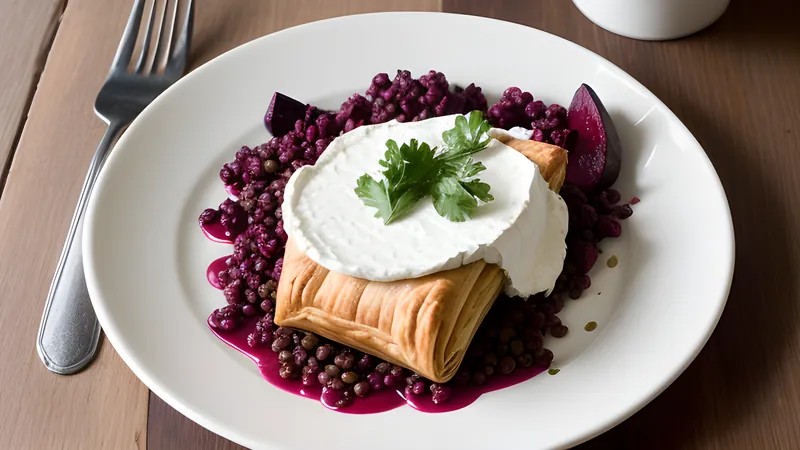
Beetroot and Goat's Cheese Wellington
Roasted beets and tangy goat's cheese in a bronze pastry case
Contents
↓ Jump to recipeA vegetarian centrepiece has to do more than exist; it has to hold the middle of the table with the same swagger as a roast, or the vegetarians spend Christmas apologising for themselves. Too many meat-free Wellingtons collapse into a soggy, grey purée the moment a knife goes in, undone by watery filling and an underbaked base. This one is built to slice cleanly and look magnificent doing it: earthy roasted beetroot at its heart, a savoury mushroom-and-lentil layer for depth, tangy goat’s cheese to cut the sweetness, and a burnished puff-pastry case that shatters.
I make it for gatherings where meat-eaters and vegetarians share a table, and it has quietly converted a few sceptics who came expecting worthy sludge. My twist is the goat’s cheese seam running through the middle, its sharp, lactic tang playing against the deep sweetness of the beets so that every slice has a savoury spine. It looks like a serious undertaking, and it is a project, though every stage can be done ahead and the assembly is straightforward once the components are cool.
Beetroot and Goat's Cheese Wellington
Ingredients
- 600g medium beetroot (about 5), scrubbed
- 2 tbsp olive oil
- 1 tbsp balsamic vinegar
- 2 sprigs thyme
- 300g chestnut mushrooms, very finely chopped
- 1 onion, finely chopped
- 3 garlic cloves, crushed
- 1 x 250g pouch cooked puy lentils (or 150g cooked)
- 1 tbsp soy sauce
- 1 tsp fresh thyme leaves
- 150g soft goat's cheese log
- 2 tbsp chopped walnuts, toasted
- 500g block all-butter puff pastry
- Plain flour, for dusting
- 1 egg, beaten (or plant milk for vegan)
- 1 tbsp nigella or sesame seeds
- Fine sea salt and black pepper
Method
- Roast the beetroot wrapped in foil with olive oil, balsamic, thyme and salt at 200C fan for 50-60 minutes, then cool, peel, slice 1cm thick and pat dry.
- Cook the onion in a little oil for 5 minutes, add the garlic and finely chopped mushrooms and cook over medium-high heat for 12-15 minutes until completely dry, then stir in the lentils, soy sauce and thyme and cool.
- Roll two-thirds of the puff pastry into a rectangle and layer half the mushroom mixture, half the beetroot, the goat's cheese, walnuts, the rest of the beetroot and the rest of the mushroom mixture into a tight, compact log.
- Cover with the remaining rolled pastry, seal and crimp the edges, then chill for at least 30 minutes. Egg-wash, score the top and scatter with nigella or sesame seeds.
- Bake on a preheated baking sheet at 200C fan for 40-50 minutes until bronze all over, then rest for 10 minutes before slicing with a serrated knife.
The Wellington, borrowed and reinvented
The classic beef Wellington — a fillet coated in mushroom duxelles and pâté, wrapped in pastry and baked — is a dish of grand hotels and celebratory dinners, usually credited to the nineteenth century and named, with patriotic flourish, for the Duke of Wellington after Waterloo. Its French bones show clearly: it is really a filet de bœuf en croûte, the technique of encasing meat in pastry that runs right through classical European cooking, from raised game pies to the Russian coulibiac.
The vegetarian Wellington is a modern British invention, born of the same instinct that gave every Sunday-roast tradition its meat-free counterpart. What makes a good one work is respecting the original’s logic rather than just wrapping vegetables in pastry and hoping. The beef version uses the mushroom duxelles as a dry, savoury barrier that soaks up juices and protects the pastry; my beetroot version keeps that exact trick, using a tightly cooked mushroom-and-lentil layer to wall off the moisture from the roasted beets. Get that barrier right and the base stays crisp.
It belongs to the same family of ambitious, pastry-wrapped centrepieces as my mushroom Wellington with chestnut and spinach, and if you want a slightly less involved pastry supper for a smaller table, the leek and cheese pie with rough puff scratches a similar itch.
Roasting the beetroot
Everything starts with properly roasted beets. Heat the oven to 200°C fan. Wrap the scrubbed beetroot individually in foil with a little olive oil, a splash of balsamic, a pinch of salt and a sprig of thyme, and roast for fifty to sixty minutes until a knife slides in with no resistance. Roasting rather than boiling is essential; boiled beetroot leaches its colour and sweetness into the water and comes out watery, whereas roasting concentrates both. The foil traps steam so they cook through without drying out.
Let them cool, then rub off the skins with a piece of kitchen paper — they slip away easily and stain everything crimson, so wear gloves if you mind pink fingers. Slice the beets into rounds about 1cm thick and pat them dry. Dryness matters at every stage of this dish, because water is the enemy of crisp pastry.
The mushroom and lentil duxelles
This layer is the flavour engine and the moisture barrier both, so cook it until it is genuinely dry. Chop the mushrooms as finely as you can, almost to a mince, either by hand or with a few careful pulses in a processor. Warm a little oil in a wide pan, add the onion with a pinch of salt and cook for five minutes until soft, then add the garlic and the mushrooms.
Here is the key: cook the mushrooms over a medium-high heat for a good twelve to fifteen minutes, stirring often. They will release a startling amount of water, then the pan will hiss and the liquid will cook away, and only once it does will the mushrooms begin to fry and turn deeply savoury. A wet duxelles means a soggy Wellington, so keep going until the pan is dry and the mixture holds together. Stir in the lentils, soy sauce and thyme, mash a little to bind, and season well with black pepper. Spread it on a plate to cool completely.
Assembling and baking
Now build it, and build it cold. Roll two-thirds of the puff pastry on a floured sheet of baking paper into a rectangle roughly 30 by 36cm. Down the centre, spread half the mushroom mixture in a strip the length of the beetroot stack. Lay half the beetroot slices over it, overlapping like fallen dominoes. Crumble the goat’s cheese along the middle, scatter the toasted walnuts, then top with the remaining beetroot and a final layer of the mushroom mixture, pressing everything into a tight, compact log. A firm, well-packed log holds its shape when sliced; a loose one falls apart.
Roll the remaining pastry into a slightly larger rectangle. Brush the exposed border of the base pastry with beaten egg, lift the second sheet over the filling using its paper, and press the edges together firmly, trimming to a neat 2cm border and crimping with a fork to seal. Using the paper, transfer the whole thing to a baking tray. Chill it for at least thirty minutes; this firms the butter in the pastry so it puffs properly and relaxes the dough so it does not shrink in the oven.
Heat the oven to 200°C fan with a baking sheet inside to preheat. Brush the Wellington all over with beaten egg for a deep gloss, score the top in shallow diagonal lines for decoration and to let steam escape, and scatter over the nigella or sesame seeds. Slide it onto the hot sheet — a preheated base is what crisps the underside — and bake for forty to fifty minutes until the pastry is a rich, even bronze all over, including underneath. If the top browns too fast, tent it loosely with foil.
Rest it for a full ten minutes before slicing. This is not optional; the resting lets the filling settle so a serrated knife glides through into clean, layered slices rather than shoving the whole log apart. Use a gentle sawing motion.
Why beetroot and goat’s cheese belong together
This is one of the great flavour marriages, and it is worth understanding why it works so you can cook it with confidence. Roasted beetroot is intensely, almost startlingly sweet, with a mineral, earthy undertone that comes from a compound called geosmin, the same molecule that gives soil its smell after rain. Left to itself, that sweetness can cloy. Goat’s cheese is the perfect foil because it brings two things the beet lacks: a sharp, lactic acidity that cuts straight through the sugar, and a savoury, faintly barnyard funk that meets the earthiness head-on and turns it appetising. The toasted walnuts add a third note, a bitter crunch that stops the whole thing feeling soft and one-paced. It is the same balancing act that makes the classic beetroot, goat’s cheese and walnut salad a menu fixture; here it simply gets wrapped in pastry and given the run of the table. If you can find an aged goat’s cheese with a bit of bite rather than the mildest supermarket log, so much the better, because its stronger tang stands up to the sweetness of five roasted beets.
Make-ahead, troubleshooting and swaps
Almost everything here can be done in advance. Roast the beets and cook the duxelles up to two days ahead, and assemble the whole Wellington a day before, keeping it wrapped and chilled, then egg-wash and bake it fresh. You can also freeze it assembled and unbaked, then bake from frozen with an extra fifteen minutes and a foil tent.
If your base turns out soggy, the usual culprits are a wet duxelles or wet beetroot, so dry both hard next time and always bake on a preheated sheet. If the pastry splits, you packed the filling too loose or too tall; keep the log compact and low. Leftovers are excellent cold in a lunchbox, or warmed through at 180°C for fifteen minutes to re-crisp.
To make it fully vegan, swap the goat’s cheese for a firm vegan alternative or a layer of thick cashew cream and glaze with plant milk; the rest already qualifies. A layer of wilted, well-squeezed spinach adds colour, and a spoon of horseradish through the duxelles gives a grown-up kick. Serve it with a red-wine gravy, roast potatoes and greens, and the vegetarians at your table will stop apologising and start going back for seconds.
Related Content