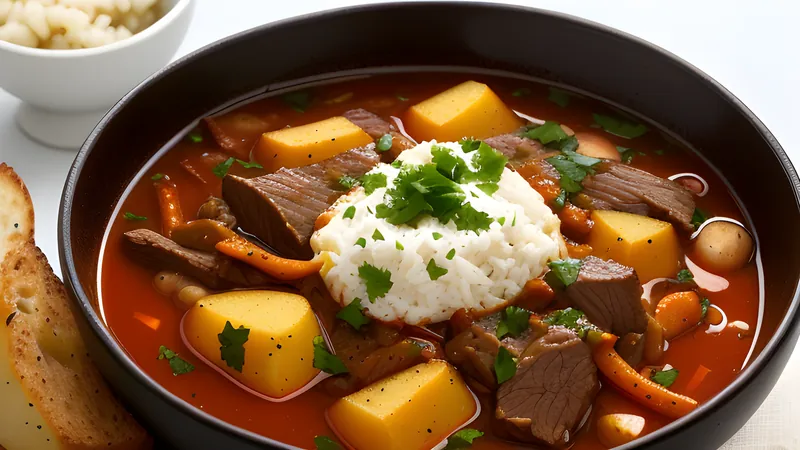
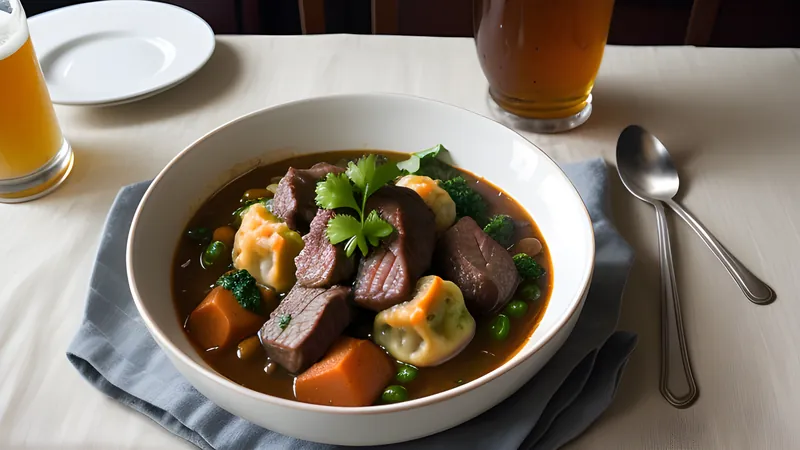
Beef Shin and Ale Stew with Herb Dumplings
A cheap, gelatinous cut and a splash of dark ale, crowned with horseradish suet dumplings
Contents
↓ Jump to recipeBeef shin is the cut butchers used to struggle to sell and now, quite rightly, charge a bit more for. It comes from the lower leg, a hard-working muscle threaded with connective tissue and a seam of collagen-rich gristle running through the middle. Cook it fast and it’s inedible, tough as an old boot. Cook it slow and low for a couple of hours and that collagen melts into gelatine, which does two things at once: it makes the meat meltingly tender, and it gives the braising liquid a glossy, lip-sticking body that no amount of flour thickening can match. It is, pound for pound, one of the best-value cuts in the shop for a stew.
Pair it with dark ale and you have a dish that tastes of a British winter. The bitterness and roasted malt of a good stout or brown ale cuts through the richness of the beef and adds a depth that stock alone won’t give you. On top go herb dumplings, and here’s the small twist: a spoonful of horseradish worked into the suet dough. It steams gently over the stew, and the horseradish gives each dumpling a warm, mustardy kick that lifts the whole bowl.
Beef Shin and Ale Stew with Herb Dumplings
Ingredients
- 1.2 kg beef shin, cut into 5 cm chunks
- 3 tbsp plain flour, seasoned with salt and pepper
- 3 tbsp beef dripping or vegetable oil
- 2 onions, roughly chopped
- 3 carrots, in thick chunks
- 2 celery sticks, sliced
- 3 garlic cloves, crushed
- 2 tbsp tomato purée
- 500 ml dark ale or stout
- 500 ml beef stock
- 2 bay leaves
- 3 sprigs thyme
- 1 tbsp Worcestershire sauce
- 1 tsp Marmite
- Sea salt and black pepper
- For the dumplings: 150 g self-raising flour
- 75 g shredded beef suet
- 1 tbsp grated fresh or jarred horseradish
- 2 tbsp chopped parsley
- 1 tsp chopped thyme leaves
- About 90 ml cold water
Method
- Heat the oven to 150C fan. Toss the beef chunks in the seasoned flour to coat. Heat 2 tbsp of the dripping in a large casserole over a medium-high heat and brown the beef in batches on all sides, about 8 minutes per batch. Set the browned meat aside.
- Add the remaining 1 tbsp dripping to the pot. Add the onions, carrots and celery and cook over a medium heat for 8 minutes until softening and lightly coloured. Stir in the garlic and tomato purée and cook for 2 minutes.
- Pour in the ale, scraping up all the browned bits from the base of the pot, and let it bubble for 3 minutes. Return the beef and any juices, then add the stock, bay leaves, thyme, Worcestershire sauce and Marmite.
- Bring to a gentle simmer, cover, and transfer to the oven. Braise for 2.5 hours, until the beef is very tender but not yet falling apart.
- Make the dumplings: mix the flour, suet, horseradish, parsley, thyme and 1/2 tsp salt. Stir in enough cold water to form a soft, slightly sticky dough. Divide into 8 and roll into balls.
- Take the stew from the oven, check the seasoning and stir. Sit the dumplings on top of the stew, spaced apart. Return uncovered to the oven for 30 minutes, until the dumplings are risen and firm on top.
- Rest for 5 minutes, then serve, spooning the stew and two dumplings into each bowl.
Why shin beats stewing steak
Most recipes that call for “stewing beef” or “braising steak” are pointing you at chuck, which is a fine cut and does the job. Shin is better for one specific reason: it has far more connective tissue, and connective tissue is what makes a braise luxurious. As beef shin cooks past around 70C and holds there for a long time, the tough collagen breaks down into gelatine. That gelatine is what separates a stew that’s merely soft from one where the meat yields to a spoon and the gravy has real body.
The trade-off is time. Shin needs longer than chuck, a good two and a half hours at a low temperature before the meat surrenders, and it can’t be hurried with a higher oven. Push the heat up to speed things along and the muscle fibres seize and squeeze out their moisture faster than the collagen breaks down, giving you dry, stringy meat sitting in thin liquid. Low and slow is the only route. Buy shin on the bone if you can, or ask for osso buco-style cross-cut slices, and the marrow adds even more richness.
Browning, and why you shouldn’t crowd the pan
The single most important thing you do before the long braise is brown the meat properly. Those dark, caramelised crusts on the surface of the beef are the source of most of the stew’s savoury depth, the result of the Maillard reaction between the meat’s proteins and sugars at high heat. Skip this step, or do it half-heartedly, and the finished stew tastes flat and grey.
The mistake nearly everyone makes is crowding the pan. Pile all the beef in at once and it releases its moisture faster than the pan can evaporate it; the meat then boils in its own juices and steams to a dull grey instead of browning. Work in batches, giving each piece room and space, and wait until the underside has a genuine dark crust before turning. It takes patience, three batches and ten minutes each, but it’s the difference between a good stew and a great one. Toss the meat in seasoned flour first, which helps the crust form and lightly thickens the gravy later.
The ale, and the two umami tricks
Choose a dark ale with roasted, malty flavours rather than a hoppy, bitter IPA, which can turn the stew acrid and unpleasantly sharp as it reduces. A stout, a porter or an English brown ale is ideal. Let it bubble for a few minutes after it goes in, both to cook off the raw alcohol and to concentrate the malt. Deglaze thoroughly as you do, scraping every browned scrap off the base of the pot, because that fond is pure flavour.
Two small additions turn the gravy from good to properly savoury. Worcestershire sauce brings a tangy, fermented depth, and a teaspoon of Marmite, stirred in until it dissolves, adds a hit of concentrated umami that reads simply as deep, meaty savour, its yeast-extract origin undetectable. Both are cheating in the best sense: they mimic the flavour of a stew that’s been reduced for far longer than yours has. Don’t overdo either, since both are salty; taste and adjust the seasoning only near the end.
The dumplings, light not leaden
A good suet dumpling should be light and cloud-like inside, never a heavy, gluey lump. Three things get you there. Use self-raising flour, or plain flour with baking powder, for lift. Handle the dough as little as possible once the water goes in, mixing just until it comes together, because overworking develops gluten and toughens the result. And keep the dough soft and slightly sticky rather than firm; a dry, stiff dough gives a dense dumpling.
They cook by steaming in the moist heat above the stew, which is why they go on top rather than submerged, and why the pot goes back in uncovered for the final half hour so the tops firm and colour while the bottoms soak up gravy. Space them apart, because they swell as they cook and will fuse into one mass if crowded. The horseradish in the dough is the twist worth keeping: it fades to a gentle warmth after cooking, more a background lift than a fierce heat, and it’s a natural partner to beef. If you’d rather a milder dumpling, swap it for a tablespoon of grated Cheddar or a spoonful of English mustard.
What to serve alongside
This is a one-pot meal in the sense that the dumplings replace the need for potatoes, but a green vegetable on the side stops it feeling too heavy. Buttered greens, steamed kale or a simple pile of peas all cut the richness. If you’ve skipped the dumplings, serve the stew over mash or with a hunk of bread to mop the gravy. A spoonful of horseradish on the side, for those who want more, never goes amiss.
For another British braise built on a cheap, slow-cooked cut, the lamb version is worth knowing, and you can find it in Lancashire Hotpot with Barley and Lamb. If you want the same low-and-slow principle in soup form, Scotch Broth with Barley and Lamb uses barley to thicken a lighter, brothier bowl.
Make-ahead and storage
Like most braises, this one is better the next day. The flavours deepen and marry overnight, and the fat that rises and sets on top when chilled is easy to lift off if you want a leaner result. Cook the stew through the braising stage, cool and refrigerate for up to three days, then reheat gently and add fresh dumplings for the final half hour just before serving. Cooked dumplings don’t keep or reheat well, so it’s worth making them fresh even from a made-ahead base.
The stew itself freezes beautifully for up to three months, again without the dumplings. Defrost overnight in the fridge and reheat slowly on the hob or in a low oven until piping hot right through. Thanks to all that gelatine from the shin, the reheated gravy sets to a near-jelly when cold and turns glossy and rich again as it warms, which is a good sign you bought the right cut.
Related Content