Avgolemono: Greece's Silky Egg-and-Lemon Soup
Rice, egg and lemon, whisked into a soup with no cream and no roux
Contents
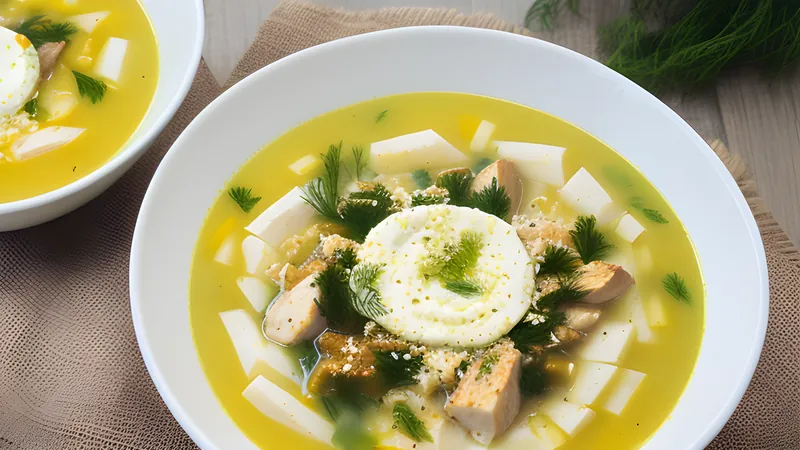
↓ Jump to recipeAvgolemono means, literally, egg-lemon - avgo and lemoni fused into one word, which tells you everything about what the dish is built from and how central both ingredients are to it. It’s the soup Greek households make when someone’s ill, when it’s cold, or simply on a Tuesday, and it turns up as a base for other dishes too - the same egg-lemon sauce thickens soutzoukakia, dolmades and a handful of braised lamb dishes across the country’s regional cooking.
What sets it apart from other chicken-and-rice soups is the total absence of cream, flour or any conventional thickener. The body comes from two things working together: starch released by the rice as it cooks in the stock, and egg proteins that set gently into the liquid once tempered and returned to low heat. Done properly, the result is glossy and pale gold, thick enough to coat a spoon, with a tartness from the lemon that cuts cleanly through the richness of the stock and egg.
Avgolemono: Greece's Silky Egg-and-Lemon Soup
Ingredients
- 1 whole chicken leg (thigh and drumstick), skin on
- 1.5 litres water
- 1 carrot, halved
- 1 celery stick, halved
- 1 onion, halved
- 1 bay leaf
- Sea salt and black pepper
- 80 g short-grain rice (Greek-style or risotto rice)
- 3 large eggs
- Juice of 2 large lemons (about 70 ml), plus zest of 1
- 2 tbsp chopped fresh dill
Method
- Put the chicken leg, water, carrot, celery, onion and bay leaf into a large pot with 1 tsp salt. Bring to the boil, skim the foam, then reduce to a bare simmer and cook uncovered for 35 minutes.
- Lift out the chicken and strain the stock into a clean pot, discarding the vegetables. Once cool enough to handle, shred the chicken meat and discard skin and bone.
- Bring the strained stock back to a simmer. Add the rice and cook for 15-18 minutes, until tender but not mushy.
- Return the shredded chicken to the pot and reduce the heat to its lowest setting, so the surface barely moves.
- Whisk the eggs in a large bowl until pale and slightly frothy, about 1 minute. Whisk in the lemon juice and zest.
- Ladle a cup of the hot soup into the egg mixture while whisking constantly. Repeat with two more ladlefuls, whisking each in fully, to temper the eggs gradually.
- Take the pot off the heat entirely. Pour the tempered egg mixture back into the pot in a thin stream, stirring constantly with a wooden spoon.
- Return the pot to the lowest possible heat and stir gently for 2-3 minutes until the soup visibly thickens and turns pale, opaque yellow. Do not let it boil.
- Season with salt and pepper to taste. Stir through the dill and serve immediately, since the soup keeps thickening slightly as it sits.
A soup older than the word for it
The egg-and-lemon thickening technique behind avgolemono is much older than modern Greek cuisine - variations on it appear across the eastern Mediterranean and into the Ottoman world, in dishes as far-flung as Turkish terbiye and the Sephardic Jewish kitchens of the region, all using the same basic principle of tempered egg to bind a broth. Greece’s version, built specifically around rice and lemon rather than flour or yoghurt, became so associated with home cooking that the word avgolemono is now used loosely for the entire family of egg-lemon sauces, not just this soup.
Restaurants outside Greece often serve a thinner, less rice-forward version aimed at a wider audience, but the home-cooked version - the one most Greek families actually grew up eating - leans much more heavily on the rice for body, closer to a light risotto suspended in tart, silky broth than to a clear consommé with egg stirred through.
Getting the stock rich enough
The stock is the one part of this recipe that’s easy to underrate. A weak, watery stock leaves nowhere for the egg and lemon to hide, since there’s so little else happening in the bowl - no roux, no cream, no long list of vegetables - that a thin base reads as a thin soup no matter how carefully you handle the tempering. A chicken leg rather than a breast is the right cut for exactly this reason: thigh and drumstick meat, simmered gently for 35 minutes, releases far more collagen and flavour into the water than a lean breast would, giving you a stock with actual body before the rice or egg gets anywhere near it.
Resist the urge to rush the simmer by turning the heat up. A hard boil clouds the stock and can make the fat emulsify into it, giving a slightly greasy mouthfeel rather than the clean, golden broth you’re after. Thirty-five minutes at a bare simmer, with the surface only occasionally breaking, is the right pace - long enough to extract real flavour, short enough that the chicken doesn’t turn stringy.
Rice does more work than you’d think
The rice isn’t just a garnish floating in the soup - it’s doing real thickening work as it cooks, releasing starch into the stock the same way risotto rice does into a pan of stock stirred at the hob. Using a short-grain, starchier rice rather than a long-grain variety like basmati matters here; long-grain rice releases far less starch and you’ll end up with a thinner soup that leans entirely on the egg for body.
Fifteen to eighteen minutes at a simmer is the window that gets the rice properly tender without turning it to mush, but watch it in the last few minutes - rice left simmering too long in a soup this size of pot keeps absorbing liquid and softening past the point of pleasant bite. If you’re not serving immediately, slightly undercook the rice, since it’ll continue to soften as the soup sits, even off the heat.
The tempering step, and why it can’t be rushed
Egg yolks (and, in a full-egg version like this one, the whites too) will scramble the instant they hit liquid much hotter than themselves, turning into unappetising flecks rather than dissolving smoothly into the soup. Tempering solves this by raising the egg’s temperature gradually, a ladleful of hot stock at a time, whisked in fully before the next addition, so that by the time the egg mixture goes back into the main pot it’s close enough in temperature not to seize on contact.
The detail that trips people up most often is what happens after the tempered eggs go back in. The pot needs to come off the heat entirely for that final pour, and then return to only the lowest possible heat once the egg mixture is stirred through - not a simmer, barely a warm. You’re not cooking the eggs so much as coaxing their proteins to set slowly and evenly through the liquid. Two to three minutes of gentle stirring over the lowest heat your hob offers is usually enough; the moment you see the soup visibly thicken and turn a more opaque, pale yellow, it’s done.
If avgolemono does split or scramble slightly, it’s almost always from one of two mistakes: adding the egg mixture too fast without full tempering, or letting the pot get too hot once the eggs are back in. There’s no rescuing a fully scrambled batch, but a soup that’s gone slightly grainy rather than fully curdled can sometimes be smoothed by blitzing briefly with a stick blender, though you’ll lose some of the shredded chicken’s texture in the process.
Whole eggs, rather than yolks alone, are what most home cooks in Greece actually use, and it’s the approach here too - whites add extra thickening power and stretch the recipe a little further, though some versions use yolks only for an even richer, more custard-like result. If you want to try the richer version, use 4 yolks in place of the 3 whole eggs and expect a slightly denser, more golden soup.
Lemon, and how much is correct
Two lemons’ worth of juice sounds like a lot until you taste the finished soup - the rice and egg both mellow acidity considerably, and a soup that tastes properly balanced right after you’ve added the lemon will often taste undersalted and a touch flat by the time it’s fully thickened and served. Taste at the very end, once the eggs have set, and adjust with a little extra lemon juice or salt rather than trying to get it perfect earlier in the process.
The zest is a smaller addition but a meaningful one - it carries aromatic lemon oils that the juice alone doesn’t, and stirring it through with the dill at the end keeps those top notes fresh rather than cooked out. Use a light hand with a fine zester and avoid the white pith underneath, which turns bitter.
Regional variations
Some households substitute orzo for the rice, giving a slightly different texture but the same essential thickening mechanism - orzo releases starch just as readily and cooks in a similar window of time. Others skip the chicken altogether and make a vegetarian version with vegetable stock and extra rice for body, though you lose some of the depth a proper chicken stock provides.
In parts of the Peloponnese, avgolemono turns up as the finishing sauce for a lamb fricassee rather than a standalone soup, ladled over braised lamb shoulder and lettuce rather than served as a broth in its own right - worth knowing if you come across the name attached to a dish that looks nothing like a bowl of soup.
Serving
Avgolemono is usually eaten on its own, without bread on the side in most Greek households, since the rice already makes it substantial enough to stand as a full light meal. A few extra twists of black pepper at the table and a small extra squeeze of lemon for anyone who wants it sharper are the only additions most people make. If you do want bread, a plain crusty loaf rather than anything olive-oil-heavy keeps the focus on the soup’s own richness rather than competing with it.
Storage
Avgolemono doesn’t freeze well for the same reason chikhirtma doesn’t - the egg protein structure breaks down on thawing and the soup separates into a watery liquid with curdled bits rather than staying smooth. It keeps in the fridge for two days, reheated very gently over low heat and stirred constantly; never let it approach a boil on reheating, or the eggs that set so carefully the first time will scramble on the second pass. If you’re making it ahead, cook the base with rice and chicken the day before, then temper and add the eggs fresh just before serving.
For a closer look at how a neighbouring cuisine solves the same egg-lemon thickening problem with a browned roux instead of rice starch, see Georgian Chikhirtma: Lemon-and-Egg Chicken Soup. And for another chicken-stock soup built on long, gentle simmering, see Lemon Chicken Noodle Soup.
Related Content